

Mezzanine safety gates: types, requirements, and what they cost
OSHA requires fall protection at every mezzanine edge, and the pallet-drop opening is where it fails most. Gate types compared — swing, sliding, lift-out, pivot — with the ANSI rule that disqualifies half of them, and real prices.
Editorial
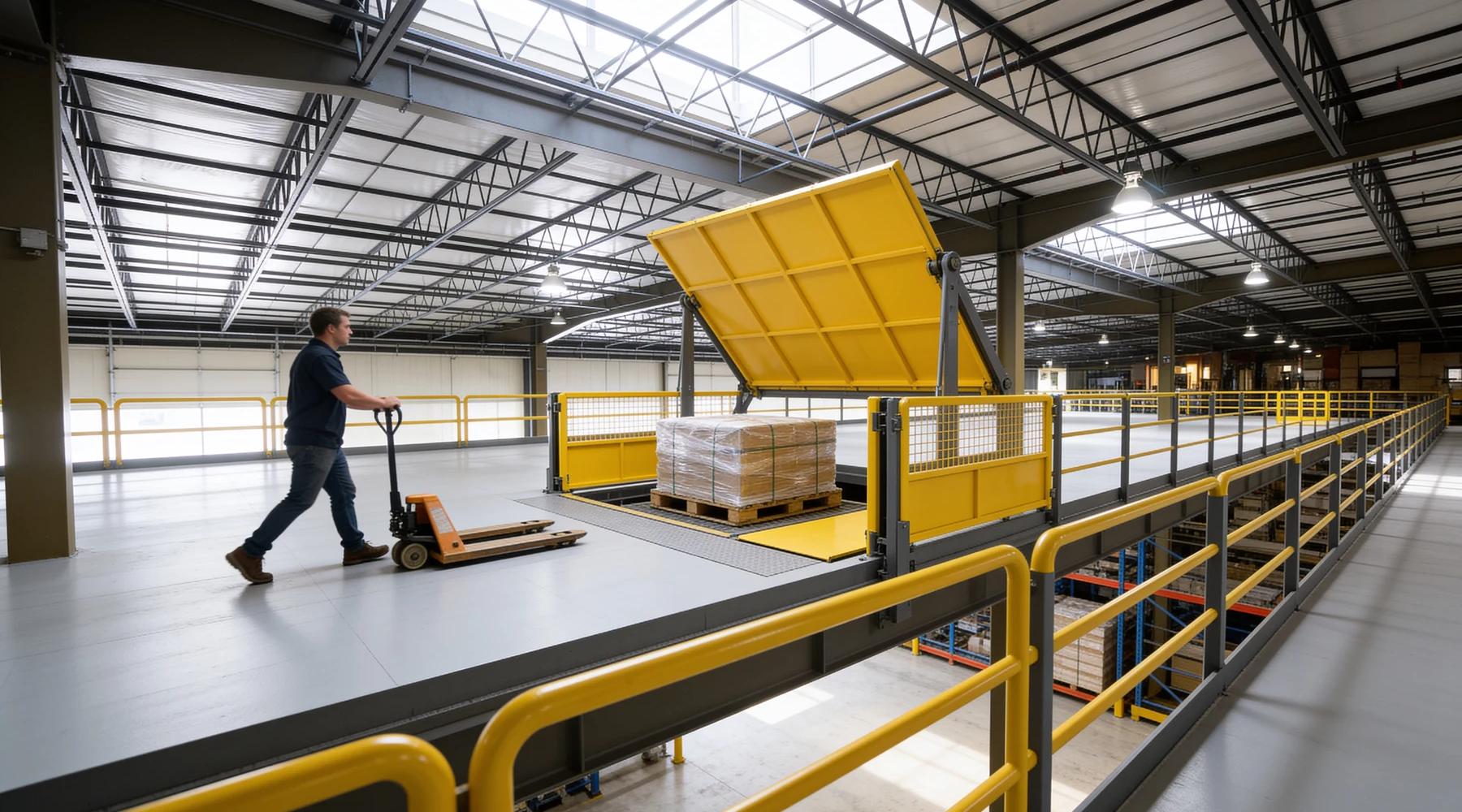
Every mezzanine has one place where its fall protection is designed to open: the pallet drop. That opening is where gravity collects its debts — and it's why the safety gate is the most consequential few hundred dollars on the whole structure. Here's the gate taxonomy, the OSHA and ANSI rules that separate compliant from clever-looking, and real published prices.
What does OSHA actually require at the edge?
Fall protection at 4 feet, and a barrier at the pallet opening whenever material isn't moving through it. The primary text (29 CFR 1910.28): unprotected sides and edges 4 feet above a lower level require guardrail, safety net, or personal fall protection — the full guardrail spec being a 42" ± 3" top rail, midrail, 200-lb strength, openings ≤ 19" (manufacturer specs add the 6-inch kick plate). At hoist areas — which is what a pallet drop is — 1910.28(b)(2) permits a removable guardrail section, gate, or chains if they provide equivalent protection, requires the barrier back in place when not hoisting, and requires personal fall arrest the moment someone must lean out past the edge.
That word equivalent is where gate design gets interesting.
Which gate types exist — and which pass the stricter test?
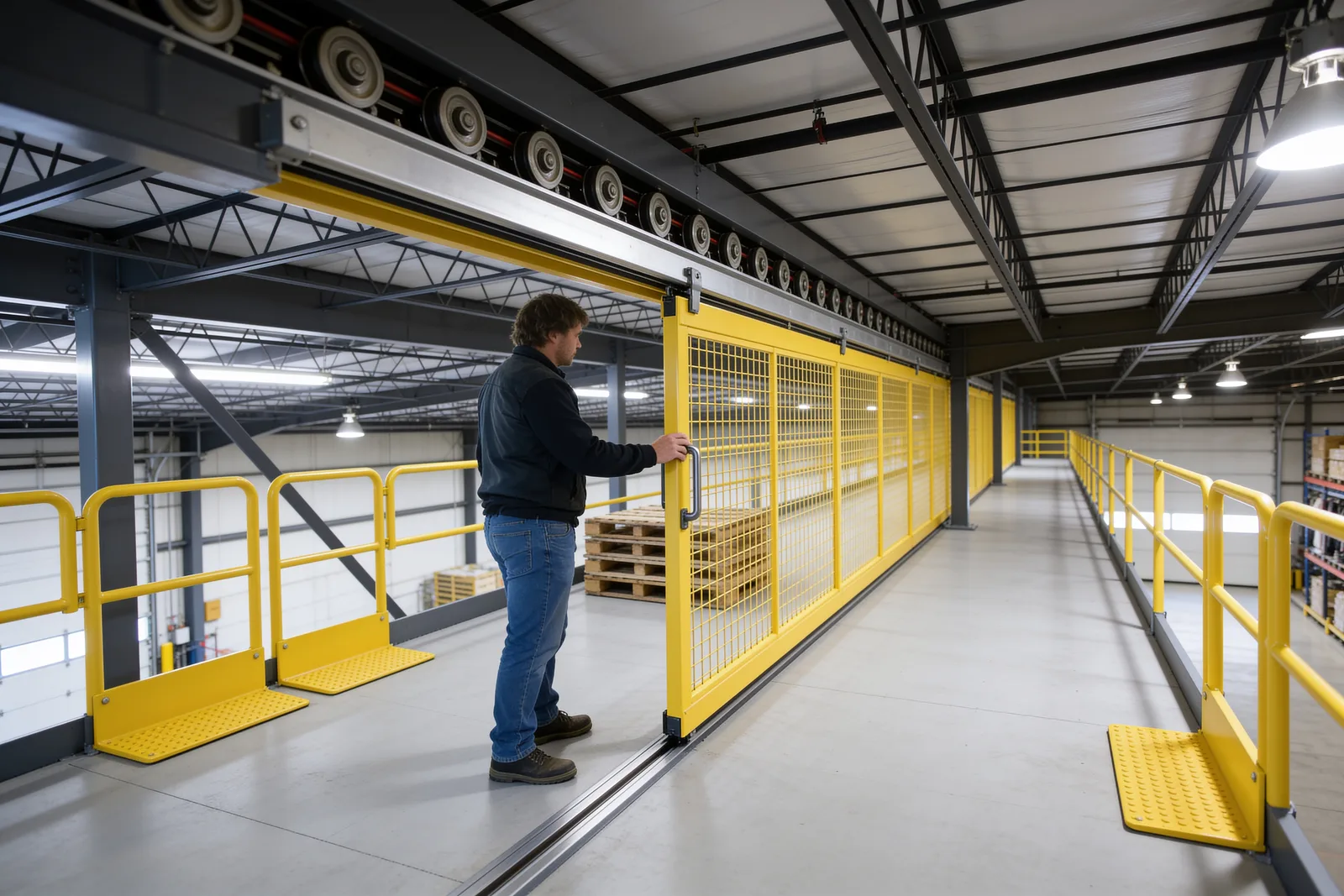
Five types dominate the catalogs; one of them exists specifically because the other four share a flaw. The published taxonomy (our publisher Cogan's gate line is representative — single swing 2'6"–4', double swing 5'–8', sliding 5'–12', lift-out 4'–5', and safety pivot gates 5'–7' standard, up to 13'):
| Gate type | How it opens | The catch |
|---|---|---|
| Single/double swing | Hinges open like a door | Edge is exposed while open |
| Sliding | Rolls along a track | Edge exposed while open |
| Lift-out | Rail section removes entirely | Edge exposed — and re-installation relies on memory |
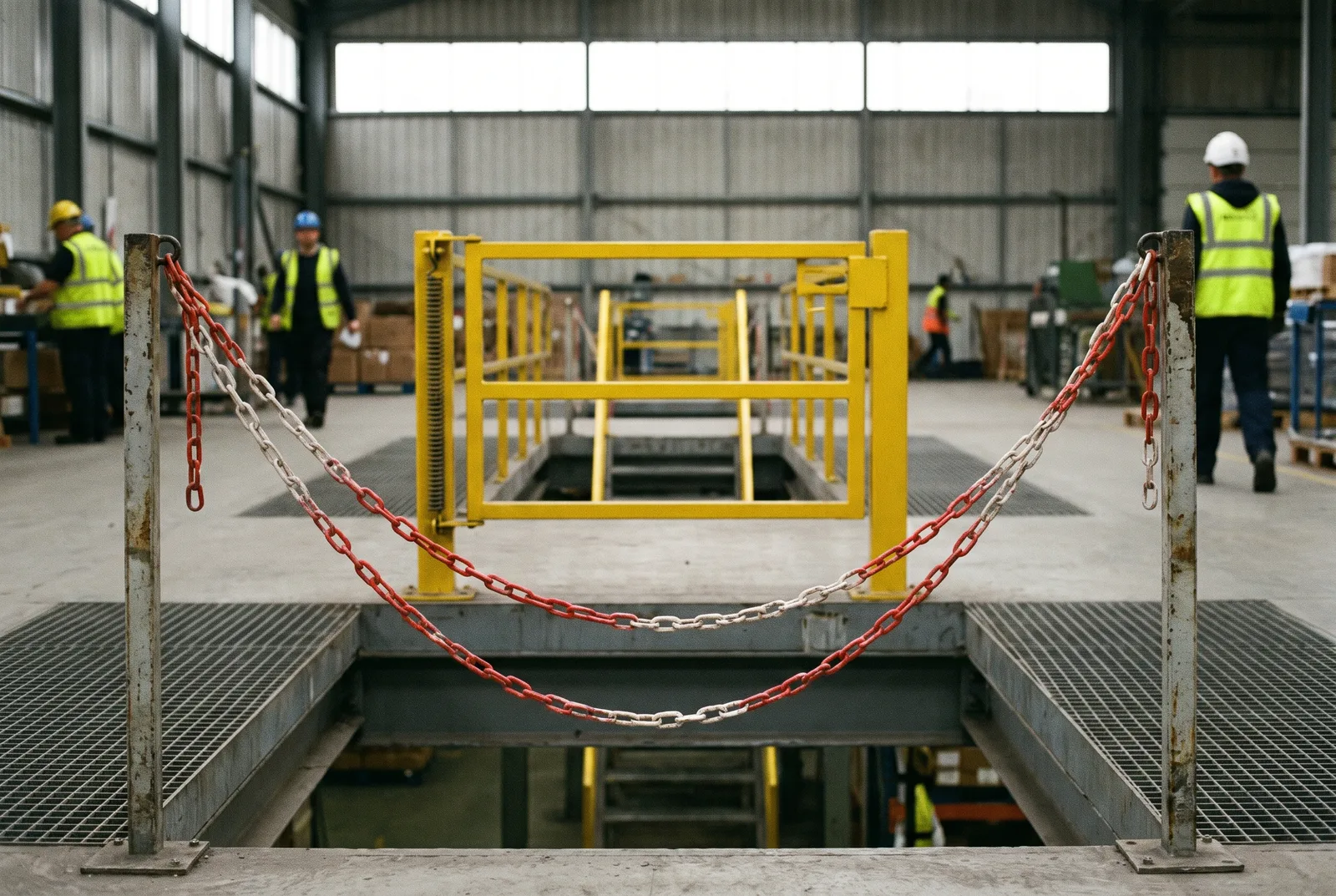
| Chain | Unclips | Weakest barrier; sags, gets left down |
| Pivot (dual-reciprocating) | Two interlocked barriers see-saw | Edge is never exposed |
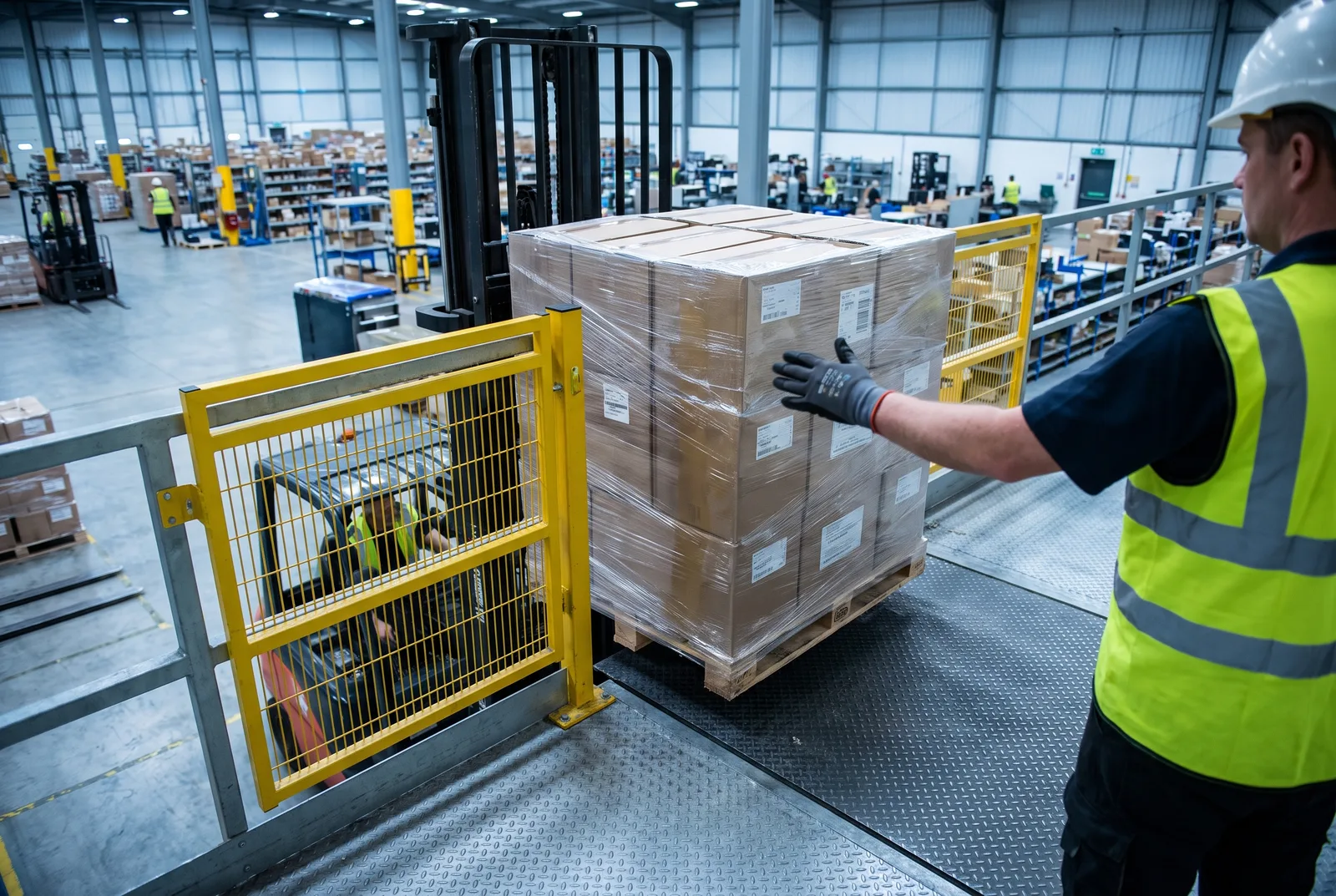
The pivot gate's geometry is the answer to the others' flaw: raising one side closes the other, "ensuring that a barrier exists between personnel and the edge of the mezzanine" at all times. Gate specialist Mezzgate states the failure mode plainly: single barriers held open by a pallet violate the intent of the rules, and dual gates remove reliance on worker memory.
The stricter standard makes it explicit. ANSI MH28.3 — the industrial work platform standard — says (§6.4.3, as quoted by gate manufacturer PS Safety Access): "A work platform shall be designed such that the elevated surface is protected by the guards at all times. Gates that swing open, slide open or lift out, leaving an unprotected opening in the guarding, are not acceptable." Swing and sliding gates still have legitimate homes — self-closing swing gates at stair tops and walk-through openings — but at the pallet drop, the industry standard points one direction.
What do safety gates cost?
Published prices: ~$335–345 for self-closing swing gates, ~$1,150 for a new pallet-drop pivot gate. Verified list pricing: Uline's self-closing safety swing gates run $335–345 for stair and ladder openings; a Global Industrial welded-steel pivot gate (68.5"W, meets OSHA) lists at $1,151 at published reseller pricing; used pivot gates appear on dealer sites near $990. Manufacturer-grade pivot gates (Wildeck's ships at 400 lb, cut-to-width from 3 to 10 feet) are quoted per project. Against a $100,000+ mezzanine — or one fall — the gate is the cheapest structural decision you'll make.
How do you choose and place gates?
Four rules cover almost every layout:
- Pallet drops get pivot gates. The always-a-barrier geometry is what ANSI MH28.3 asks for, and it survives busy shifts that defeat discipline-dependent designs.
- Stair openings get self-closing swing gates — spring hinges beat chains and beat "someone will close it" (why chains fail the test).
- Size the gate to the load, not the opening minimum — Cogan's published pivot range reaching 13 feet exists because oversized pallets and gaylords do.
- Match the system: gates bolt into the guardrail line, so spec them with the structure — retrofitting posts into a finished rail run costs more than ordering the opening right (the full guarding spec).
What to read next
- OSHA requirements for mezzanines: railings, gates, and egress — the full guarding rulebook around the gate
- Mezzanine lifts and VRCs — the interlocked-gate alternative for moving pallets up
- Mezzanine stairs requirements: IBC vs OSHA — the other opening in the rail line
- Mezzanine railing requirements: the 42-inch rules — the guard the gate interrupts, specified against both rulebooks
Put this guide into practice
Frequently asked questions
- Does OSHA require gates on mezzanines?
- OSHA requires fall protection at edges 4 feet and higher, and at hoist and pallet-drop areas it permits gates or chains only where they provide equivalent protection — with a barrier in place whenever hoisting isn't happening, and personal fall arrest when someone must lean past the edge.
- What is a pivot or dual-reciprocating safety gate?
- A gate with two interlocked barriers on a see-saw linkage: raising the outer side to receive a pallet automatically closes the inner side, so a rail always stands between the worker and the open edge. It removes reliance on worker memory — the failure mode of single gates.
- Are swing or sliding gates OSHA compliant at pallet openings?
- They can satisfy OSHA if used correctly, but ANSI MH28.3 — the industrial work platform standard — is stricter: gates that swing, slide, or lift out and leave an unprotected opening 'are not acceptable' because the edge is exposed while the gate is open. Pivot gates exist to close that gap.
- How tall do mezzanine gates and railings have to be?
- The guardrail standard: top rail at 42 inches plus or minus 3, a midrail midway, capable of resisting 200 pounds of outward or downward force, with openings no more than 19 inches — and manufacturer specs add a 6-inch kick plate at the deck edge.
- How much do mezzanine safety gates cost?
- Published pricing: self-closing swing gates for stair and ladder openings run about $335–345 each; full pallet-drop pivot gates run around $1,150 new at published reseller pricing, with used units listed near $990.
Continue planning your mezzanine
All Code & Permits guides →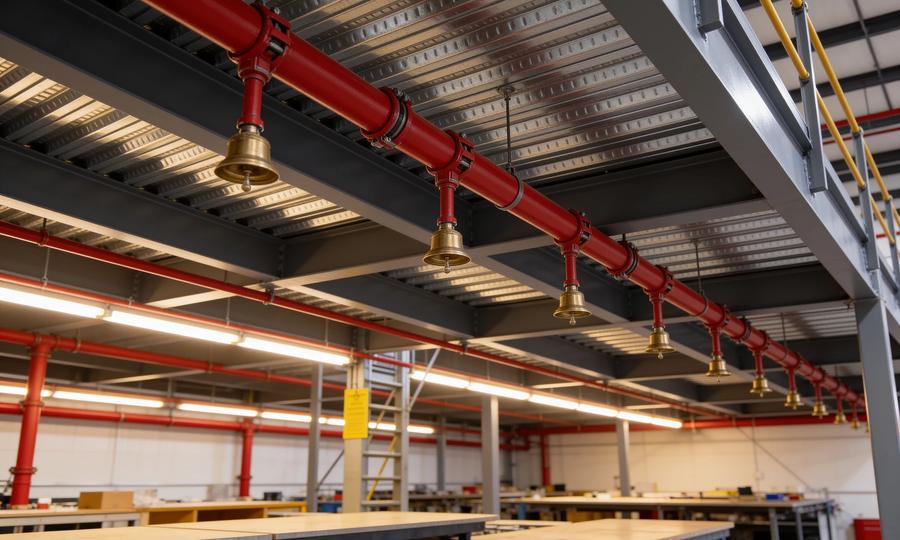
Code & Permits
Mezzanine Fire Sprinkler Requirements: NFPA 13 Guide
Review mezzanine sprinkler requirements, below-deck obstructions and open grating. Understand the design questions to resolve with your fire-protection team.
Code & Permits
Mezzanine Permit Requirements: Drawings & Approvals
Prepare a mezzanine permit application: drawings, structural review, building codes and inspections. Find state resources and understand the approval process.
Code & Permits
IBC 2024 Mezzanine Requirements: Area, Height & Egress
Review IBC mezzanine area, height, openness and egress requirements. Find the related OSHA, sprinkler and permit guides, plus a project planning checklist.