

OSHA requirements for mezzanines: railings, gates, and egress
OSHA 1910.29 sets the federal workplace-safety requirements for every commercial mezzanine. Here's exactly what railings, gates, and egress paths must meet, with the specific numbers.
Editorial
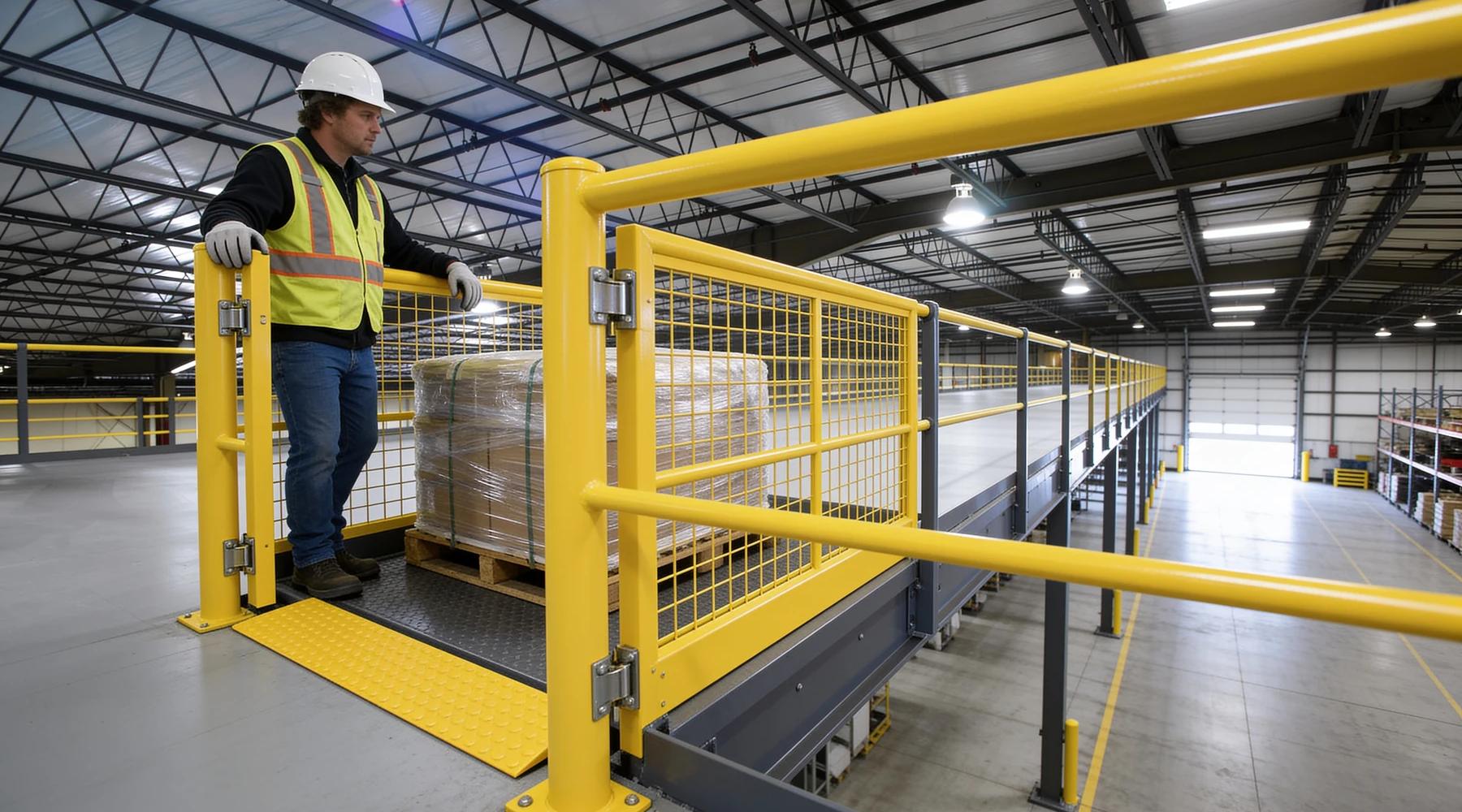
OSHA 1910.29 (full standard at osha.gov) is the federal workplace-safety regulation that governs fall protection on every elevated walking-working surface in U.S. general industry — including all commercial mezzanines.
The building code (IBC) tells you how to build the mezzanine. OSHA tells you how to keep workers from falling off it. Both apply, and failing the OSHA side is what catches most facilities during their first inspection.
This is the practical reference: every numeric requirement, why it matters, and the common mistakes that fail audits.

What are the OSHA guardrail requirements for mezzanines?
OSHA 1910.29(b) requires a 42-inch top rail (plus or minus 3 inches) that withstands 200 lb of force, a mid-rail roughly midway that withstands 150 lb, and toe boards at least 3.5 inches high where objects could fall. The full specifications:
Top rail
- Height: 42 inches (107 cm) above the walking-working surface, plus or minus 3 inches (so a 39–45 inch range is acceptable)
- Strength: must withstand a 200 lb force applied in a downward or outward direction at any point along the top rail without deflecting below 39 inches above the walking surface
- Continuous along all exposed edges where a fall of 4 feet or more is possible
Mid-rail (or equivalent)
- Position: roughly midway between the top rail and the walking surface (typically 21 inches above the floor)
- Strength: must withstand 150 lb force in any downward or outward direction
- Alternatives accepted: screens, mesh, intermediate vertical members (max 19" between), or solid panels — anything that prevents a 20" sphere from passing through
Toe boards (kick plates)
- Height: minimum 3.5 inches (89 mm) above the walking surface
- Required where there's a risk of objects falling onto people, equipment, or operations below
- Gap to floor: no more than 1/4 inch (so the toe board sits essentially flush with the deck)
Surface and construction
- Smooth — no burrs, splinters, sharp protrusions
- No openings that allow a person to pass through, fall through, or get caught
- Strong enough to support its own weight plus the imposed loads above
What does OSHA require at mezzanine stair openings?
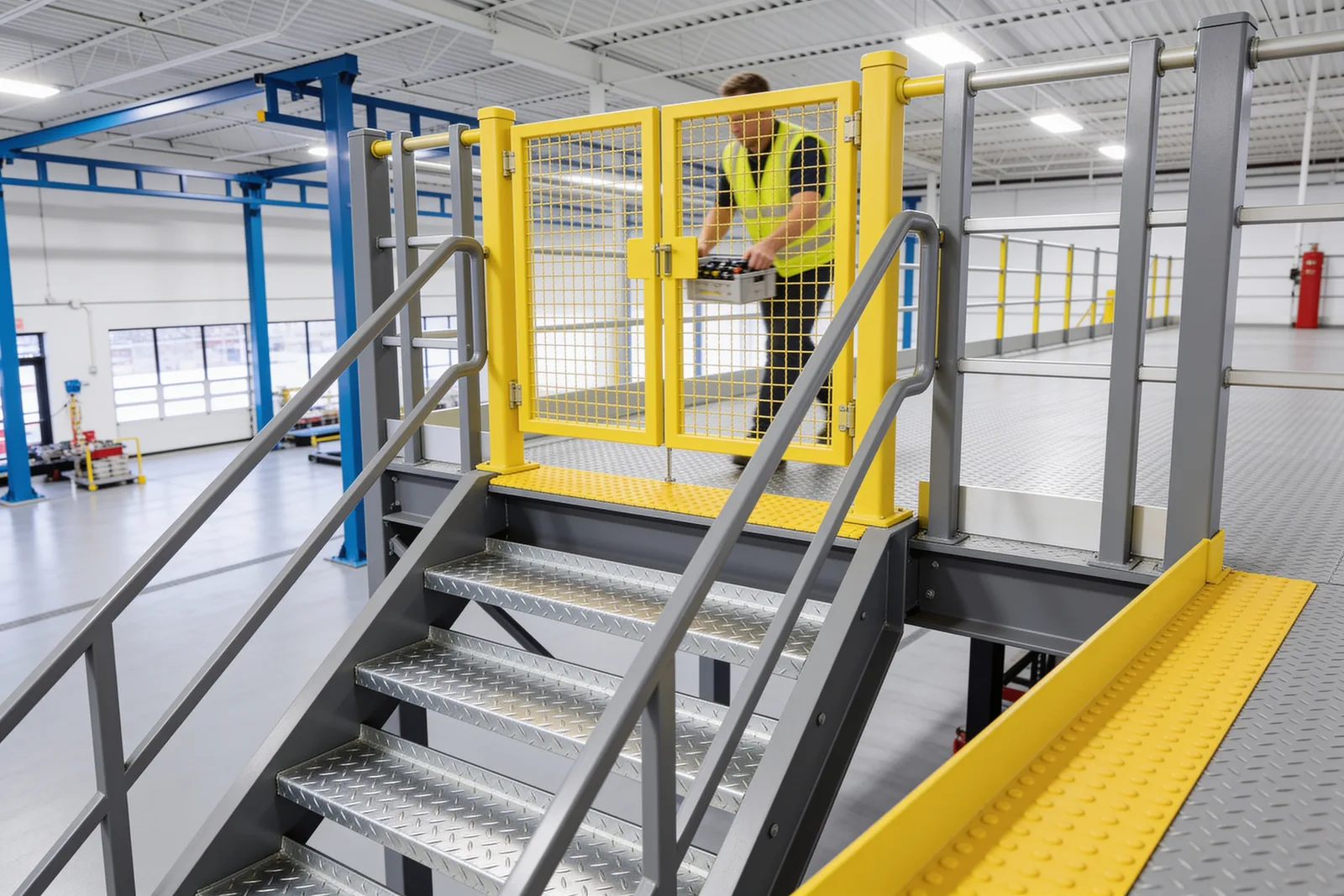
OSHA 1910.29(b)(13) requires standard guardrails on the three open sides of a stair opening plus a self-closing safety gate or an offset wall configuration at the stair entrance — a chain or removable bar is not compliant.
The single most common OSHA violation on existing mezzanines is inadequate protection at stair openings. Workers on the upper level can walk straight off the edge into the stairwell.
OSHA 1910.29(b)(13) requires that stair openings on elevated platforms be protected by:
- Standard guardrails on three sides (the open sides of the stair opening), AND
- A self-closing safety gate OR an offset wall configuration at the entrance to the stairs
A chain or removable bar is not OSHA-compliant. We see this constantly: a single chain stretched across a stair opening, easy to step over or under. That fails the standard.
The self-closing safety gate is the simplest solution. It must:
- Close automatically when released (spring-loaded mechanism)
- Swing outward toward the stair (not into the open mezzanine, where it could push a worker over)
- Meet the same height and strength requirements as the guardrail it replaces
Yellow safety-yellow paint isn't required by OSHA but is industry standard for visibility and is recommended.
How many exits does a mezzanine need?
A mezzanine needs at least one stair or ramp to ground level — and two means of egress, located remotely from each other, once the occupant load exceeds 10.
OSHA defers to the IBC and NFPA 101 (Life Safety Code) for egress provisions, but applies its own work-area rules on top.
The practical requirements that apply to most mezzanines:
- At least one stair or ramp to the ground level
- If occupant load is more than 10, at least two means of egress required, located remotely from each other (the "diagonal rule" from IBC Chapter 10)
- Stair design must meet IBC 1011: typically 11" minimum tread depth, 7" maximum riser height, handrails on at least one side, lighting
- Travel distance to the nearest exit governed by IBC 1017 — typically 200 feet for sprinklered industrial occupancies, less without sprinklers
For mezzanines that are also part of an emergency egress path for the rooms below, additional requirements apply — get a code consultant involved.
Other walking-working surface requirements
OSHA 1910.22 (full text) covers the general condition of the surface itself:
- Capacity: the surface must be able to support the maximum intended load
- Cleanliness: kept in a clean, dry, sanitary condition (slip hazard from spills is a violation)
- Free from hazards: no protrusions, holes, leaks
- Inspections: the employer must inspect walking-working surfaces "regularly and as necessary" and correct hazardous conditions before resuming work
For mezzanines this typically means:
- Annual inspection of the deck, joists, columns, anchors, railings
- Documented records of inspection and any repairs
- Posted load rating (so workers know not to overload the deck)
What are the most common OSHA violations on mezzanines?
The most frequent failures: chains instead of self-closing gates at stair openings, missing toe boards, damaged guardrails, decking with holes, absent or illegible load ratings, stairs without handrails, and ladders used as primary access.
Patterns we see repeatedly in compliance audits:
- Stair openings protected only by a chain — chains are not guardrails. Replace with a self-closing safety gate.
- Missing toe boards where tools or boxes could fall onto people or equipment below.
- Damaged guardrails — bent, missing welds, no longer meeting the 200 lb deflection test.
- Decking with holes or openings — even small gaps can fail compliance if they allow object-fall.
- Posted load rating absent or illegible. Workers can't be expected to follow load limits they can't read.
- Stairs without handrails — required for any flight with four or more risers (1910.28).
- Ladders used as primary access to mezzanines — ladders meet only the access requirement for infrequent maintenance use. Frequent traffic requires a stair.
Compliance with both IBC and OSHA: how they interact
The building inspector (IBC) and the OSHA inspector are different people with different mandates. A structure can pass IBC plan review and fail OSHA inspection — and vice versa.
The simple rule: design to whichever is stricter on any given dimension. For mezzanines:
- IBC §505.2.3 caps perimeter walls at 42 inches (openness requirement) — OSHA requires 42 ± 3 inch guardrails. They align.
- OSHA's 200 lb top-rail force test is more specific than IBC's general "structurally adequate" — OSHA governs.
- IBC's egress requirements are more detailed than OSHA's general "means of egress" requirement — IBC governs.
A structural engineer experienced with industrial mezzanines will design to both. If you're working with a vendor who's vague about which standards their drawings address, that's a red flag.
How often should a mezzanine be inspected?
OSHA sets no interval at all. 1910.22(d)(1) requires only that walking-working surfaces be "inspected, regularly and as necessary, and maintained in a safe condition." The duty is mandatory and the frequency is yours to justify.
Two widely repeated claims about this do not survive checking. The weekly-visual-plus-annual-expert schedule quoted as an OSHA rule is not one — it traces to UK guidance HSG76 ¶645–646, which is written about pallet racking and states of itself that "Following the guidance is not compulsory." And no walking-working-surfaces provision sets any record-retention period, so the five-year figure attached to mezzanine inspection records has no basis in this part of the standard.
Note also where the credential sits: 1910.22(d)(3) requires a qualified person to perform or supervise a correction or repair only "When any correction or repair involves the structural integrity of the walking-working surface." It says nothing about who does the looking.
Our mezzanine inspection and maintenance guide builds the risk-based frequency argument in full, and collects the published pass/fail criteria for bolts, coatings, deck and gates.
What to read next
- Mezzanine stairs requirements: IBC vs OSHA — the stair rules in full detail
- The IBC 2024 mezzanine requirements explained in plain English — building code companion
- Mezzanine load capacity explained: live, dead, and point loads — engineering the capacity rating
- Warehouse catwalks: what code actually calls them — why OSHA regulates catwalks as runways, and the stricter guardrail rule that follows
- Mezzanine inspection and maintenance — the one-sentence federal duty, why no US interval exists, and the sourced criteria for bolts, coatings and deck
- Mezzanine railing requirements: the 42-inch rules — where the IBC and OSHA disagree on the guard, and the warehouse exceptions that change what you build
Put this guide into practice
Frequently asked questions
- Do mezzanines need OSHA-compliant guardrails?
- Yes. OSHA 1910.29 requires guardrails along all exposed edges where a fall of 4 feet or more is possible: a 42-inch top rail (plus or minus 3 inches) that withstands 200 lb of force, a mid-rail that withstands 150 lb, and toe boards at least 3.5 inches high where objects could fall on people below.
- How high do OSHA mezzanine railings need to be?
- 42 inches (107 cm) above the walking-working surface, plus or minus 3 inches — so 39 to 45 inches is acceptable. The top rail must withstand a 200 lb force applied in a downward or outward direction at any point without deflecting below 39 inches above the walking surface.
- Is a chain across a mezzanine stair opening OSHA-compliant?
- No. A chain or removable bar is not OSHA-compliant. OSHA 1910.29(b)(13) requires standard guardrails on the three open sides of the stair opening plus a self-closing safety gate or an offset wall configuration. The gate must close automatically and swing outward toward the stair.
- How many exits does a mezzanine need?
- At least one stair or ramp to ground level. If the occupant load is more than 10, at least two means of egress are required, located remotely from each other. Stairs must meet IBC 1011: typically 11-inch minimum tread depth, 7-inch maximum riser height, and handrails on at least one side.
- Does OSHA require mezzanine inspections?
- OSHA 1910.22 requires employers to inspect walking-working surfaces regularly and as necessary, and to correct hazardous conditions before resuming work. A defensible program pairs weekly visual checks by a floor supervisor with a detailed annual inspection by a qualified person, documented and kept for at least 5 years.
Last substantive revision —
Continue planning your mezzanine
All Code & Permits guides →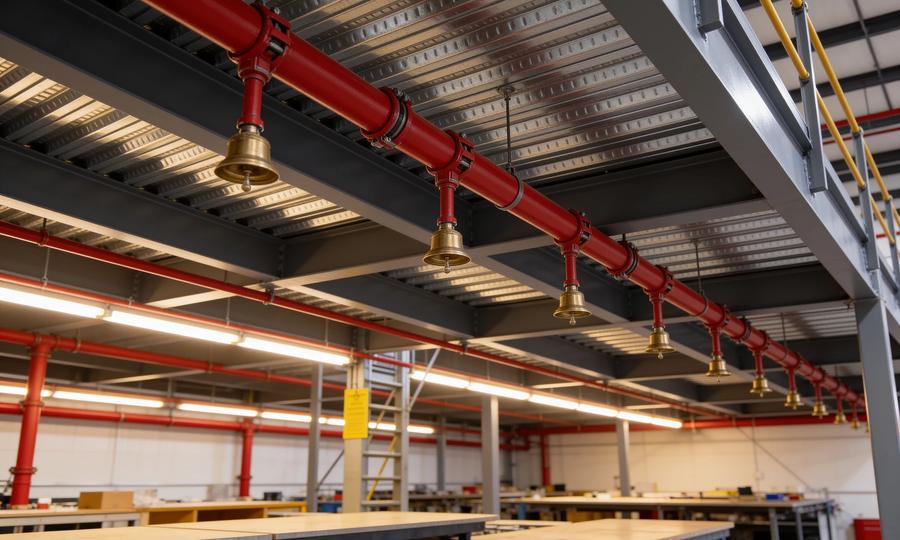
Code & Permits
Mezzanine Fire Sprinkler Requirements: NFPA 13 Guide
Review mezzanine sprinkler requirements, below-deck obstructions and open grating. Understand the design questions to resolve with your fire-protection team.
Code & Permits
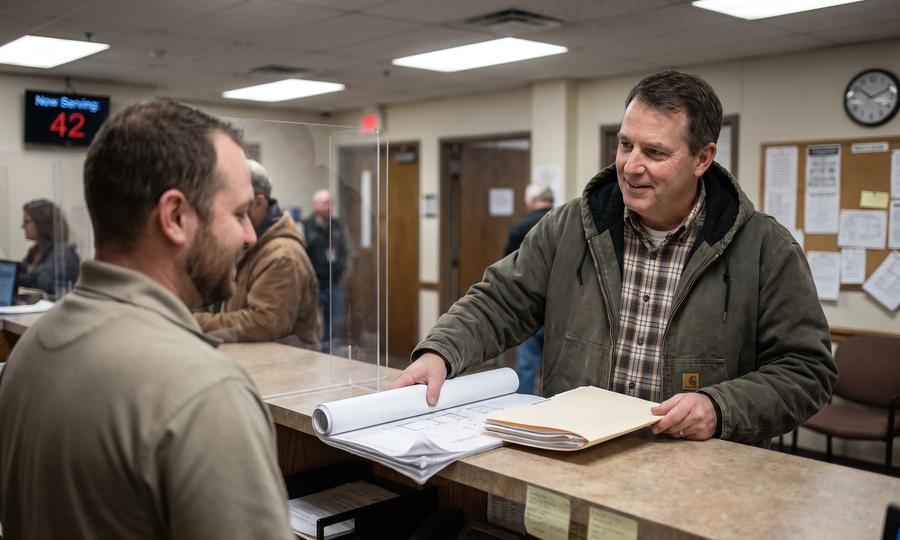
Mezzanine Permit Requirements: Drawings & Approvals
Prepare a mezzanine permit application: drawings, structural review, building codes and inspections. Find state resources and understand the approval process.
Code & Permits
IBC 2024 Mezzanine Requirements: Area, Height & Egress
Review IBC mezzanine area, height, openness and egress requirements. Find the related OSHA, sprinkler and permit guides, plus a project planning checklist.