

Can a forklift drive on a mezzanine? Designing for forklift access
A mezzanine rated 125 psf can still fail under one forklift wheel. Why concentrated wheel loads — not the PSF average — govern, which decks take forklift traffic, and how ramps and VRCs get the truck up there safely.
Editorial
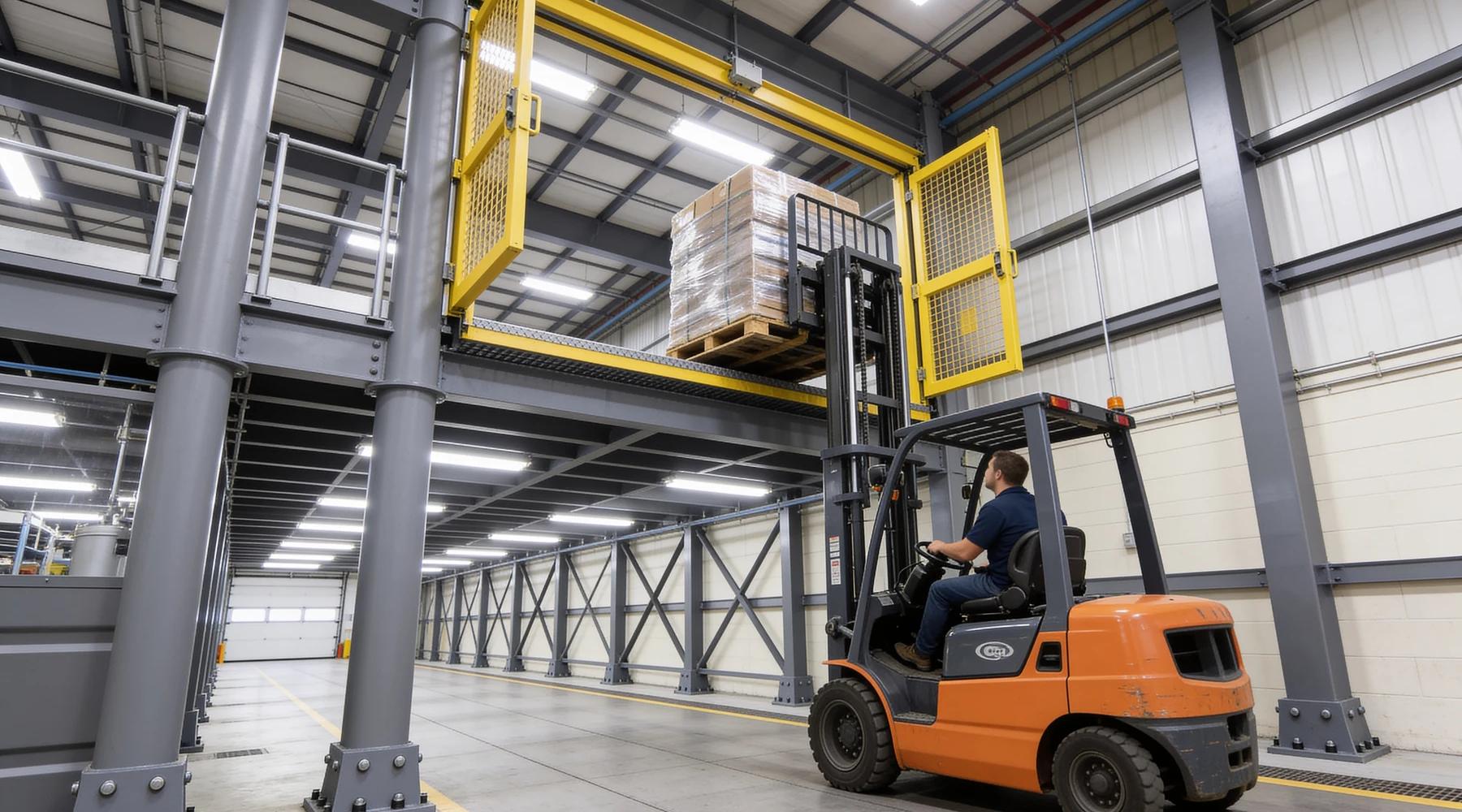
"Can we just drive the forklift up there?" is the question that quietly wrecks mezzanine budgets. The honest answer is that a mezzanine will take a forklift only if someone engineered it to — and the reason has nothing to do with the psf number on the load plate. A deck rated 125 or 250 psf uniform can still be destroyed by a single forklift wheel, because the truck delivers thousands of pounds through a tire contact patch a few inches wide. Here's how the load, the deck, and the access route actually get designed.
Why can't a standard mezzanine take a forklift?
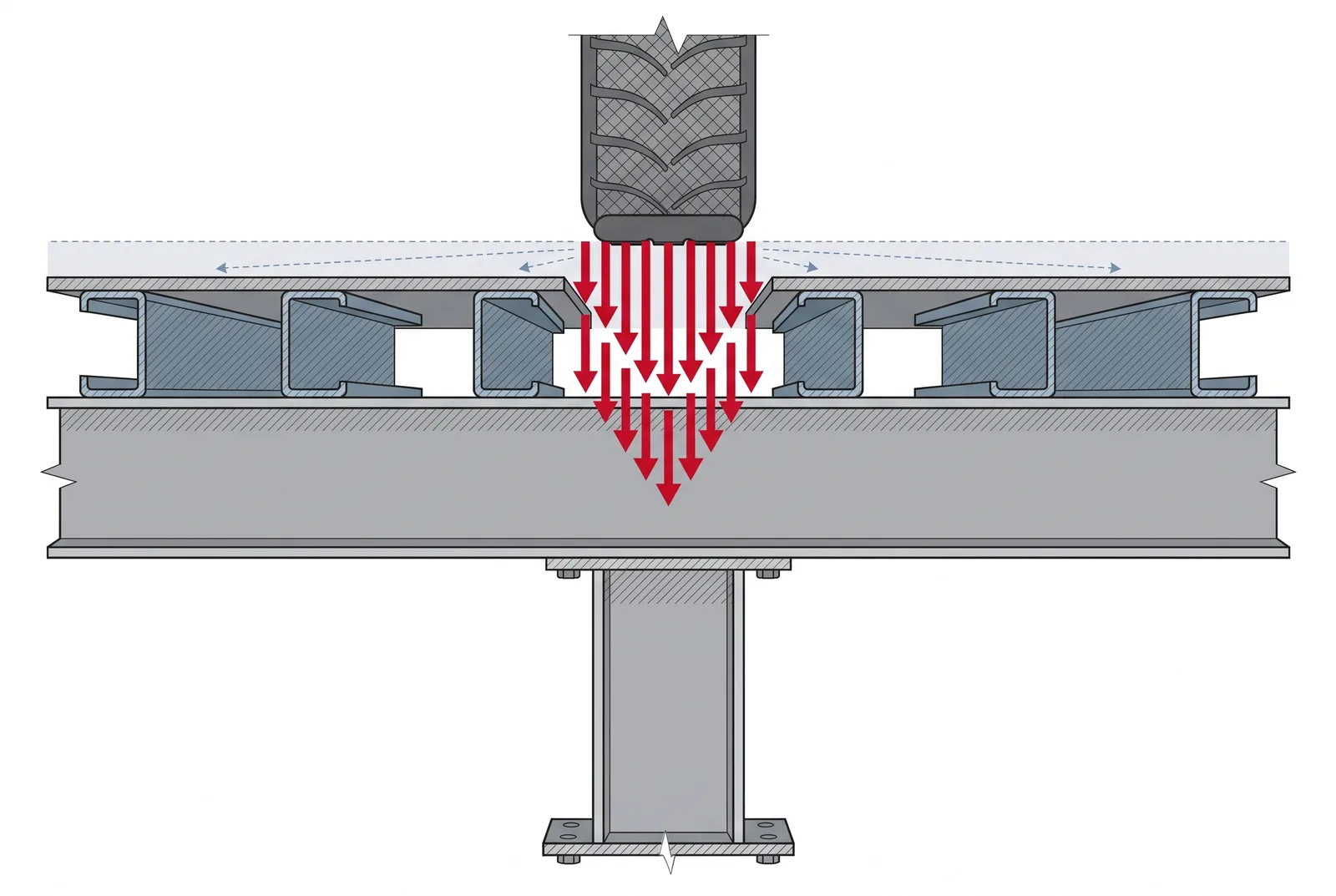
Because a forklift is a concentrated load, and a mezzanine is rated for a distributed one. Storage decks are engineered to a uniform live load — commonly 125 psf for light storage and 250 psf for heavy storage, tracing to the IBC/ASCE 7 minimum-load tables. A forklift ignores that average entirely.
The math is unforgiving. A common 5,000-lb-capacity counterbalance truck — a Toyota 8FGCU25, for instance — has a service weight of about 8,000 lb empty. Pick up a 5,000-lb pallet and you have ~13,000 lb on the machine, of which roughly 85% rides on the front axle once the load is up. That's on the order of 5,000+ lb pressed through each front tire's small contact patch — a point load an order of magnitude above anything the uniform rating contemplates. As one mezzanine design guide puts it plainly, vehicle traffic "must be engineered with that in mind, including appropriate surface treatments, slab thickness, and reinforcements"; you cannot assume uniform-load values for a forklift.
This is why manufacturers split the load spec in two. Our publisher Cogan separates every design into Uniformly Distributed Loads and Point Loads, and asks clients to declare "any applications that may cause concentrated (point) loads or vibrations" up front. A forklift is the definitive point load — and if it isn't on the drawing before the steel is sized, retrofitting for it later means new columns, new connections, sometimes a new deck.
Which mezzanine decking can a forklift actually drive on?
Structural concrete on composite deck, heavy steel plate, and heavy-duty bar grating — not resin board or wood composite. The decking is where forklift-rating is won or lost, because it's the deck that meets the tire first.
| Deck type | Forklift traffic? | Why |
|---|---|---|
| Concrete on composite steel deck | Yes — the standard | Most durable, highest point-load capacity; the choice for permanent forklift floors |
| Steel diamond/checker plate | Yes | High capacity and traction for wheeled equipment |
| Heavy-duty bar grating (MBG 532) | Yes, when specified | Quarter-inch-plus bearing bars carry vehicle loads; standard-duty grating does not |
| Resin board (e.g., ResinDek) | No — rolling loads only | Rated 2,000–3,500 lb for pallet jacks, carts, AGVs, not counterbalance trucks |
| Wood / OSB composite | No | Handles only light, random wheel loads |
The most common and most expensive mistake here is treating rolling-load decking as forklift-rated. Resin-board panels are genuinely engineered for wheels — but for the gentle, distributed wheels of pallet jacks and autonomous mobile robots, not the concentrated tire load of a sit-down forklift. For grating, the line is just as hard: standard pedestrian grating is not vehicular grating. Heavy-duty steel grating engineered to an AASHTO H-20 rating carries a 32,000-lb axle load — the benchmark for truck traffic — but you have to specify it. (We cover the full grating picture separately.)
Do you add an impact factor for a moving forklift?
Usually yes — engineers add 10–25% to the wheel load for dynamic impact, though the exact figure is a judgment call. A wheel rolling across a deck, hitting a seam or an edge, delivers more than its static weight. There's no single mandated number for forklifts, so structural engineers borrow the nearest code precedent.
The most-cited analog is ASCE 7's crane provision, which requires a 25% increase to maximum wheel loads for powered bridge cranes and 10% for pendant-operated ones. Some engineers argue forklifts move too slowly to warrant a full impact allowance and apply around 10% to maximum wheel loads; grating makers designing for rolling service assume 25–50% above static weight. The practical takeaway: this is a design-judgment range, not a lookup value, and it belongs to your stamping engineer — not to a sales quote.
How do you get a forklift onto the mezzanine?
Three routes: a designed ramp, a VRC, or a freight elevator — and for most operations a VRC is the safer, cheaper answer. Driving a loaded truck up a ramp is legal but demanding. OSHA's forklift rule sets the behavioral floor: on grades above 10%, loaded trucks must travel with the load pointed upgrade, empty trucks with forks downgrade, never turning on the ramp and never approaching the edge. Note that OSHA's 10% figure is an operating threshold, not a ramp-design spec — the design grade should match your specific truck's OEM gradeability rating, and daily loaded travel usually targets something gentler.
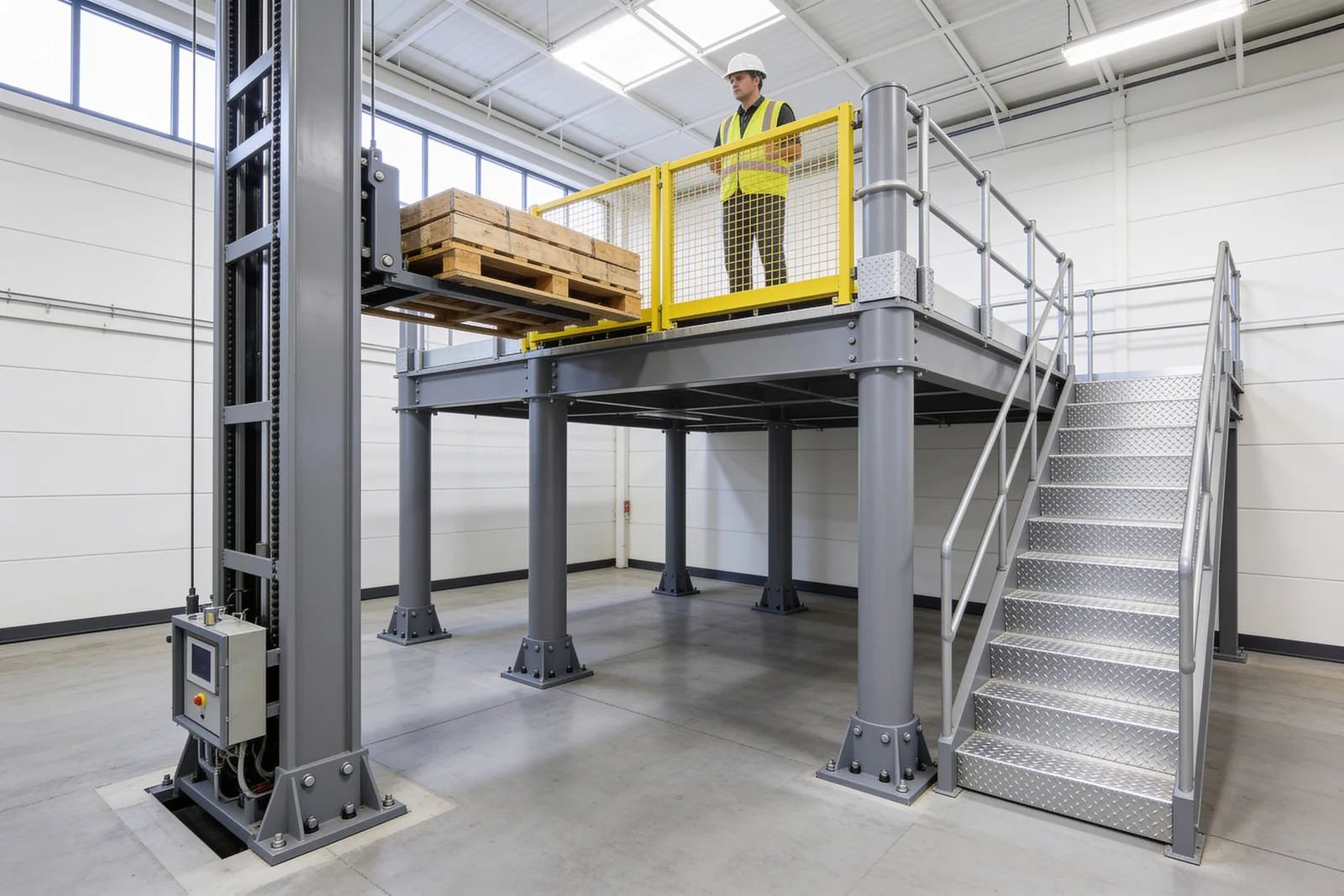
The alternative most facilities land on is a vertical reciprocating conveyor (VRC). A VRC lifts palletized material between levels on a platform, so no truck ever climbs. Critically, VRCs are governed by ASME B20.1 as conveyors and are not permitted to carry people — which is exactly what keeps them out of the far more expensive passenger-elevator code regime. You load a pallet at the bottom, a forklift or pallet jack retrieves it at the top, and the mezzanine deck itself never has to carry a truck at all.
What has to be protected where a forklift operates?
Columns, deck edges, and the pallet-drop opening — all engineered as if a truck will eventually hit them, because one will. A forklift near a mezzanine is a structural threat, not a cosmetic one.
- Columns. A strike on a mezzanine column is a load-path event. Bollards and column guards protect the point locations where trucks run under or beside the deck — the column-spacing decision and the aisle plan have to be reconciled so guards fit without pinching the aisle.
- Deck edges. OSHA requires toe boards at least 3.5 inches high, with screening to the midrail where material is piled — a real curb against a wheel or pallet running off the edge.
- The pallet drop. This is the one place fall protection is designed to open. A dual/pivot pallet gate keeps a barrier between the worker and the open edge at all times — one side closes as the other opens. Standard swing and slide gates leave the edge exposed while open, which is why the gate type matters as much as the gate itself.
And the guardrail behind it all must resist 200 lb applied outward at the top rail — a static-load figure that a moving forklift can exceed in an instant, which is the real argument for the curb and the column guard doing the heavy work.
What does forklift-rating cost?
A meaningful premium — heavier steel, a structural deck, and reinforced connections push you toward the top of the range. Standard steel mezzanines run roughly $35–85 per square foot, while heavy-duty industrial systems built for higher loads and reinforced connections run about $80–150 per square foot. Add the access equipment — a pallet-drop or pivot gate runs $1,200–3,500 each — and a VRC on top of that if you go that route.
The decision isn't really "forklift or no forklift." It's whether the operational value of driving onto the deck beats the cost of a VRC-plus-pallet-jack workflow that lets you build a lighter, cheaper structure. Price both. Set the load class with the load calculator, then run the configuration through the cost calculator — the forklift-rated version and the VRC-served version are often closer than the sales conversation suggests.
What to read next
- Bar grating mezzanine: load specs and applications — including the heavy-duty grating that does take forklift wheels
- Mezzanine decking options compared: B-deck, bar grating, resin, concrete — the deck choice that decides forklift-rating
- Mezzanine lifts and VRCs: getting material to the deck — the safer alternative to driving a truck up a ramp
Put this guide into practice
Frequently asked questions
- Can a forklift drive on a mezzanine floor?
- Only if the mezzanine was specifically engineered for it. A standard storage mezzanine rated 125–250 psf uniform load is not designed for the concentrated wheel loads of a counterbalance forklift, which can deliver thousands of pounds through a single tire contact patch. Forklift access requires a stamped design with the right deck, heavier steel, and reinforced connections.
- How much does a loaded forklift weigh on a mezzanine deck?
- A common 5,000-lb-capacity counterbalance truck weighs about 8,000 lb empty, and roughly 85% of the combined truck-plus-load weight rides on the front axle once a pallet is picked up. That concentrates far more load per wheel than the deck's uniform psf rating accounts for.
- What mezzanine decking can support a forklift?
- Structural concrete on composite steel deck, heavy steel plate, and heavy-duty bar grating (MBG 532, quarter-inch-plus bars) can carry forklift wheels when engineered for it. Resin-board and wood-composite panels cannot — they are rated for pallet jacks, carts, and AGVs at 2,000–3,500 lb rolling loads, not counterbalance forklifts.
- What is the maximum grade for a forklift ramp?
- OSHA 1910.178(n)(7) sets a behavioral threshold: on grades above 10%, loaded trucks must be driven with the load pointed upgrade. Actual design grade should follow the specific forklift's OEM gradeability rating — many facilities target far gentler slopes than the 10% limit for daily loaded travel.
- Is a VRC safer than a forklift ramp for a mezzanine?
- For most operations, yes. A vertical reciprocating conveyor (VRC) moves palletized material between levels without driving a forklift up a ramp. VRCs are governed by ASME B20.1 and are for materials only — never people — which is what lets them sidestep passenger-elevator codes.
Continue planning your mezzanine
All Engineering guides →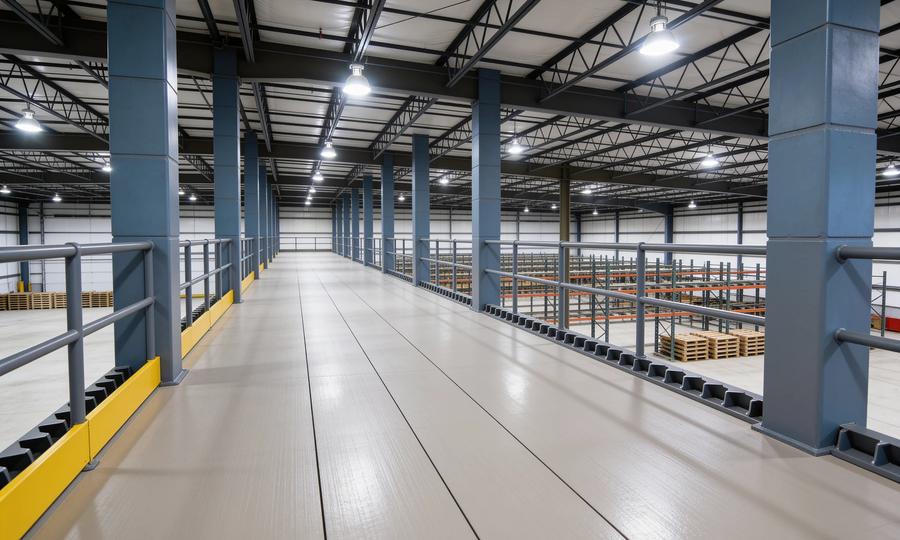
Engineering
Mezzanine Flooring: Structural Decks & Surface Finishes
Choose mezzanine flooring for storage, pallet jacks or automation. Review the structural deck, surface finish, rolling loads and the specifications to compare.
Engineering
Mezzanine Load Capacity: PSF Ratings & Point Loads
Understand mezzanine PSF ratings, uniform live loads and point loads. Use documented ratings, prepare a load brief and avoid unsupported capacity assumptions.
Engineering
Mezzanine Ceiling Height Requirements & Clearance
Work through mezzanine ceiling height requirements, clear headroom and framing depth. Check sprinkler obstructions and forklift clearance before planning.