

Mezzanine Decking Options: Grating, Panels & Concrete
Compare mezzanine decking options for storage and equipment: bar grating, floor panels, steel plate and concrete. Review trade-offs and use the decking selector.
Editorial
Correction — October 9, 2026: Replaced unsupported concrete-specific capacities, prices, curing delay and sprinkler-cost assumptions. The comparison table and FAQs now require project-specific evidence; this was not a complete source re-audit of every retained material section.
Decking is the horizontal floor surface that sits on top of mezzanine joists. It's the cheapest line item in a mezzanine quote — and the one that most affects how the structure performs in service.
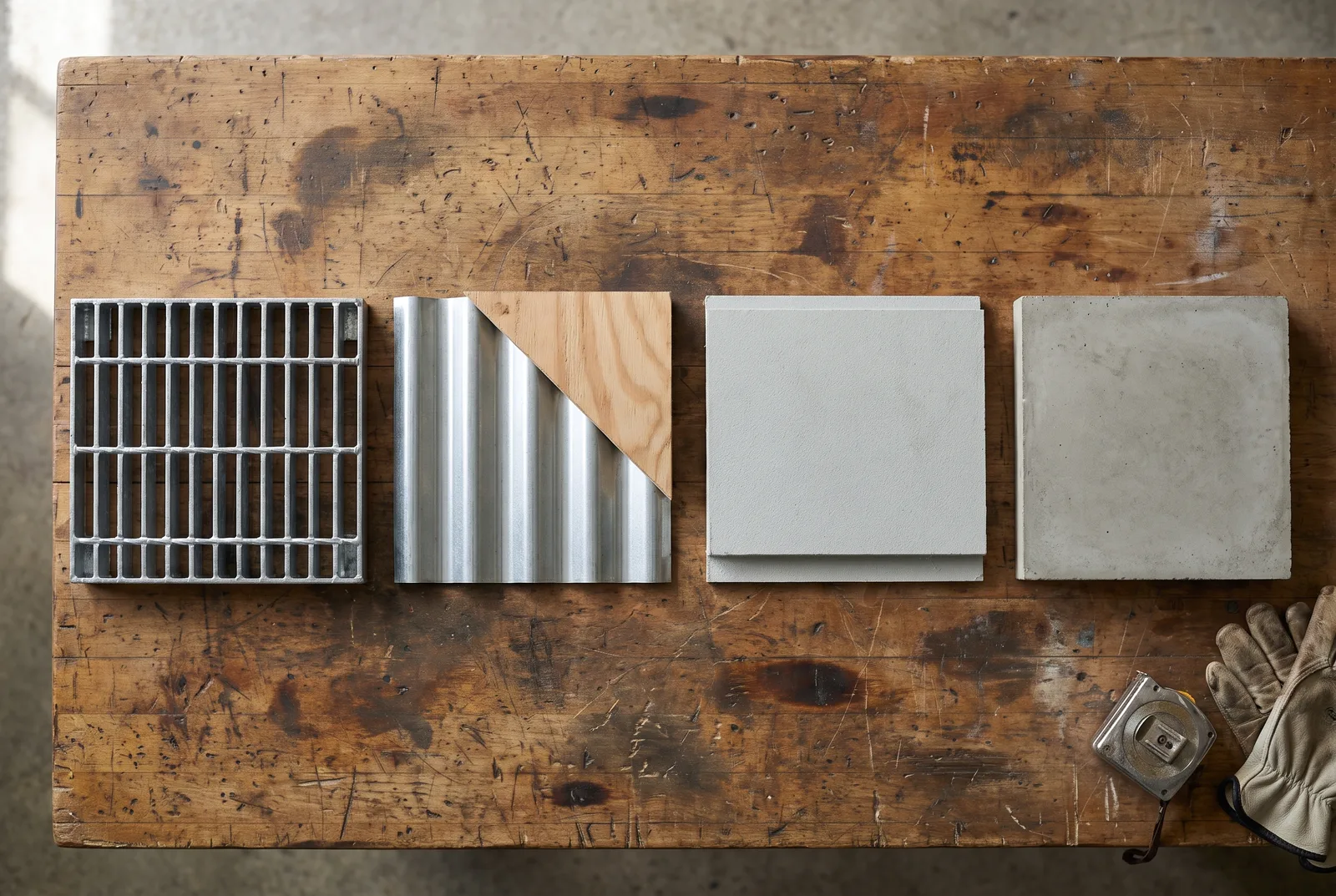
Four materials dominate the market: bar grating, B-deck with concrete fill, resin board / OSB, and diamond plate steel. Picking the wrong one costs more than picking the wrong steel structure, because changing decking later means stripping the floor.
Use the mezzanine decking selector to compare your requirements. For a closer look at individual systems, read the bar grating guide and resin panel guide.
When should you use bar grating on a mezzanine?
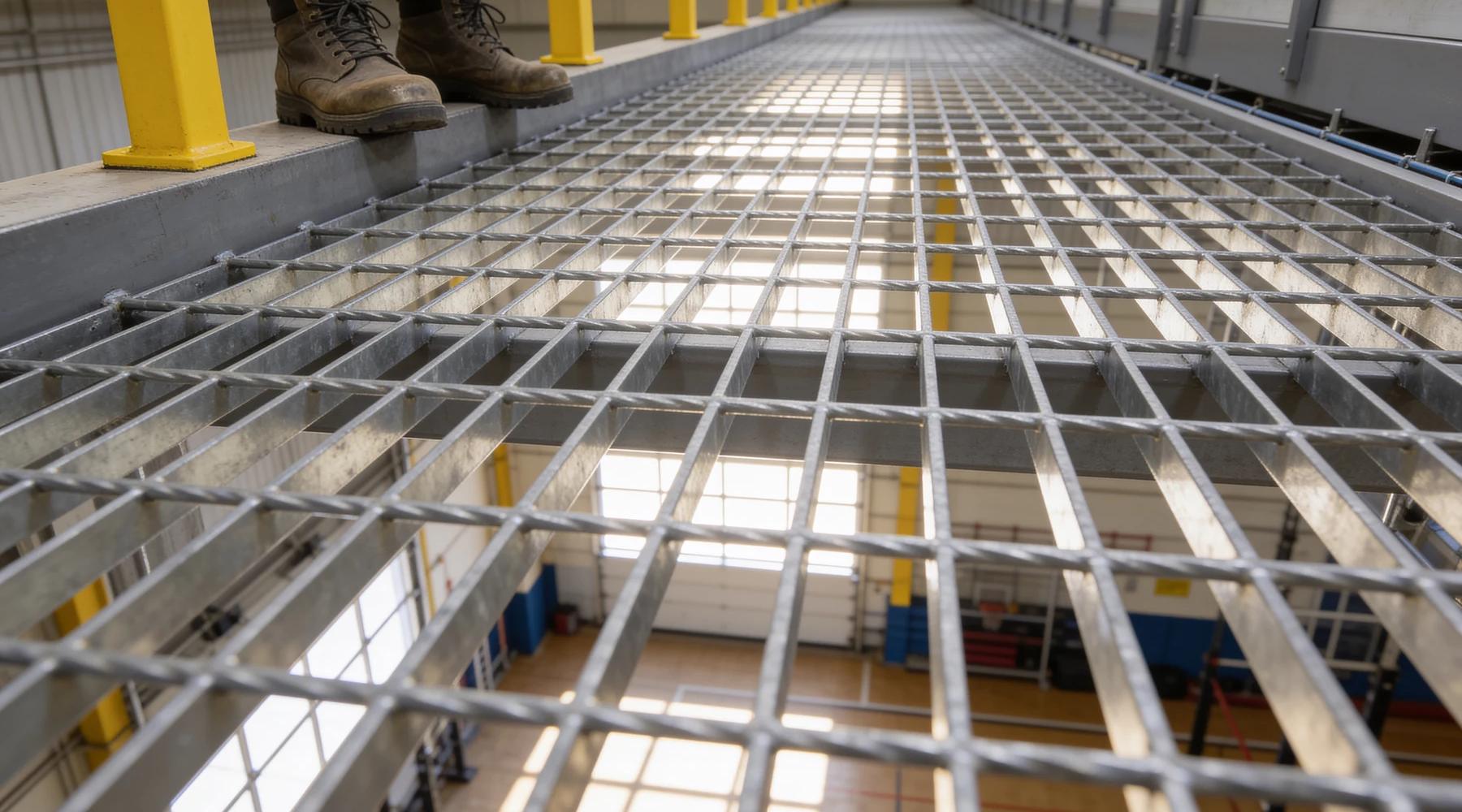
Choose bar grating for storage mezzanines: at $3–6 per square foot it's the cheapest option, handles typical 125 PSF loads, and lets sprinkler water pass through — often avoiding a second level of sprinkler coverage.
Steel grate panels — typically welded steel bars on edge, set on perpendicular cross-bars, forming an open grid.
Cost: $3–6 per square foot (galvanized steel, standard 1.25" or 1.5" depth)
Best for:
- Storage operations where you want sprinkler water and light to pass through to the level below
- Light-to-moderate load duty (125 PSF typical)
- Industrial workspace where slip resistance matters more than smoothness
- Operations where the mezzanine is over heavy equipment that needs heat/airflow
Trade-offs:
- Heels and small wheels can catch in the grate openings — not great for offices, retail, or non-industrial uses
- Loose items can fall through to the level below (mitigated by toe boards at edges)
- Higher noise transmission to level below
- Less comfortable for long standing/walking
Fire code: Bar grating is the preferred deck for sprinkler compliance in many storage applications. Because water passes through, often only single-level sprinkler coverage is required (sprinklers below the deck protect the level above and the room).
Load capacity: Standard 1.25" bar grating at 1-3/16" spacing handles ~125 PSF uniform load with joists at 4 foot spacing. Heavier grating (1.5" or 2") for higher loads.
When should you use B-deck with concrete fill?
Specify the actual assembly before choosing this option. Concrete on steel deck may use non-composite permanent formwork or a specified composite product; the words "B-deck with concrete" do not establish which. Vulcraft's form-deck guidance explains the distinction for its products.
The project team must establish the deck designation, concrete geometry and density, reinforcement, supports, construction-stage loading and intended service loads. Canam's composite-deck notes specifically call for checks of concentrated and moving loads. A concrete surface or a high uniform PSF figure is not an automatic forklift approval.
Obtain a project-specific installed quotation and curing/release plan. This comparison no longer assigns concrete a universal installed price, dead load, waiting period, forklift class or sprinkler-cost percentage. The concrete-filled deck specification guide explains the design inputs and gives clearly limited weight arithmetic.
When should you use resin board (structural OSB) decking?
Resin board fits budget-constrained, light-load storage: $4–8 per square foot installed for 60–125 PSF duty, and it can't tolerate wet environments — the leading manufacturer states its panels are "not intended for exterior applications" and excludes prolonged standing water from warranty.
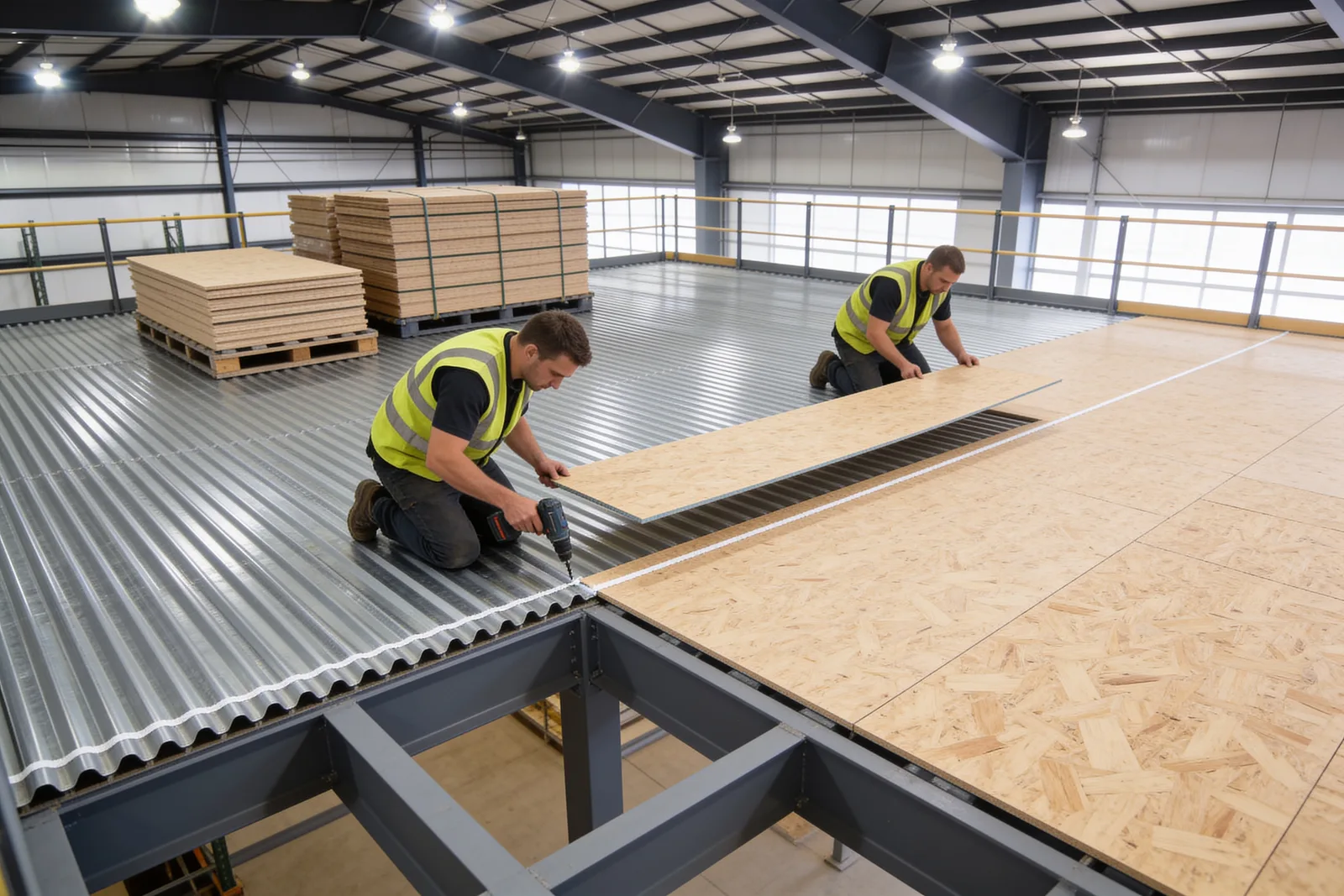
One correction worth making, because generic decking comparisons get it wrong: engineered resin panels are not plain OSB, and the branded products are rated for wheeled traffic. Published ResinDek ratings run 2,000 to 8,000 pounds for manual pallet jacks and 500 to 6,000 pounds for AGVs and robots, depending on panel grade and the B-deck beneath — though no grade carries a forklift rating. Our resin deck deep dive works through the tables and the footnotes that qualify them.
Engineered wood panels — typically 3/4", 1-1/8" or 1-1/2" thick high-density wood fiber composite, manufactured specifically for mezzanine use.
Cost: $4–8 per square foot installed
Best for:
- Light-load storage operations (60–125 PSF)
- Budget-constrained projects with limited storage requirements
- Operations where dust or moisture isn't a concern
- Workspaces where some give in the floor is acceptable
Trade-offs:
- Lower load capacity than steel options
- Susceptible to moisture damage and wet environments; branded panels are made in cold-storage grades, but washdown and standing water are excluded
- No forklift rating at any grade — pallet jack and robot ratings apply only to the specific panel and deck gauge specified
- Some products have higher off-gassing — verify formaldehyde and VOC ratings if mezzanine is in an occupied indoor space
- Less fire-resistant than steel grating
Fire code: Combustible deck — many jurisdictions and insurers require additional sprinkler coverage or fire-resistant treatments. Check before specifying.
Load capacity: Standard 1.125" panels at 24" joist spacing handle ~125 PSF uniform load. Lighter capacities (60–100 PSF) work at wider joist spacing for budget builds.
When should you use diamond plate steel decking?
Diamond plate is the heavy-duty pick for harsh conditions — frequent forklift or vehicle traffic and wet, oily, or chemical environments — at $10–18 per square foot installed, the most expensive option, handling 250+ PSF.
Solid steel sheet (typically 1/4" or 3/8" thick) with raised diamond pattern for slip resistance.
Cost: $10–18 per square foot installed
Best for:
- Heavy industrial use with frequent forklift or vehicle traffic
- Wet, oily, or chemical environments where chemical resistance matters
- Areas requiring high impact resistance
- Industrial walkways and platforms in harsh conditions
Trade-offs:
- Most expensive option
- Heavier than bar grating (more dead load)
- Slippery when wet despite the pattern — slip-resistance ratings vary
- Not great for offices or assembly work
- Single-level sprinkler coverage usually adequate (water won't pass through, but if used as walkway over storage the rules vary)
Load capacity: Heavy. 1/4" plate at 24" joist spacing handles 250+ PSF; thicker plates or tighter joist spacing for higher.
How do the four mezzanine decking options compare?
Compare the approved assemblies and quote scopes, not material names alone. The table distinguishes surface types; capacity, vehicle use, fire protection and price need project-specific evidence.
| Feature | Bar grating | B-deck + concrete | Resin board | Diamond plate |
|---|---|---|---|---|
| Cost per sqft | Project quote | Project quote | Project quote | Project quote |
| Load capacity | Assembly-specific | Assembly-specific | Assembly-specific | Assembly-specific |
| Smooth surface | No | Yes | Yes | Yes (raised pattern) |
| Fire-protection scope | Project design | Project design | Project design | Project design |
| Sound performance | Confirm assembly | Confirm assembly | Confirm assembly | Confirm assembly |
| Forklift use | Verify actual loads | Verify actual loads | Verify actual loads | Verify actual loads |
| Best use | Storage | Office, retail, heavy industrial | Light storage, budget | Heavy industrial, harsh environments |
How do you choose the right mezzanine decking?
Start with the operation, then compare complete proposals. Give the designer the actual stored goods, loaded equipment, wheel/contact information and layout. Specify the finish requirements and environmental exposure separately from the structural deck.
Use the project planning checklist to keep the same brief in front of each supplier. Record what is included, which work needs a separate price and what remains unassessed. A lower material price does not establish a lower complete-project cost or a suitable design.
A mistake to avoid
Do not substitute a floor assembly after design without review. Different permanent weight, support requirements and surface performance need to be considered together. Do not subtract an assumed dead load from a documented live-load rating or conclude that lighter decking creates spare capacity. Confirm the revised assembly and its effects with the responsible designer.
Compare individual mezzanine floor systems
-
B-deck with concrete fill: specification, weight and construction stages — distinguish form and composite deck before interpreting a load table
-
Mezzanine flooring: the deck layer and the finish layer — what goes on top of the deck: coatings, wet slip resistance, ESD, and moisture testing
-
Bar grating mezzanine: load specs and applications — a deep dive on the open-deck option and its NAAMM load tables
-
Mezzanine load capacity explained: live, dead, and point loads — how decking interacts with load design
-
Can a forklift drive on a mezzanine? — the decking choices that decide forklift-rating
-
Wire mesh decking: capacity ratings and the fire-code rule — the rack-beam equivalent, governed by ANSI MH26.2 and explicitly not a walking surface
-
Resin deck for mezzanines: ResinDek and its alternatives — the engineered composite panel in depth, with the published load tables and their footnotes
Put this guide into practice
Frequently asked questions
- What is the cheapest mezzanine decking option?
- Compare project quotations for the same loads, support arrangement, access and installed scope. This guide does not establish a universal lowest-cost material or a current installed price for concrete-filled decking.
- What is the best mezzanine decking for storage?
- Specify the actual stored goods, support/contact conditions, handling equipment, finish and environmental requirements. Have the structural and fire-protection teams evaluate the proposed assembly rather than choosing by material name alone.
- Can you drive a forklift on a mezzanine?
- Only when the actual floor and supporting structure have been assessed for the proposed truck and loaded configuration. Concrete fill or a uniform PSF figure alone does not establish forklift capacity.
- Does mezzanine decking affect sprinkler requirements?
- Include the proposed floor assembly in the project fire-protection review. This guide does not assign sprinkler coverage or a fixed fire-protection cost percentage from the material name alone.
- Can you change mezzanine decking after the design is done?
- Have the responsible designer review the changed assembly, its permanent weight, support requirements and intended loads. Do not assume a substitution is approved or creates spare live-load capacity.
Last substantive revision —
Continue planning your mezzanine
All Engineering guides →
Engineering
Mezzanine Flooring: Structural Decks & Surface Finishes
Choose mezzanine flooring for storage, pallet jacks or automation. Review the structural deck, surface finish, rolling loads and the specifications to compare.
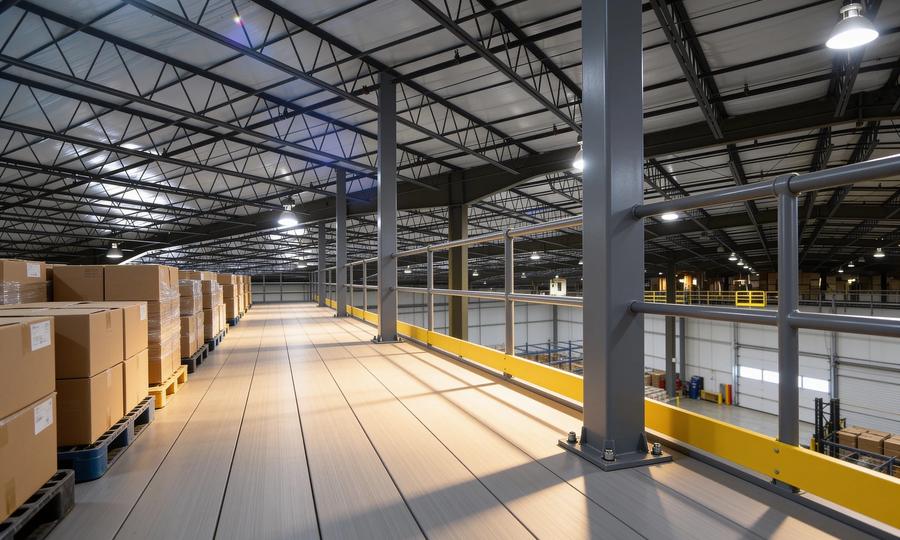
Engineering
Resin deck for mezzanines: ResinDek and its alternatives, honestly compared
ResinDek is an engineered wood fiber composite, not structural OSB — and its load tables carry footnotes that change the numbers. What the specs say, and where steel still wins.
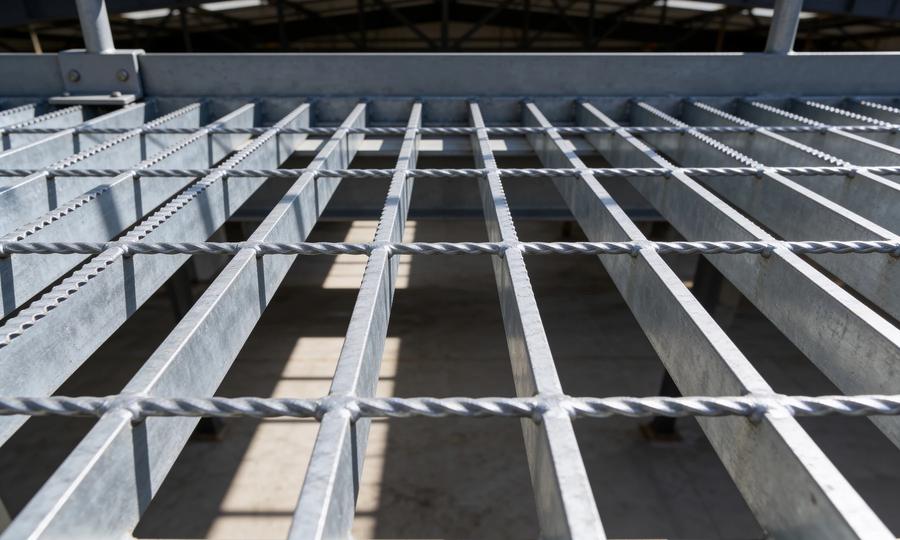
Engineering
Bar grating mezzanine: load specs, open area, and when to choose it
Steel bar grating decks a mezzanine at 7–14 psf dead load while carrying hundreds of psf live — and lets light, air, and sprinkler spray through. The NAAMM specs, real load-table numbers, the ADA catch, and when grating beats a solid deck.