

Mezzanine Load Capacity: PSF Ratings & Point Loads
Understand mezzanine PSF ratings, uniform live loads and point loads. Use documented ratings, prepare a load brief and avoid unsupported capacity assumptions.
Editorial

A mezzanine's usable load capacity comes from its approved design and actual condition, not from a generic PSF table. A uniform live-load rating describes distributed loading over a stated area. It does not, by itself, approve a forklift wheel, pallet-rack post or machine foot at a particular location.
Correction — October 6, 2026: We removed unsupported universal forklift ratings, wheel-load ranges, overload “reserve” factors, retrofit prices and a claim that OSHA 1910.22 itself mandates capacity placards. The guide now separates documented ratings, simple arithmetic and the information needed for a project-specific review.
For a simple example, 125 pounds per square foot × 2,000 square feet = 250,000 pounds uniformly distributed. Those numbers illustrate multiplication only. They do not establish that a particular floor has that rating, that the whole area has the same rating, or that the weight can be concentrated into a few pallets. The load calculator now requires documented inputs and makes those limits explicit.

What are the three types of mezzanine loads?
Keep live load, permanent load and concentrated loading distinct in the project brief. The terms answer different questions: what the floor is used for, what is permanently part of the assembly, and where forces enter it. Ask the designer how each appears in the approved calculations and operating limits.
Live load (uniform, variable)
A uniform live-load rating is often expressed in pounds per square foot, abbreviated PSF. It is not a universal rating shared by everything sold as a mezzanine. FCP's guide specification directs the specifier to determine the live-load requirement from the project occupancy, with other design criteria tied to the project location. FCP specification, section 2.1.
Record whether the number on a drawing is a design input, an approved operating rating or something else. Use the matching area and stated loading arrangement. Do not replace an unknown rating with an internet example, even when the example looks similar to your installation.
Dead load (permanent, fixed)
Permanent structural and floor components also matter to the design. Tell the designer about the actual deck build-up and additions such as fixed partitions or equipment. Avoid using a generic pounds-per-square-foot allowance for a floor assembly whose materials and dimensions have not been confirmed.
Do not subtract an assumed dead load from a documented live-load rating. Conversely, do not relabel an ambiguous “total load” number as a live-load rating. Ask the responsible designer to explain what the documented number includes. Our calculator does neither conversion; it simply multiplies the live-load rating supplied by the reader by its corresponding area.
Point loads (concentrated)
A wheel, post or machine foot introduces force through a limited contact area. Its location and contact arrangement belong in the brief alongside the distributed load. PortaFab's public questionnaire separates uniform loading, point loading and pallet-jack information rather than treating them as one interchangeable field. PortaFab project questionnaire.
| Information | Record it as | Do not replace it with |
|---|---|---|
| Uniform live-load rating | Documented PSF and the area it covers | A supplier's example rating |
| Rack or machine support | Support reactions and positions | Total machine weight divided by the whole floor |
| Wheeled equipment | Actual loaded configuration and wheel/contact information | A generic wheel load from truck class alone |
| Permanent additions | Materials, dimensions and locations | An assumed “spare capacity” deduction |
How do engineers specify mezzanine load capacity?
The design needs the actual loading arrangement and supporting conditions. A buyer's role is to supply a complete brief, not select isolated load factors from a table. FCP's specification calls for project drawings showing framing, columns, decking and accessories, with design submittals where applicable. Its values are project specifications, not permission to reuse another installation's capacity.
Separate the elevated floor review from the supporting slab review. Cisco-Eagle explains that slab thickness alone does not establish building-floor capacity; underlying conditions and column reactions matter. It also distinguishes the mezzanine supplier's information from the purchaser's responsibility to verify the building support. Cisco-Eagle floor-capacity guidance.
Have the project team confirm the actual support arrangement and design basis. The column-spacing guide and slab guide provide background for that conversation. A different column layout is not a cosmetic substitution in a comparison of two proposals.
What is the most common mezzanine load-spec mistake?
A practical mistake to avoid is treating a uniform rating as approval for a new concentrated load. We do not have a verified industry-wide frequency dataset, so this heading should not be read as a statistical ranking of failure causes.
Consider a hypothetical change from hand-stacked cartons to a rack or production machine. The important new information includes support positions, reactions and the intended layout, not merely the total weight of goods on the floor. A higher uniform number on another quotation does not establish that the new arrangement is suitable.
Do not assume that adding a steel plate, reinforcing a joist or relocating a post is an approved remedy. Get a documented review of the proposed change. This guide offers no generic retrofit price, capacity-upgrade percentage or self-directed repair instruction.

How do you spec mezzanine live load capacity correctly?
Prepare an evidence-backed load brief and have the designer determine the requirements. Our printable project checklist helps organize the conversation. Include the current use and any specific planned change; do not claim to have assessed every possible future operation.
- Identify the floor or zone and its drawing revision. Attach the existing approved documents where available.
- Describe stored goods, staffing, equipment and how the area will actually be used.
- Obtain equipment and rack data from their suppliers, including loaded configurations and support/contact details.
- Mark locations, travel paths and proposed changes on the same layout sent to the mezzanine designer.
- Identify missing information explicitly and record who will resolve it before the affected use begins.
The floor-plan guide helps put those inputs in context. For proposals, use the buying guide to align responsibilities and scope rather than choosing a design from the lowest headline rate.
For a forklift, its carrying capacity is a limit on the truck, not a mezzanine-floor certification. OSHA's industrial-truck rules address the truck's rated load at 1910.178(o)(2); that does not supply an allowable floor PSF. OSHA 1910.178. Give the project team the actual truck and load information instead of selecting a universal “forklift minimum.”
Does a mezzanine load rating need to be posted?
Check the applicable posting requirements; do not attribute a blanket placard rule to OSHA 1910.22. Its load provision requires walking-working surfaces to support the maximum intended load. That provision does not itself state a universal placard requirement. OSHA 1910.22(b).
Ask the project designer and site safety team how approved limits must be communicated under local rules and the installation's documents. Keep those records accessible and resolve missing or conflicting ratings. A sign with an unverified number is not a substitute for establishing what the structure can support.
What happens if you exceed a mezzanine's load rating?
Do not treat a design safety factor as permission to exceed the approved limit. This guide cannot predict a safe overload amount, the onset of damage or the remaining strength of an existing floor. It no longer publishes an assumed reserve multiplier or a blanket insurance-coverage conclusion.
OSHA 1910.22(d) calls for inspections as needed, correction or guarding of hazardous conditions, and qualified involvement when structural integrity is affected. It does not prescribe a universal annual-only inspection interval. Bring suspected damage, overloading or an unapproved change to the responsible safety and engineering professionals; do not use this article to justify continued affected use.
For maintenance planning, consult the installation's records and the inspection guide. This article is a source-based planning reference, not an assessment of your structure or a named engineer's review.
What to read next
Put this guide into practice
Frequently asked questions
- How much weight can a mezzanine floor hold?
- Use the documented rating, applicable area, loading arrangement and condition of the actual floor. A generic PSF example does not establish capacity. Wheels, rack posts and machine feet need separate consideration.
- How do I calculate pounds from PSF?
- Multiply a documented uniform live-load rating by its corresponding area. As arithmetic only, 125 psf times 2,000 sq ft equals 250,000 pounds uniformly distributed. It does not authorize concentrated loading or verify a structure.
- What PSF rating allows a forklift on a mezzanine?
- This guide specifies no universal forklift PSF minimum. Supply the actual truck, loaded configuration, wheel/contact information and travel layout for a project-specific review.
- Can I use a safety factor as extra load capacity?
- No. Do not treat design safety factors as permission to exceed an approved limit. A suspected overload, damage or changed use needs review by the responsible safety and engineering professionals.
- Should I subtract dead load from a live-load rating?
- Do not subtract an assumed dead load from a documented live-load rating. Ask the designer to clarify what the recorded rating includes rather than converting an ambiguous total-load figure yourself.
Last substantive revision —
Continue planning your mezzanine
All Engineering guides →
Engineering
Is my slab strong enough for a mezzanine? Slab requirements explained
Evaluate mezzanine slab requirements using column reactions, concrete records, scanning and core tests. Learn what each check establishes before installation.

Engineering
Can a forklift drive on a mezzanine? Designing for forklift access
A mezzanine rated 125 psf can still fail under one forklift wheel. Why concentrated wheel loads — not the PSF average — govern, which decks take forklift traffic, and how ramps and VRCs get the truck up there safely.
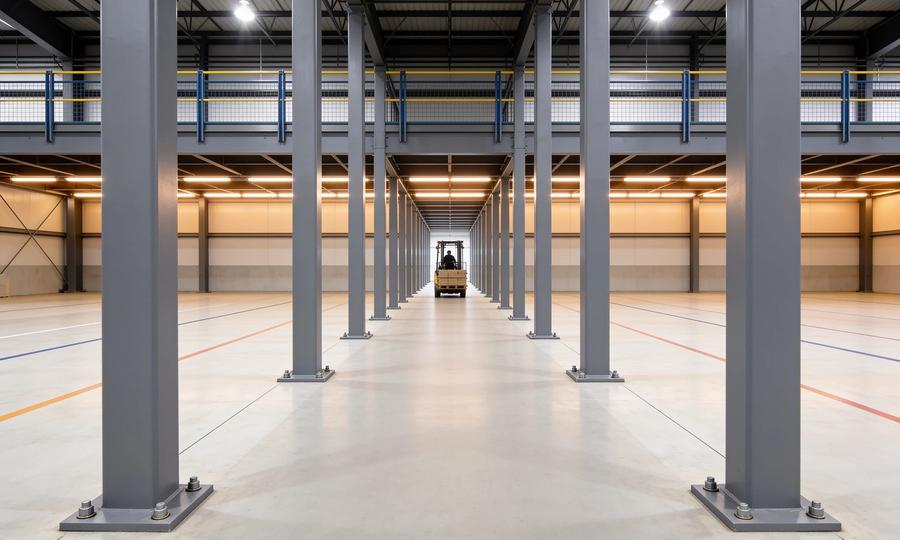
Engineering
Mezzanine column spacing, spans, and layout: designing the grid under your deck
Mezzanine columns typically land on 8–25 ft grids, with 14×14 ft the largest standard spacing at 125 psf and clear spans to 40 ft possible. How the grid, bracing, and forklift aisles get reconciled.