

40+ mezzanine and industrial storage statistics (2026)
The reference list: 40+ sourced statistics on mezzanine costs, industrial real estate, warehouse labor, steel prices, e-commerce demand, and safety — every number linked to its primary source. Updated July 2026.
Editorial

Every number on this page comes from a named primary source published in 2024–2026, linked inline. We refresh this page quarterly; the Last updated stamp reflects real revisions. Cite freely with attribution.
The five numbers that frame the entire industrial-space conversation in 2026:
- Warehouses typically use only 22–27% of their vertical (cubic) space (iGPS)
- New industrial leases cost $0.94/sq ft more than in-place rents (CommercialEdge, May 2026)
- E-commerce needs ~1.2M sq ft of logistics space per $1B in online sales — 3x brick-and-mortar retail (Prologis Research)
- A mezzanine adds floor at $50–150/sq ft vs $85–200/sq ft turnkey new construction (Safety Source, 2026; National Steel Buildings, 2026)
- Fall protection has been OSHA's #1 citation for 15 straight years (OSHA FY2025)
Mezzanine market and cost statistics
- The global mezzanine floor market is valued at $8.4 billion in 2026, projected to reach $13.7 billion by 2033 (7.2% CAGR). (Persistence Market Research, 2026)
- Alternate estimates span $7.9 billion (Research and Markets, 2025, 5.8% CAGR to 2034) to $16.1 billion (Market Research Future, 2025, 7.3% CAGR) — scope and methodology differ; treat as a range.
- A typical industrial mezzanine costs about $70 per square foot installed in 2026, within a $50–150 range. (Safety Source, 2026)
- Structural steel mezzanines typically run $35–65 per square foot per manufacturer Panel Built. (Panel Built)
- Basic steel mezzanines run $30–60/sq ft, heavy-duty systems $60–100/sq ft, with installation adding $2–10/sq ft. (Allied Modular, 2025)
- Typical mezzanine lead times: 4–6 weeks for small-to-medium projects, 10–12 weeks for large engineered projects including permitting. (Warehouse Optimizers)
- The global material handling equipment market was worth $261.7 billion in 2025, projected to reach $489.7 billion by 2034. (Fortune Business Insights)
- The global pallet racking market was worth $12.9 billion in 2025, heading to $22.5 billion by 2034 (6.5% CAGR); North America holds a 37.1% share. (Fortune Business Insights)
US industrial real estate statistics
- US industrial vacancy in Q1 2026: 6.7% per CBRE, 7.0% per Cushman & Wakefield, 7.5% per JLL.
- Cushman & Wakefield declared "peak vacancy likely in the rearview mirror" in April 2026 — vacancy sat 10 bps below its Q3 2025 peak. (Cushman & Wakefield)
- Q1 2026 net absorption rebounded to 43.1 million sq ft, the strongest first quarter since 2023. (CBRE)
- NAIOP forecasts 345.9 million sq ft of full-year 2026 absorption — more than double 2025's 168.3 msf. (NAIOP)
- New construction completions fell to ~55 million sq ft in Q1 2026 — down 27% year-over-year, the lowest quarterly total since mid-2017. (CBRE; Cushman & Wakefield)
- Average US industrial asking rent: $10.20/sq ft/yr in Q1 2026, with annual growth accelerating to 2.1%. (Cushman & Wakefield)
- In-place rents averaged $9.12/sq ft in May 2026, while newly signed leases averaged $10.06 — a $0.94 premium for moving. (CommercialEdge)
- Most expensive US industrial markets by in-place rent: Orange County, CA ($17.71/sq ft), Miami ($13.73), Inland Empire ($12.42). (CommercialEdge, May 2026)
- US industrial sale prices averaged $139/sq ft through May 2026, on $31.5 billion in transactions. (CommercialEdge)
- Canada: industrial availability held at 5.5% in Q1 2026 with average net asking rent of C$14.91/sq ft and absorption nearly double the 3-year average. (CBRE Canada)
- 89% of large US warehouses built since 2011 have clear heights of 28–36 feet, and new e-commerce facilities increasingly reach 40 ft — vertical space is the fastest-growing dimension of the industrial market. (CBRE via Logistics Management)
Space utilization statistics
- Typical warehouse cubic (vertical) space utilization is just 22–27% — roughly three-quarters of air space goes unused. (iGPS)
- High-density and automated storage systems can push cubic utilization to 60–80%+. (Hopstack)
- Relocating a larger warehouse typically takes 6–12 months from lease signing to completed move. (F. Curtis Barry & Co.)
- Warehouse construction costs $85–200/sq ft turnkey in 2026; a mezzanine adds equivalent floor area at $50–150/sq ft in 2–6 weeks — see the full three-way comparison.
E-commerce and fulfillment demand statistics
- US e-commerce sales hit $326.7 billion in Q1 2026, up 9.8% year-over-year — 16.9% of total retail. (US Census Bureau)
- E-commerce grew 2.5x faster than total retail in Q1 2026 (9.8% vs 3.9%). (US Census Bureau)
- Full-year 2025 US e-commerce totaled roughly $1.23 trillion (computed from the Census Bureau's four adjusted quarterly figures). (US Census Bureau, Table 1)
- E-commerce requires ~1.2 million sq ft of logistics space per $1 billion in online sales — about 3x the footprint of store-based retail. (Prologis Research)
- 2025 US holiday-season online sales reached $257.8 billion, up 6.8% year-over-year. (Digital Commerce 360)
- The global 3PL market reached an estimated $1.26 trillion in 2025, with forecasts to $4.3 trillion by 2035. (Grand View Research; GMI)
Warehouse labor statistics
- US warehousing and storage employed about 1.86 million workers in 2024. (BLS via Red Stag)
- Warehousing employment peaked at 1,942,200 in May 2022 after growing 34% from February 2020. (BLS/FRED via ISCRO)
- The number of US warehousing establishments grew 73% between 2001 and 2023. (BLS QCEW via ISCRO)
- The national average annual warehousing wage was $51,865 in 2023; the median wage for hand laborers and material movers was $37,680 in May 2024. (BLS)
- BLS projects ~1,008,300 annual job openings for hand laborers and material movers through 2034. (BLS Occupational Outlook Handbook)
- 45% of supply chain leaders plan to buy automation equipment within three years; 83% predict robotics adoption within five. (MHI Annual Industry Report 2025)
- The global warehouse automation market is forecast to reach $55 billion by 2030 (15% CAGR). (LogisticsIQ)
Steel and construction cost statistics
- Hot-rolled coil steel stood at $1,130–1,160 per ton in early July 2026, after 23 consecutive weekly increases earlier in the year totaling $380/ton. (Steel Market Update)
- The Turner Building Cost Index rose 4.87% year-over-year to 1530 in Q1 2026. (Turner Construction)
- Mortenson's index shows nonresidential construction costs up 6.77% over twelve months, with tracked materials up 7.0%. (Mortenson, Q1 2026)
- US industrial construction averages $139/sq ft for small projects, $85 for medium, $77 for large. (Cushman & Wakefield Industrial Construction Cost Guide)
- Tariffs pushed steel prices up 17% and aluminum up 30%+ in 2025, adding an estimated 4–8% to import-heavy construction budgets. (Brown Integrated Logistics)
Safety and compliance statistics
- 5,070 US workers died from fatal work injuries in 2024 (3.3 per 100,000 FTE), down 4.0% from 2023. (BLS CFOI)
- Fatal falls, slips, and trips killed 844 workers in 2024; falls to a lower level accounted for 725 deaths in 2023. (BLS CFOI)
- Fall protection (29 CFR 1926.501) was OSHA's most-cited standard for the 15th consecutive year in FY2025, with 5,914 violations. (OSHA)
- OSHA maximum penalties as of January 2026: $16,550 per serious violation, $165,514 per willful or repeated violation. (OSHA)
- Warehouses recorded 4.8 injuries per 100 full-time workers in 2024 — more than double the 2.3 all-industry private average. (BLS SOII)
- Transportation and warehousing recorded 930 worker deaths in 2023, among the highest of any sector. (BLS CFOI via Voxel)
For what these numbers mean for a specific project: mezzanine cost per square foot, OSHA mezzanine requirements, and the free cost calculator.
Methodology and citation policy
Every statistic links to its source inline; nothing on this page is estimated by us, and the two computed figures (2025 e-commerce annual total) are labeled as computed. Where major trackers disagree (vacancy rates, market sizes), we show each figure with its source rather than averaging. This page is published by The Mezzanine Experts, a Cogan company — full disclosure here. To cite: "Source: The Mezzanine Experts, Mezzanine & Industrial Storage Statistics 2026" with a link to this page.
What to read next
- Mezzanine vs warehouse expansion vs relocation: the 2026 cost comparison — the statistics applied to a decision
- Mezzanine cost per square foot in 2026 — the pricing deep-dive
- OSHA requirements for mezzanines — the compliance side of the safety numbers
Put this guide into practice
Frequently asked questions
- How much of a warehouse's vertical space is typically used?
- Industry benchmarks put typical warehouse cubic (vertical) space utilization at just 22–27%, meaning roughly three-quarters of the air space above the floor goes unused. High-density and automated systems can push utilization to 60–80% or more.
- How big is the mezzanine floor market?
- Published 2025–2026 estimates range from $7.9 billion to $16 billion globally depending on scope and methodology, with forecast growth rates of 5.8–7.3% annually through the early 2030s across the three major research firms tracking the market.
- What is the US industrial vacancy rate in 2026?
- Between 6.7% and 7.5% in Q1 2026 depending on the tracker: CBRE reports 6.7%, Cushman & Wakefield 7.0%, and JLL 7.5%. Cushman & Wakefield declared peak vacancy 'likely in the rearview mirror' as demand recovers and new supply slows.
- How much does warehouse space rent for in 2026?
- The national average industrial asking rent was $10.20 per square foot per year in Q1 2026 per Cushman & Wakefield, with newly signed leases averaging $0.94 more per square foot than in-place rents — a quantifiable premium for moving instead of optimizing existing space.
- What is OSHA's most-cited safety violation?
- Fall protection (29 CFR 1926.501) — OSHA's most-cited standard for 15 consecutive years, with 5,914 violations in FY2025. Willful or repeated violations now carry maximum penalties of $165,514 each as of January 2026.
Continue planning your mezzanine
All Complete Guide guides →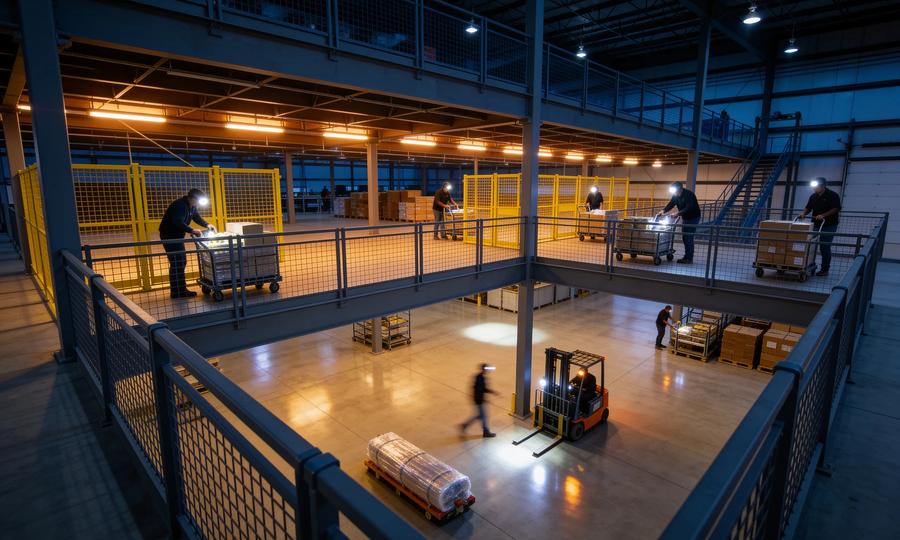
Complete Guide
Warehouse Mezzanine Floors: Storage, Layout & Costs
Plan a warehouse mezzanine floor for storage, picking, packing or offices. Compare layouts, material flow, project examples and the scope of supplier quotes.
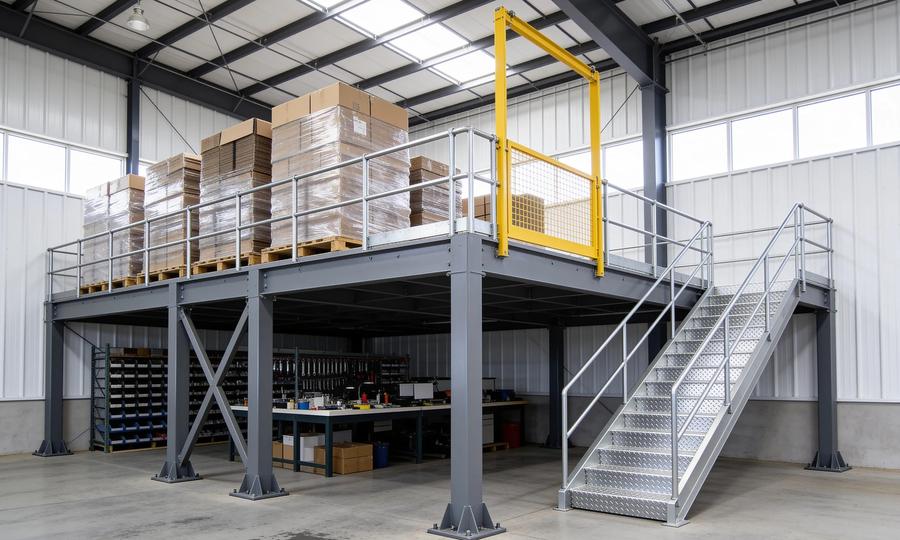
Complete Guide
What Is a Mezzanine Floor? Meaning, Types & Uses
What is a mezzanine floor? Learn its meaning, industrial types and warehouse uses, then compare flooring, material lifts and the questions to ask before buying.
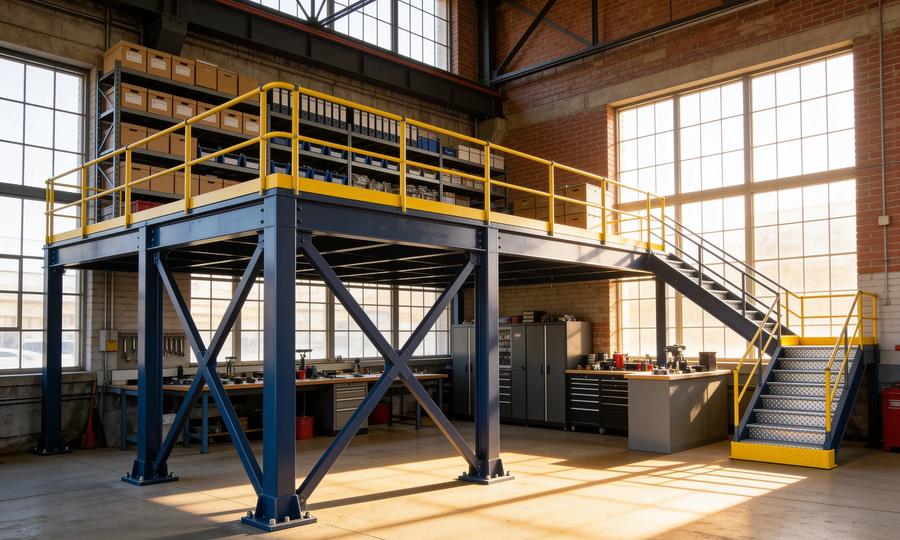
Engineering
Free-standing vs rack-supported vs structural mezzanines: a buyer's decision framework
The three structural types of industrial mezzanine — free-standing, rack-supported, and structural — solve different problems. Here's how to pick the right one based on use case, flexibility, cost, and code path.