

Mezzanine vs work platform vs catwalk: the legal and practical differences
These three structures look similar but are treated very differently by building codes, OSHA, and tax law. Picking the wrong category can cost you permits, tax benefits, and code compliance.
Editorial
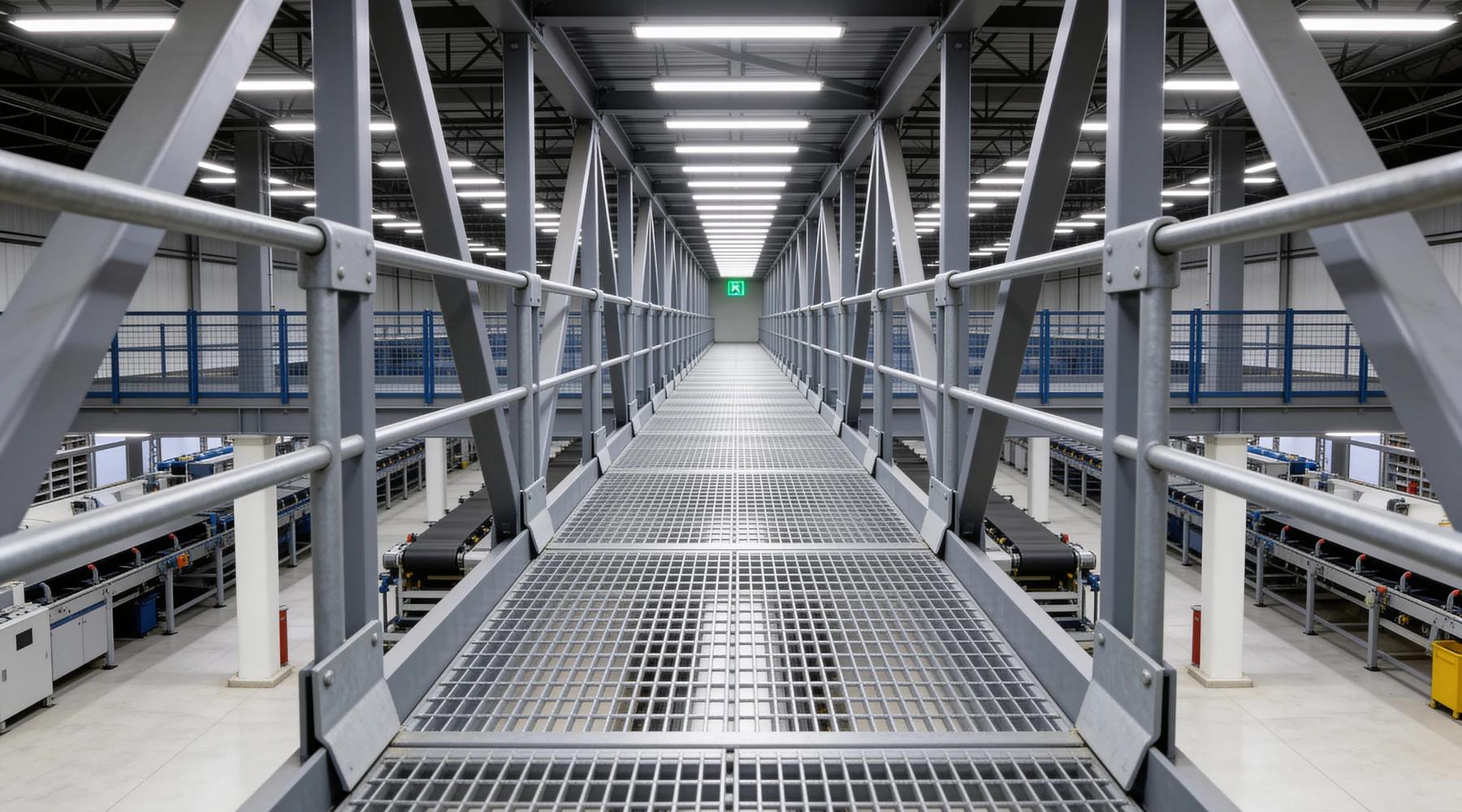
The terms mezzanine, work platform, and catwalk get used interchangeably in conversation, but they describe three structurally and legally distinct things. The differences drive code requirements, permitting timelines, tax treatment, and resale value.
Use the wrong label on a permit application and you'll get bounced. Use the wrong category for tax depreciation and you'll lose meaningful deductions.
What's the difference between a mezzanine, a work platform, and a catwalk?
A mezzanine adds usable floor area to the building; a work platform provides access to specific equipment; a catwalk is a narrow walkway for access between points. Mezzanines are building elements under IBC §505 — platforms and catwalks are equipment.
| Structure | Primary purpose | Permanence | Code category |
|---|---|---|---|
| Mezzanine | Adds usable floor area to the building | Permanent or semi-permanent | Building element (IBC §505) |
| Work platform | Provides access to specific equipment | Equipment, removable | Equipment (case-by-case) |
| Catwalk | Narrow walkway for access between points | Equipment, removable | Equipment (OSHA 1910.28/29) |
The driving question is what is the structure for? Floor area for general use → mezzanine. Access to specific equipment → platform or catwalk.
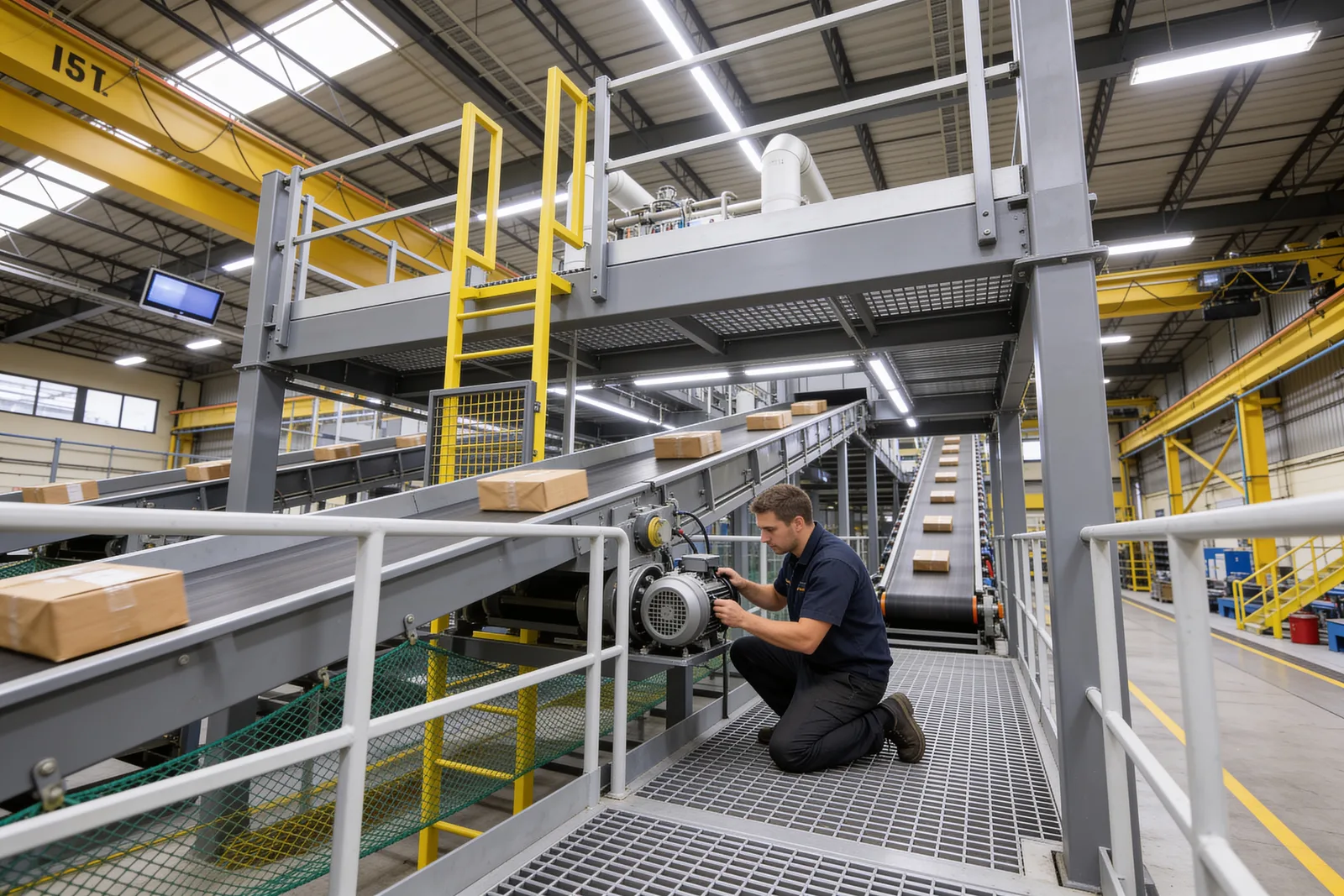
What counts as a mezzanine?
A mezzanine is an intermediate floor that adds general-purpose space. It can support storage, work areas, offices, or production. It's treated as a building element under IBC §505.2.
Key characteristics:
- Floor area not exceeding one-third of the room (one-half or two-thirds with sprinkler/special exceptions)
- 7 feet of clear height above and below
- Open to the room below (or specific egress exceptions)
- Permanent or semi-permanent installation
Code path: Building permit required. Plans reviewed for area, height, egress, fire protection, structural design. Inspections at foundation, structure complete, and finals.
Tax treatment: Typically classified as a building improvement, depreciated over 39 years (commercial nonresidential real property). Less favorable than equipment.
What is a work platform (equipment platform)?
A work platform — sometimes called an equipment platform under IBC §505.3 — provides access to or supports specific equipment. The distinguishing feature is that the platform serves the equipment, not general occupancy.
Key characteristics under IBC §505.3:
- Not for use as general storage or for human occupancy beyond servicing the equipment
- Aggregate area cannot exceed two-thirds of the room area
- Maintenance and inspection access only — not a primary work area
Common examples:
- Mezzanines built around HVAC units for service access
- Platforms supporting batching equipment, conveyors, packaging lines
- Maintenance walkways around tanks, pipes, or process equipment
Code path: Often permitted as equipment rather than a building element, which can mean simpler permit review and faster timeline. The threshold is whether the AHJ accepts the equipment-platform classification — they may insist on the full mezzanine path if usage looks like a general work area.
Tax treatment: When properly classified as equipment, can be depreciated over 7 years (MACRS class life for industrial equipment) instead of 39 years for buildings. On a $100,000 platform, that's a tax timing difference worth $20,000–$40,000 in present value depending on the depreciation method and tax rate.
What is a catwalk?
A catwalk is a narrow walkway — typically 24–48 inches wide — used for access between points or to inspect/maintain equipment. Catwalks are clearly equipment, not building structure.
Key characteristics:
- Narrow (usually no more than 4 feet wide)
- Linear function — getting from point A to point B, not a work area
- Always classified as equipment
- OSHA 1910.28 and 1910.29 apply (workplace safety, fall protection, railings)
Common examples:
- Maintenance access along the top of long conveyor lines
- Inspection walkways around large tanks or process vessels
- Roof-access walkways between equipment
Code path: Usually doesn't require a building permit — the structure is treated as equipment. OSHA fall-protection requirements still apply: 42-inch guardrails, toe boards, secure footing, etc.
Tax treatment: Equipment depreciation, same advantage as work platforms.

The grey area: when is it a mezzanine vs a platform?
The honest answer: the AHJ decides, not you. But there are practical indicators.
A structure is likely a mezzanine if:
- People work on it in a general capacity (workstations, offices, assembly)
- It carries general storage (boxes, materials, not just spare parts for the equipment below)
- Its area exceeds 10–15% of the room — sufficient that an AHJ sees it as adding floor area
- It's enclosed or walled
A structure is likely an equipment platform if:
- Its only function is access to specific equipment for operation or service
- Occupants on it are servicing or operating that equipment, not doing general work
- It's open and obviously supplementary
- Its usage is intermittent (maintenance crews, not full-time workers)
The IBC §505.3 limit of two-thirds room area is generous, but most AHJs will push back if a "platform" looks like a full mezzanine in everything but name.
Why does the mezzanine vs platform classification matter?
Three concrete costs ride on the classification: permit cost and timeline, sprinkler requirements, and tax depreciation — where the 7-year vs 39-year MACRS difference alone can be worth tens of thousands of dollars in present value.
-
Permit cost and timeline. Mezzanine permits typically take 2–8 weeks in most jurisdictions. Equipment platforms, when accepted as equipment, can sometimes be permitted in 1–2 weeks or treated as no permit required (subject to AHJ).
-
Sprinkler requirements. Mezzanines often trigger sprinkler additions both above and below the deck. Equipment platforms with limited human occupancy may not — depending on the building's existing sprinkler design and the occupancy classification.
-
Tax depreciation. As above, the 7-year vs 39-year MACRS treatment difference can be worth tens of thousands of dollars in present value on a meaningful installation. Talk to your accountant before you finalize the classification.
A decision checklist
Before designing or quoting, answer:
- What's the primary use? General work/storage = mezzanine. Equipment access = platform or catwalk.
- How wide is it? Narrow linear = catwalk. Larger area = mezzanine or platform.
- What's the occupancy? Full-time workers = mezzanine. Intermittent maintenance crews = platform/catwalk.
- Is it permanent or removable? Bolt-down equipment = platform. Welded into structure = mezzanine likely.
- Will AHJ accept the equipment classification? Ask before designing.
- What's the tax accounting impact? Run the depreciation math both ways.
Getting this right at the design stage costs hours. Getting it wrong costs months of permit re-review and lost tax benefit.
What to read next
- The IBC 2024 mezzanine requirements explained in plain English — full code walkthrough
- OSHA requirements for mezzanines: railings, gates, and egress — workplace safety overlay
- What is an industrial mezzanine? Types, uses, and when you need one — foundational overview
- Warehouse catwalks: what code actually calls them — the catwalk classification and egress path in depth
- Manufacturing mezzanines: machine loads, occupancy rules and clearances — what changes once a production process runs on or under the deck
- Mezzanine depreciation: building or equipment? — what the IRS audit guide and the L.L. Bean case actually say about the tax classification
- Industrial work platforms under the 2024 IBC — what the new Sections 2212 and 2213 actually say, and why "work platform" and "equipment platform" are not the same code term
Put this guide into practice
Frequently asked questions
- What is the difference between a mezzanine and a work platform?
- A mezzanine adds general-purpose floor area — storage, work areas, offices — and is treated as a building element under IBC 505.2. A work platform (equipment platform under IBC 505.3) exists to access or support specific equipment, is not for general storage or occupancy beyond servicing that equipment, and is often permitted as equipment instead.
- Do catwalks require a building permit?
- Usually not — catwalks are treated as equipment rather than building structure, so a building permit typically isn't required. OSHA fall-protection requirements still apply under 1910.28 and 1910.29, including 42-inch guardrails, toe boards, and secure footing. Catwalks are narrow walkways, typically 24–48 inches wide, for access between points or equipment inspection.
- How is a mezzanine depreciated for tax purposes?
- A mezzanine is typically classified as a building improvement and depreciated over 39 years as commercial nonresidential real property. A structure properly classified as an equipment platform can instead be depreciated over 7 years under MACRS — on a $100,000 platform, a tax timing difference worth $20,000–$40,000 in present value.
- When does a work platform become a mezzanine in the eyes of the code?
- The AHJ decides. A structure is likely a mezzanine if people work on it in a general capacity, it carries general storage, its area exceeds 10–15% of the room, or it's enclosed. It's likely an equipment platform if its only function is access to specific equipment and usage is intermittent.
- How long does a mezzanine permit take compared with an equipment platform?
- Mezzanine permits typically take 2–8 weeks in most jurisdictions. Equipment platforms, when the AHJ accepts the equipment classification, can sometimes be permitted in 1–2 weeks or treated as requiring no permit at all — one of the main practical reasons the classification matters.
Last substantive revision —
Continue planning your mezzanine
All Complete Guide guides →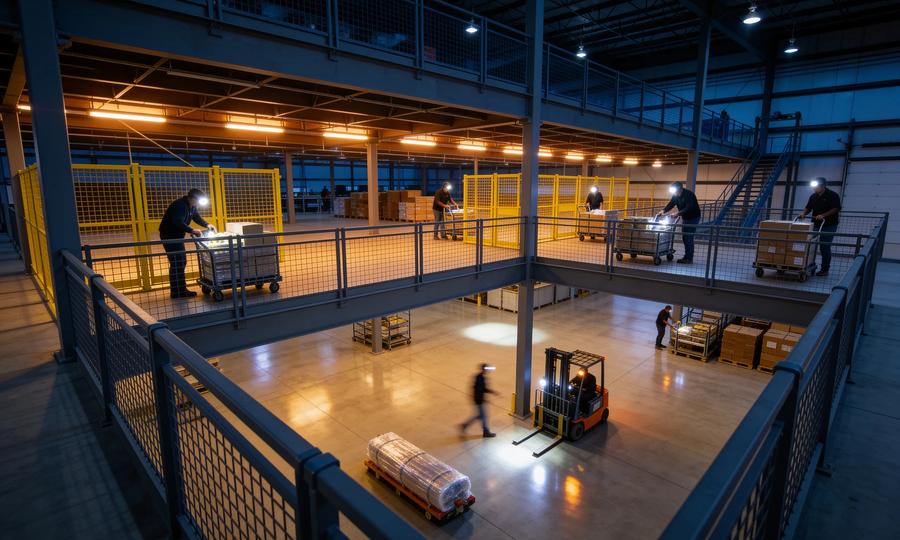
Complete Guide
Warehouse Mezzanine Floors: Storage, Layout & Costs
Plan a warehouse mezzanine floor for storage, picking, packing or offices. Compare layouts, material flow, project examples and the scope of supplier quotes.
Complete Guide
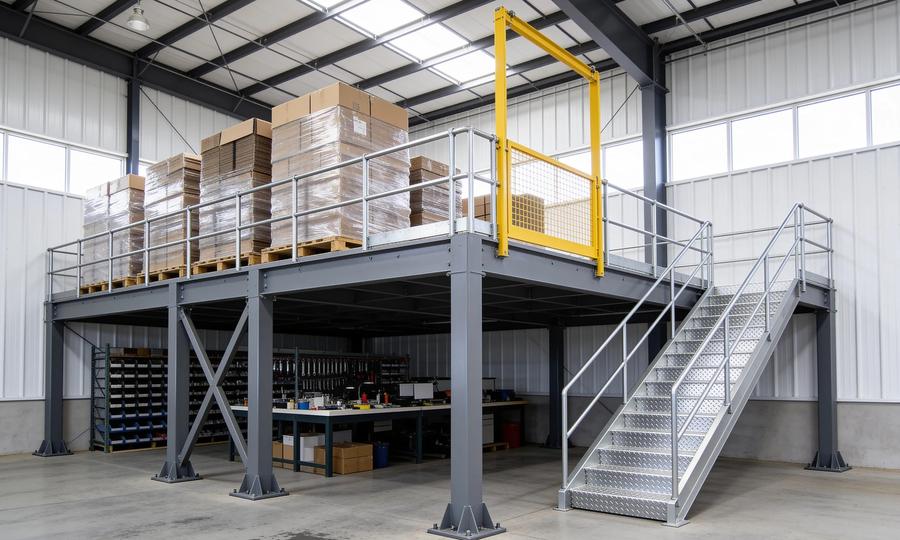
What Is a Mezzanine Floor? Meaning, Types & Uses
What is a mezzanine floor? Learn its meaning, industrial types and warehouse uses, then compare flooring, material lifts and the questions to ask before buying.
Engineering
Free-standing vs rack-supported vs structural mezzanines: a buyer's decision framework
The three structural types of industrial mezzanine — free-standing, rack-supported, and structural — solve different problems. Here's how to pick the right one based on use case, flexibility, cost, and code path.