

Pick modules: how multi-level order-picking structures actually work
A pick module is a rack-supported structure where workers pick directly inside the racking. How its levels, carton flow lanes, and conveyors actually work.
Editorial
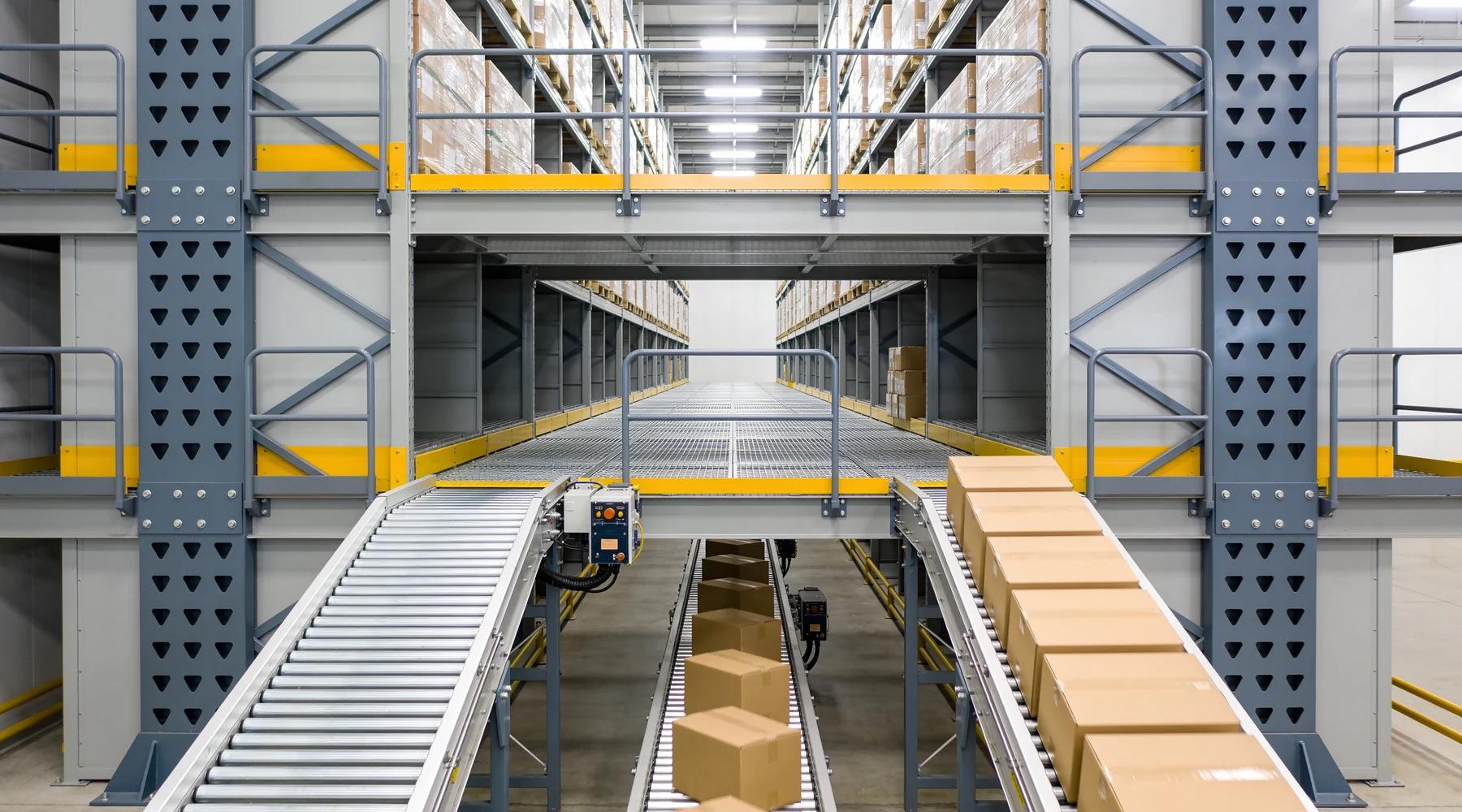
A pick module is what a warehouse builds when picking — not storage — is the bottleneck. It looks like a rack-supported mezzanine, and structurally it is one, but it is engineered around a different job: moving thousands of order lines a day out of the racking and onto a conveyor.
This article covers the pick module specifically — its anatomy, how work flows through it, what the deck is made of, and the standards that govern it. For the structural and cost picture of platforms built from racking, start with our pallet rack mezzanine guide; for the three-way structural choice, see free-standing vs rack-supported vs structural.
What is a pick module?
It's a rack structure with platform levels of flow bays feeding a central pick aisle. RMI's glossary defines a pick module as "A rack structure comprised primarily of vertical frames and horizontal beams, typically having one or more platform levels of selective, case-flow, or pallet-flow bays feeding into a central pick aisle(s)".
The structure is ordinary rack anatomy doing structural work. RMI defines the upright frame as "A structural assembly that transfers the vertical and horizontal loads to the floor" — in a pick module, those same frames carry the platform, the conveyor, and everything on them.
How is a pick module different from a rack-supported platform?
The difference is picking inside the rack, not just standing on top of it. RMI draws the line directly. A rack-supported platform "usually supports product storage, and sometimes assembly processes. Essentially, it's like a mezzanine, but made out of pallet racking. It's constructed from rack uprights and beams with flooring added to the higher levels".
A pick module is a variation on that, aimed at fulfillment: "pallets of products are stored up high and accessed from a platform for picking. Employees break down pallets into smaller quantities by picking directly inside the racks" — and workers "then send the case picks to outbound shipping via a conveyor".
So: a platform is elevated floor space. A pick module is an order-fulfillment machine that happens to be made of rack.
How many levels does a pick module have?
One to four, in the engineered mainstream. UNARCO states that "Engineered multi-level Pick Modules can be from one to four levels high," integrating pallet flow, carton flow, push back, and conveyor into one system. Rack.ca describes "Single-, double-, or triple-plus-level systems" with a typical head clearance of 84 inches and a most-common aisle width of 48 inches. Automation pushes it further: RMI notes it "can allow the operation to extend several levels high".
Frazier notes modules can "accommodate hundreds to thousands of SKUs", consolidating them to cut picker travel.
What's inside a pick module?
Storage that feeds a pick face, and conveyor that takes the picks away. Cisco-Eagle explains why the rack ends up doing the structural work: "many pick modules opt for rack support because they're storing pallets or inserting carton flow into the structure". The storage menu ranges "from carton flow to pallet flow to static pallet storage to cantilever"; the pieces, as published:
| Component | What it does |
|---|---|
| Carton flow | Full-case or piece picking; enforces rotation so the freshest product presents to the picker |
| Pallet flow | Full-case picking, lanes "from a couple of pallets to 5-plus pallets deep" |
| Takeaway conveyor | Sits between aisles so workers "pick their portion of an order" into totes or cartons |
| Spiral conveyor | "The throughput champion for vertical movement," in a tight footprint |
| VRC lift | Footprints "as small as 36″ x 36″", added to the side of a module |
| Incline conveyor | More economical than spirals; serves single- or lower-level modules |
Frazier's description is a useful reminder of what the steel actually carries: racking "engineered to safely support the weights from conveyor loads, pallet staging, shelving and handling equipment" — four load sources, not just product.
How does carton flow work?
Gravity moves product from a rear replenishment face to a front pick face, automatically. Carton flow systems "use gravity to move cartons, totes, or cases from the back of a rack to the pick face", per UNEX, and the mechanism is self-advancing: "As one carton is removed, the next automatically advances into position".
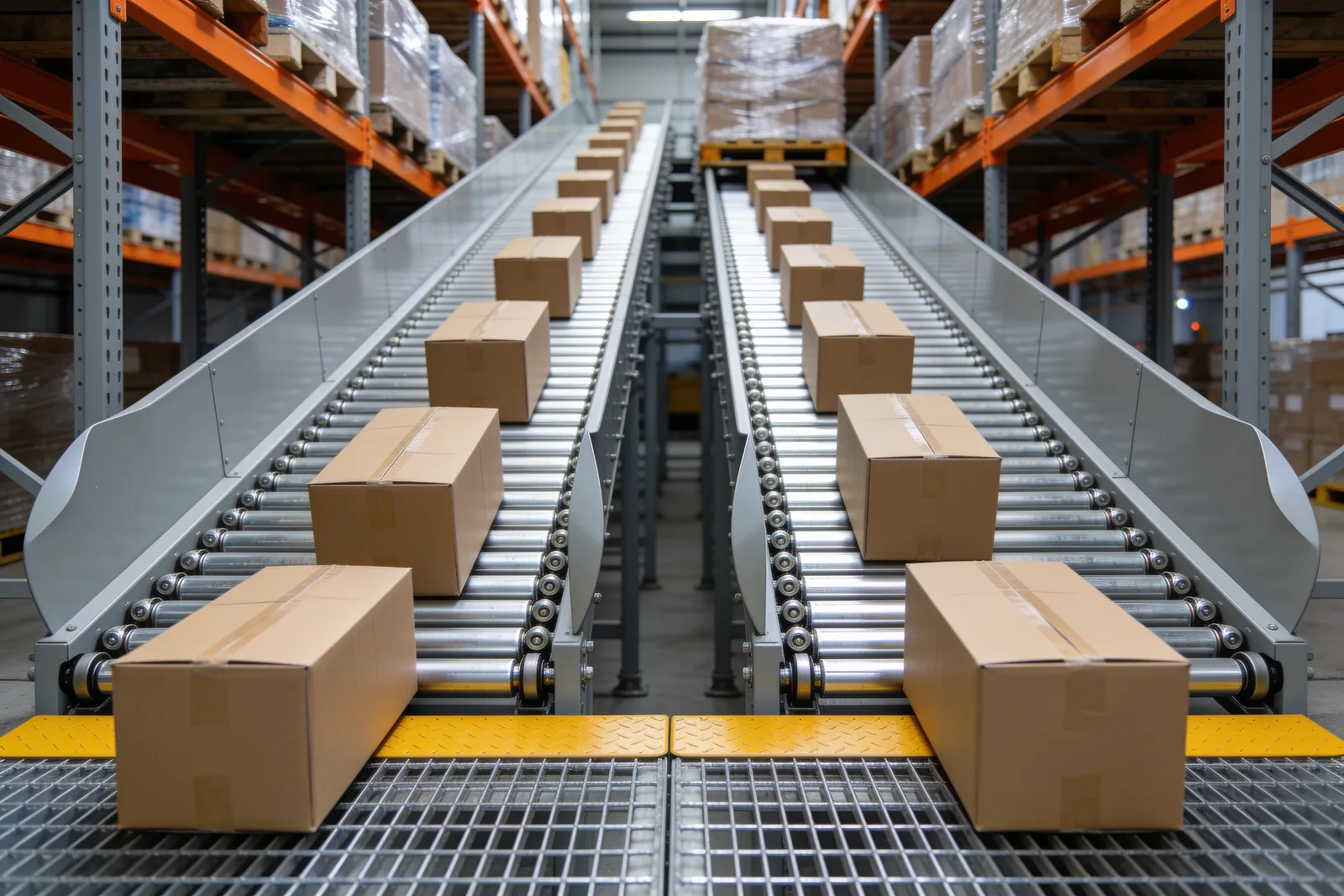
The bed type follows the SKU mix (UNEX): roller beds suit "uniform cartons with consistent dimensions," while "skate wheels arranged across the full width of the rack" handle "a wide mix of SKU shapes and sizes." Because the back-to-front sequence is physically enforced, carton flow also delivers "a First-In, First-Out (FIFO) inventory flow" — which matters where there are "expiration dates, lot tracking, or strict inventory rotation requirements."
The cost of that convenience is labor upstream. Cisco-Eagle is blunt: carton flow "requires effort to replenish, as pallets must be placed on the module, then broken down and segmented into the infeed side of the flow racks". Pallet flow replenishes more simply and stores deeper, but "pallet flow leaves an unguarded edge, which should be protected from fall risks" — a fall exposure created by the storage method itself.
What flooring goes in a pick module?
Bar grating unless something rolls on it. Cisco-Eagle's published trade-off is the clearest statement of the logic:
- Bar grating — for modules without wheeled transport. The open design allows light and air circulation between levels, and "Fire suppression systems can work between bar grate levels."
- Resin deck or plywood — lets you push carts on the elevated levels. "It's more comfortable to stand, work and walk on, but will require lighting, circulation and fire control on each level of the pick module." It also stops smaller items falling through toward lower levels.
- Steel decking — used "when activity on the level might abuse a wood or resin floor."
If carts roll, resin is the common answer, and the ratings are published: ResinDek's MD panel lists 3/4-inch thickness at 2.8 psf with an ASTM E-84 Class A fire rating, carrying pallet-jack rolling loads "up to 2,500 lbs (1135 kg) with 20 GA (0.9 mm) B-Deck" and up to 3,500 lbs on 18 GA. Our decking selector and decking options guide walk the full comparison.
How much weight does a pick module deck hold?
One published figure: 125 psf. Rack.ca states "The typical floor capacity is 125 pounds per square foot (psf)" — while noting "All systems are custom-designed and engineered."
Treat that as a starting point, not a spec. A pick module deck carries conveyor, staged pallets, shelving, and equipment simultaneously (Frazier), and the governing number is whatever your engineer stamps. See load capacity explained and the load calculator for how PSF classes map to real duty.
What standards govern a pick module?
ANSI MH16.1 §12.3 for the structure; ANSI MH32.1 for the stairs and guards; OSHA for the people. RMI states plainly that both pick modules and rack-supported platforms fall under ANSI MH16.1, section 12.3, with ANSI MH32.1 covering stairs, ladders, and guarding. MH32.1-2018 — "Stairs, Ladders, and Open-Edge Guards for Use with Material Handling Structures" — was developed jointly by RMI and the Storage Manufacturers Association.
RMI's published pick module stair specifications give the concrete numbers: stairway slope angles "can range from 30° to 50°"; headroom "80 inches at a minimum"; a single stairway without landings no taller than 20 feet; tread depth at least 7.5 inches; each stair able to withstand a concentrated point load of 300 pounds; and guarding at a minimum height of 42 inches that prevents a 21-inch-diameter sphere from passing through. Compare that against the building-code path in our mezzanine stairs requirements guide.

The people on those levels are covered by OSHA's general industry rules: fall protection on unprotected sides and edges "4 feet (1.2 m) or more above a lower level"; guardrails with a top edge at "42 inches (107 cm), plus or minus 3 inches (8 cm)" withstanding "a force of at least 200 pounds (890 N)"; toeboards at least "3.5 inches (9 cm)" high. A ladderway floor or platform hole needs a guardrail system and toeboards on all exposed sides, "except at the entrance to the hole, where a self-closing gate or an offset must be used" (1910.28(b)(3)(iv)).
RMI's worker-protection guidance adds kick-plates (so a dropped object cannot slide off the edge onto someone below), product fall barriers or netting, flooring "consistent and free of gaps or trip points," and ESD flooring near powered conveyor. MH16.1 itself, RMI notes, "details requirements for posting of design loads... in conspicuous locations within the structure."
Whether your structure is also classified as a mezzanine for building-code purposes — and what that means for permits and IBC area limits — is a determination for your engineer and your local authority. Check your jurisdiction in our permit guides.
What does a pick module actually buy you?
Vendors publish large numbers; treat them as vendor numbers. The most-cited framing comes from Frazier: "Picking accounts for an average of 63% of distribution time, and of that, 60% is spent traveling." Against that baseline, Frazier states pick modules "can cut travel time by up to 50% while reducing staffing requirements by one-third." UNARCO states engineered modules are "Capable of fulfilling over one hundred thousand orders per day."
Both are manufacturer marketing claims published without methodology or facility context. The underlying logic is uncontroversial — consolidating fast-movers into a dense vertical pick face shortens travel — but the percentages are the vendor's, not an independent measurement.
When is a pick module the wrong answer?
When the layout isn't settled. This is the honest constraint, and it follows from the structure: because the rack is the building, the picking layout and the structure are the same decision. Cisco-Eagle's published caution on rack-supported systems is that "Column quantity, placement and space footprint can be more limited. Vertical and cross-aisle expansion requires forethought and planning".
Damage makes that coupling concrete. When damage is found, RMI's instruction is to "unload the bays adjacent to the damaged frame. Then, tape off the area until the damaged upright is repaired or replaced" — and before it returns to service, "a registered design professional shall certify that the storage rack system and/or the repaired components have been restored to at least their original design capacity". On an ordinary rack run, a bent upright is a bay outage. In a pick module, that same upright may be carrying a platform and a conveyor.
If your SKU profile, order profile, and slotting are still moving, a free-standing platform keeps the floor below reconfigurable. If they're settled and the volume is real, the pick module is the denser machine. Builders publishing pick module capability include UNARCO, Frazier (100% structural steel), and Steel King — see our manufacturer comparison for the wider field.
What to read next
- Pallet rack mezzanines: how rack-supported platforms work — the structural and cost pillar behind pick modules
- Free-standing vs rack-supported vs structural mezzanines — the decision framework when flexibility matters
- Mezzanine decking options — grating, resin, and steel deck compared in full
- Wire mesh decking: capacity ratings and the fire-code rule — how the decking on the pick module's rack levels is rated, and why you can't walk on it
- Fulfillment center mezzanines: when the deck holds people, not pallets — the e-commerce case for the deck, and the occupancy and occupant-load questions it raises
Put this guide into practice
Frequently asked questions
- What is a pick module?
- The Rack Manufacturers Institute defines a pick module as a rack structure of vertical frames and horizontal beams, typically with one or more platform levels of selective, case-flow, or pallet-flow bays feeding into a central pick aisle. Workers pick directly inside the racking rather than simply storing product on a deck.
- What is the difference between a pick module and a rack-supported platform?
- A rack-supported platform is a decked working surface supported by the rack — essentially a mezzanine made of pallet racking, used for storage and sometimes assembly. A pick module is a variation on it built for order fulfillment: pallets are stored high, employees break them down by picking inside the racks, and conveyors carry the picks to shipping.
- How many levels does a pick module have?
- UNARCO states engineered multi-level pick modules run from one to four levels high, and that automation can extend an operation several levels. Rack.ca describes single-, double-, and triple-plus-level systems with a typical head clearance of 84 inches and a common 48-inch aisle width.
- What flooring is used in a pick module?
- It depends on what moves across it. Cisco-Eagle uses bar grating where there is no wheeled transport, because its open design allows light and air circulation between levels and fire suppression can work between grate levels. Resin deck or plywood lets you push carts, but will require lighting, circulation and fire control on each level. Steel decking is used where activity on the level might abuse a wood or resin floor.
- What standards govern a pick module?
- RMI states pick modules and rack-supported platforms are covered under ANSI MH16.1 section 12.3, with ANSI MH32.1 addressing stairs, ladders, and open-edge guards. Workers on the elevated levels are also covered by OSHA's general industry fall-protection rules. Confirm the classification and permitting path for your structure with your engineer and local authority.
Continue planning your mezzanine
All Complete Guide guides →
Complete Guide
Warehouse Mezzanine Floors: Storage, Layout & Costs
Plan a warehouse mezzanine floor for storage, picking, packing or offices. Compare layouts, material flow, project examples and the scope of supplier quotes.
Complete Guide
What Is a Mezzanine Floor? Meaning, Types & Uses
What is a mezzanine floor? Learn its meaning, industrial types and warehouse uses, then compare flooring, material lifts and the questions to ask before buying.
Engineering
Free-standing vs rack-supported vs structural mezzanines: a buyer's decision framework
The three structural types of industrial mezzanine — free-standing, rack-supported, and structural — solve different problems. Here's how to pick the right one based on use case, flexibility, cost, and code path.