

IBC 2024 Mezzanine Requirements: Area, Height & Egress
Review IBC mezzanine area, height, openness and egress requirements. Find the related OSHA, sprinkler and permit guides, plus a project planning checklist.
Editorial
The International Building Code §505.2 (2024 edition, full text here) is the controlling code for mezzanines in every U.S. jurisdiction that has adopted IBC 2024 — which is most of the country, with the exception of California (CBC), New York City (NYCBC), and a handful of others that use modified versions.
This is the practical translation: what the code actually requires, why it's written that way, and where the exceptions matter.
Important: Local jurisdictions can amend IBC. Always verify with the authority having jurisdiction (AHJ) — the local building department — before you finalize design. For California projects, use the California Building Code; for NYC, the NYC Building Code.
For a specific project, start with the permit lookup by state, then check ceiling height requirements and mezzanine stair requirements.
What are the IBC's core requirements for a mezzanine?
IBC §505.2 imposes four core requirements: mezzanine area capped at one-third of the room, at least 7 feet of clear height above and below, openness to the room below, and at least one means of egress.
1. Area limit: typically one-third of the room
IBC §505.2.1 limits the aggregate area of mezzanines to one-third of the floor area of the room or space they're in.
That's the default rule. Three important exceptions push it higher:
- Type I or II construction with special industrial occupancies (H-2, H-3, F-1, S-1): up to two-thirds of the room area
- Buildings equipped throughout with automatic sprinklers AND emergency voice/alarm systems: up to one-half of the room area
- Other specific cases listed in §505.2.1.1–2 — read the code carefully or have a code consultant verify
If your mezzanine exceeds the applicable area limit, it's no longer a mezzanine in code terms — it becomes a story. That triggers stricter building height calculations, occupancy classifications, and fire separation rules. Usually a project-killer if you're trying to keep an existing building under its current allowed height/area.
2. Height clearance: at least 7 feet above and below
Per §505.2.2, the clear height above the mezzanine floor and below the mezzanine floor construction must each be at least 7 feet (2,134 mm).
That's the absolute minimum. Practical minimums to use the space functionally:
- 8 feet under for forklift travel, taller pallet storage
- 8 feet over for any active workspace; 9–10 feet for office or assembly work
A common mistake: people forget the depth of the structural members. Joist depth (typically 8–18 inches) and decking thickness (1.5–4 inches for B-deck + concrete) eat into the "ceiling height" you see. Plan from finished floor to finished floor on both levels.
3. Openness: mezzanine must be open to the room below
IBC §505.2.3 (direct link to subsection) requires that a mezzanine be open and unobstructed to the room below it. Walls or enclosures around the mezzanine perimeter cannot exceed 42 inches in height.
The point: a mezzanine is treated as part of the room below it, sharing the same fire alarm coverage, sprinkler protection, and means of egress. Wall it off entirely and it stops behaving like a mezzanine — at which point it has to satisfy the requirements of a separate story.
Three exceptions to the openness rule:
- Occupant load of 10 or fewer people on the mezzanine
- Two or more means of egress from the mezzanine
- Special-purpose enclosures (control rooms, equipment platforms, etc. — case-by-case)
4. Means of egress
A mezzanine needs at least one means of egress — a stair or ramp — to the level below. If the occupant load on the mezzanine exceeds 10, at least two means of egress are required, and they must be remote from each other (the standard "diagonal" rule: separated by at least half the diagonal of the mezzanine).
Egress stairs must comply with general egress provisions in IBC Chapter 10: minimum width, riser height (4–7 inches typically), tread depth (11 inches minimum), handrails, lighting, and signage.
What other codes apply to mezzanines?
Beyond §505.2 itself, four other code areas commonly trip up mezzanine projects: sprinkler coverage under NFPA 13, workplace-safety rules in OSHA 1910.29, structural load minimums from ASCE 7, and the IECC energy code for new conditioned space.
Sprinklers (NFPA 13, referenced by IBC Chapter 9)
A mezzanine often changes the sprinkler coverage requirement for the room it's in. If the room below is sprinklered and the mezzanine deck is solid, sprinklers may be required above and below the mezzanine deck. If the deck is open grating allowing water flow, single-level sprinkler coverage may suffice.
Storage occupancies (S-1, S-2) have specific NFPA 13 storage-class sprinkler requirements that interact with mezzanines in non-obvious ways. Get a fire protection engineer involved early, not after steel is ordered.
OSHA 1910.29 (federal workplace safety)
The IBC is the building code; OSHA 1910.29 (full standard) is the workplace safety code, and both apply to commercial mezzanines.
OSHA requires:
- Guardrails 42 inches tall (±3 inches), with mid-rails and toe boards
- Top rail capable of supporting 200 lbs of downward or outward force without deflecting below 39 inches
- Mid-rail capable of supporting 150 lbs
- Self-closing safety gates at stair openings (no chain barriers)
Details in our OSHA mezzanine compliance guide.
ASCE 7 (loads)
The structural load design references ASCE 7. Live load minimums for mezzanines per ASCE 7-22:
- Light storage: 125 PSF
- Heavy storage: 250 PSF
- Office: 50–80 PSF
- Assembly: 100 PSF
- Manufacturing (light): 125 PSF
- Manufacturing (heavy): 250 PSF
Always design to the highest applicable load for the room's use. Don't underspec — re-rating a mezzanine later costs more than building it heavier the first time.
Energy code (IECC, where adopted)
If the mezzanine creates new conditioned office space, the International Energy Conservation Code may require additional insulation, controls, and HVAC efficiency upgrades. Usually a minor line item but easy to forget.
How does the mezzanine permit process work?
Seven steps: confirm classification with the AHJ, produce stamped engineered drawings, submit with a permit fee of typically 1–3% of construction value, wait 2–8 weeks for plan review, build to approved drawings, pass inspections, and obtain a certificate of occupancy.
- Pre-design. Confirm building classification and existing sprinkler coverage with AHJ. Hire structural engineer.
- Design. Engineer produces stamped drawings showing structure, loads, egress, accessibility, fire protection.
- Submit. Submit drawings to building department. Pay permit fee (typically 1–3% of construction value).
- Review. Wait 2–8 weeks for plan review in most jurisdictions; longer in dense urban markets.
- Approval and installation. Build to approved drawings.
- Inspection. Required inspections at: foundation/anchorage, structure complete, finals (railings, stairs, sprinklers).
- Certificate of occupancy (or revised CO for the affected area).
Skipping any of this — particularly building without a permit — is a common shortcut that becomes very expensive at next sale, refinancing, or insurance audit.
Which guide answers your next code question?
For workplace rules, see OSHA mezzanine requirements. For the local application process, use permit requirements and the state permit lookup. Use the planning checklist to prepare questions for the authority and project designer.
What to read next
- Do you need a permit for a mezzanine? — the permit process this code review lives inside
- Mezzanine fire sprinkler requirements (NFPA 13) — the sprinkler rules behind the area increases
- ANSI MH16.1 vs the IBC for rack-supported mezzanines — how the building code splits duties with the rack standard when racking is the structure
- Mezzanine egress: exit count, travel distance, and the common-path trigger — §505.2.2 sends the deck to Chapter 10; this is what Chapter 10 then asks
- Canadian mezzanine code: the NBC, provincial differences, and P.Eng stamps — how the NBC's 40% and 10% rules compare with the IBC's one-third limit
- California mezzanine code: what the CBC changes from the IBC, and what it doesn't — Section 505 is unchanged in California; Chapter 11B access, Cal/OSHA Title 8 and local rules are not
Put this guide into practice
Frequently asked questions
- What are the IBC requirements for a mezzanine?
- IBC §505.2 in the 2024 edition imposes four core requirements: aggregate mezzanine area limited to one-third of the floor area of the room, at least 7 feet of clear height above and below the mezzanine floor, openness to the room below, and at least one means of egress to the level below.
- How big can a mezzanine be under IBC 2024?
- The default limit is one-third of the floor area of the room or space. Exceptions allow up to two-thirds in Type I or II construction with special industrial occupancies, and up to one-half in buildings equipped throughout with automatic sprinklers and emergency voice/alarm systems. Exceed the applicable limit and the structure becomes a story.
- Does a mezzanine need two exits?
- A mezzanine needs at least one means of egress — a stair or ramp — to the level below. If the occupant load exceeds 10, at least two means of egress are required, and they must be remote from each other, separated by at least half the diagonal of the mezzanine.
- Can you enclose a mezzanine with walls?
- IBC §505.2.3 requires a mezzanine to be open and unobstructed to the room below, with perimeter walls or enclosures no taller than 42 inches. Exceptions apply when the occupant load is 10 or fewer, when there are two or more means of egress, or for special-purpose enclosures such as control rooms.
- Do OSHA rules apply to mezzanines too?
- Yes. The IBC is the building code and OSHA 1910.29 is the workplace safety code; both apply to commercial mezzanines. OSHA requires 42-inch guardrails with mid-rails and toe boards, a top rail supporting 200 lbs, a mid-rail supporting 150 lbs, and self-closing safety gates at stair openings.
Last substantive revision —
Continue planning your mezzanine
All Code & Permits guides →
Engineering
Mezzanine Ceiling Height Requirements & Clearance
Work through mezzanine ceiling height requirements, clear headroom and framing depth. Check sprinkler obstructions and forklift clearance before planning.
Code & Permits
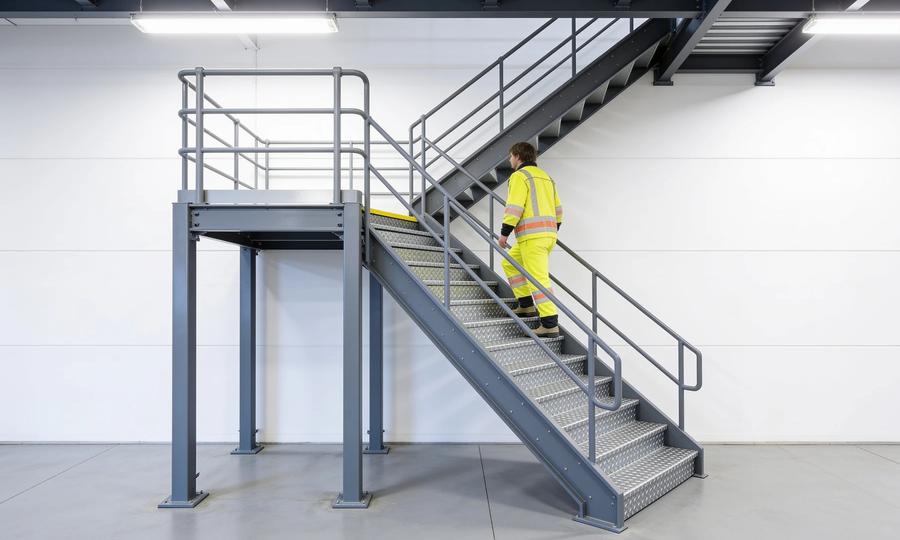
Mezzanine stairs requirements: IBC vs OSHA, explained with the actual numbers
IBC stairs: 7-inch risers, 11-inch treads, 36–44 inches wide. OSHA stairs: up to 9.5-inch risers at up to 50 degrees. Which one your mezzanine needs — and why the answer changes the cost by up to 30%.
Code & Permits
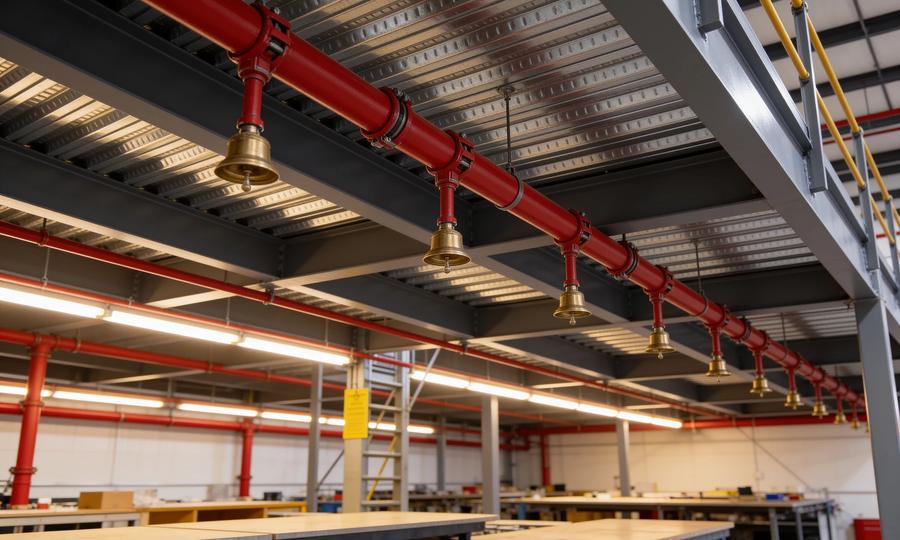
Mezzanine Fire Sprinkler Requirements: NFPA 13 Guide
Review mezzanine sprinkler requirements, below-deck obstructions and open grating. Understand the design questions to resolve with your fire-protection team.