

Mezzanine ladders: when a ladder is legal, when stairs are mandatory, and the 2036 rule nobody's planning for
A fixed ladder is the cheapest way up to a platform — and usually illegal as the way out of an occupied mezzanine. Here's the exact IBC and OSHA line between ladder, ships ladder, alternating tread device, and stairs.
Editorial
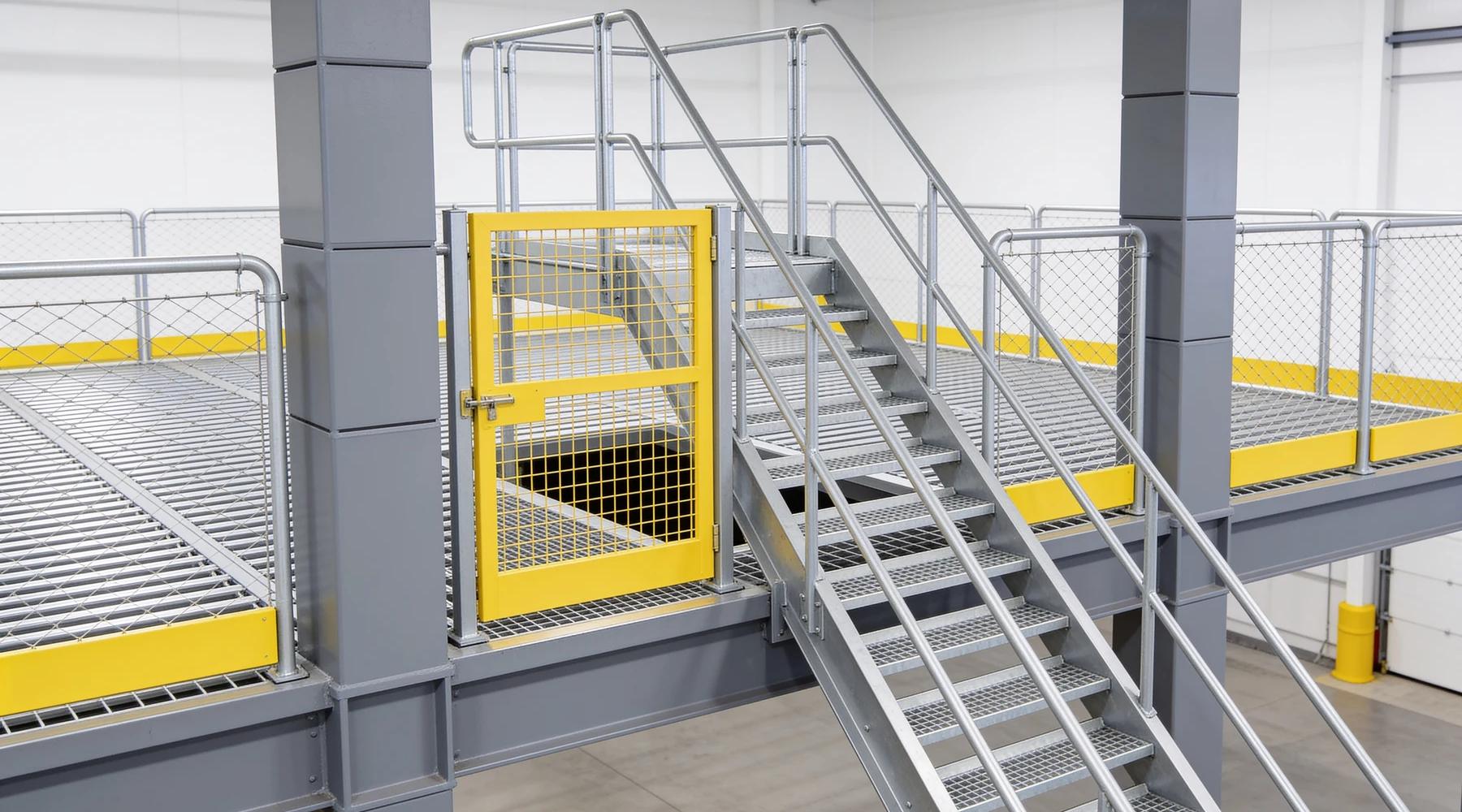
The appeal of a mezzanine ladder is obvious: it's the cheapest access money can buy and it consumes almost zero floor space. The problem is equally simple: for most occupied mezzanines, a ladder cannot legally be the way out. Whether a ladder works for your platform comes down to two documents — IBC Chapter 10 and OSHA 1910 — and they draw the line in different places.
Can a ladder serve as the egress from a mezzanine?
Under the IBC, permanent ladders "shall not serve as a part of the means of egress from occupied spaces" — with a short list of exceptions. That's IBC 1011.16 verbatim. The exceptions that matter in industrial buildings:
- Spaces frequented only by personnel for maintenance, repair, or monitoring of equipment
- Nonoccupiable spaces accessed by catwalks and crawl spaces
- Elevated Group U (utility) levels not open to the public, and unoccupied roofs
The cleanest legal home for ladder access is the equipment platform under IBC 505.3: "an unoccupied, elevated platform used exclusively for mechanical systems or industrial process equipment," which the code explicitly allows to be reached by "walkways, stairways, alternating tread devices and ladders" — because an equipment platform, by definition, is never part of the means of egress.
For a true occupied mezzanine, egress must comply with Chapter 10 like any floor — which normally means stairs. The narrow escape hatch: in Groups F, H, and S, an alternating tread device is permitted as egress from a mezzanine of 250 square feet or less serving five or fewer occupants (IBC 1011.14).
What's the difference between a ladder, a ships ladder, and an alternating tread device?
They're bands on an angle spectrum — and each band has its own rules. From the verified code text:
| Device | Angle (from horizontal) | Where it's allowed |
|---|---|---|
| Standard stairs | 30–50° (OSHA 1910.25(c)); IBC egress stairs at 7"/11" geometry (1011.5.2) | Always — the default |
| Ship stairs | 50–70° | OSHA: only where standard stairs aren't feasible; IBC egress: essentially Group I-3 control rooms and roof access (1011.15) |
| Alternating tread device | 50–70°, min projected tread 8½" | OSHA: same feasibility test; IBC: the 250-sqft/5-occupant mezzanine exception in F, H, S |
| Fixed ladder | Up to 90° | Equipment access; not egress from occupied spaces |
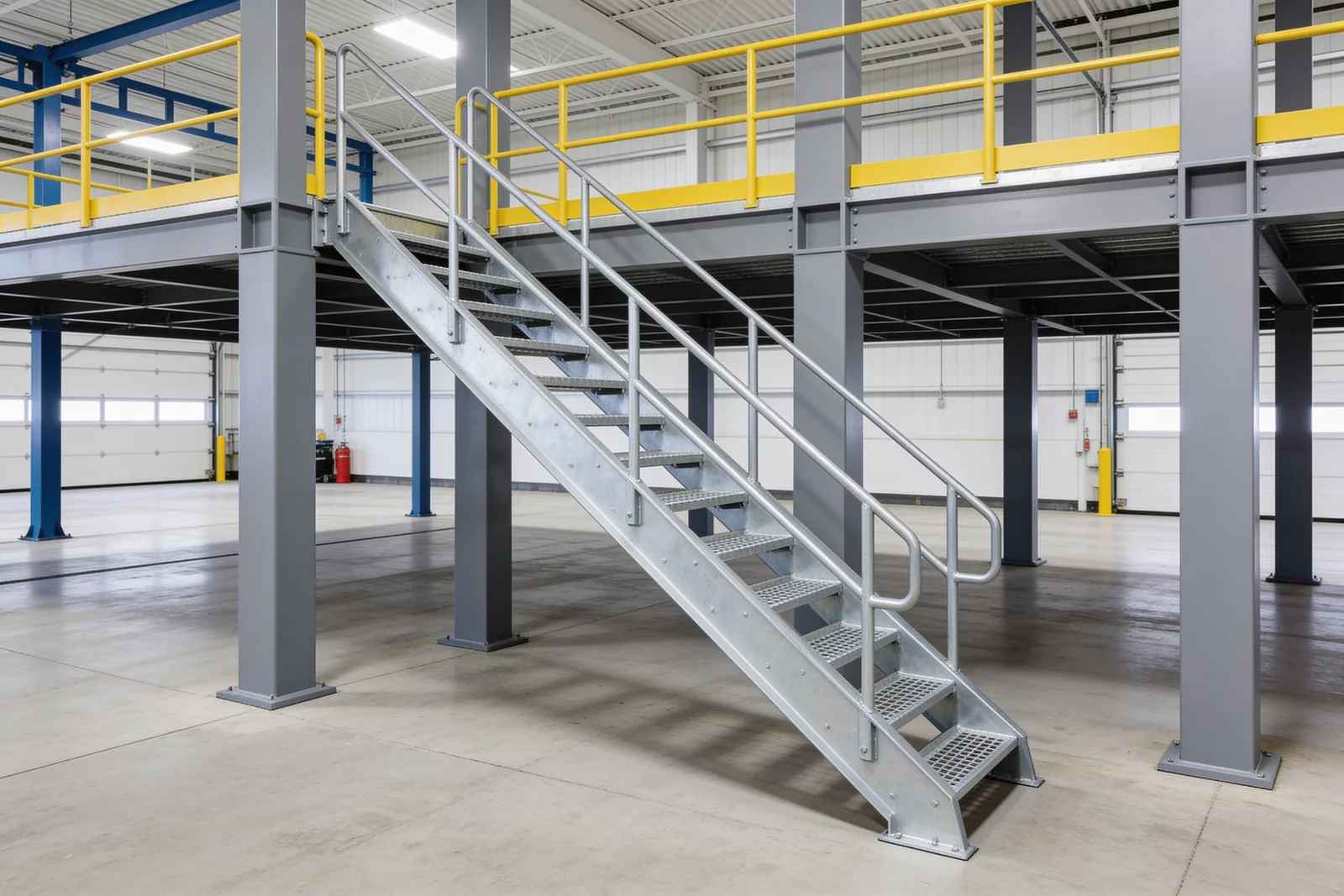
Note OSHA's gatekeeper: spiral, ship, or alternating tread stairs may be used "only when the employer can demonstrate that it is not feasible to provide standard stairs" (1910.25(b)(8)). Space-saving is an argument, not an automatic pass.
What does OSHA require of the ladder itself?
OSHA 1910.23 fixes the geometry. The load-bearing numbers, all from the regulation text:
- Rungs spaced 10–14 inches on centers, minimum 16 inches of clear width
- 7 inches of clearance behind the rungs; 30 inches of clearance on the climbing side
- Side rails extending at least 42 inches above the landing, with through-ladder flares of 24–30 inches and a 7–12 inch step-across
- Pitch never past 90 degrees from horizontal
What is the 2036 fixed-ladder rule?
Cages stop counting as fall protection on November 18, 2036. For fixed ladders extending more than 24 feet above a lower level, OSHA 1910.28(b)(9) phases out the cage era: ladders installed on or after November 19, 2018 already require a personal fall arrest system or ladder safety system; replace a ladder section and that section needs one too; and "on and after November 18, 2036, all fixed ladders are equipped with a personal fall arrest system or a ladder safety system."
Most single-level mezzanine ladders sit under the 24-foot trigger — but pick modules, multi-level platforms, and roof-access ladders in the same building often don't. If you're buying a caged ladder in 2026 for a tall application, you're buying a retrofit obligation with it.
Do I need a safety gate at the top?
Yes — a self-closing gate or an offset, guarded on all other sides. OSHA 1910.28(b)(3)(iv) requires ladderway holes to carry a guardrail system and toeboards on all exposed sides, with the entrance protected by a self-closing gate or offset; 1910.29(b)(13) adds that the gate must slide or swing away from the hole and carry a top rail and midrail. The surrounding guardrail: 42 inches ± 3, withstanding 200 pounds. Full details in our mezzanine safety gates guide.
What does mezzanine ladder access cost?
Published list prices, 2026:
- Fixed caged ladders: $1,385 for a 10-foot (120") ladder up to $4,017 for a 29-foot (348") ladder; walk-through tops add roughly $200–300 per height
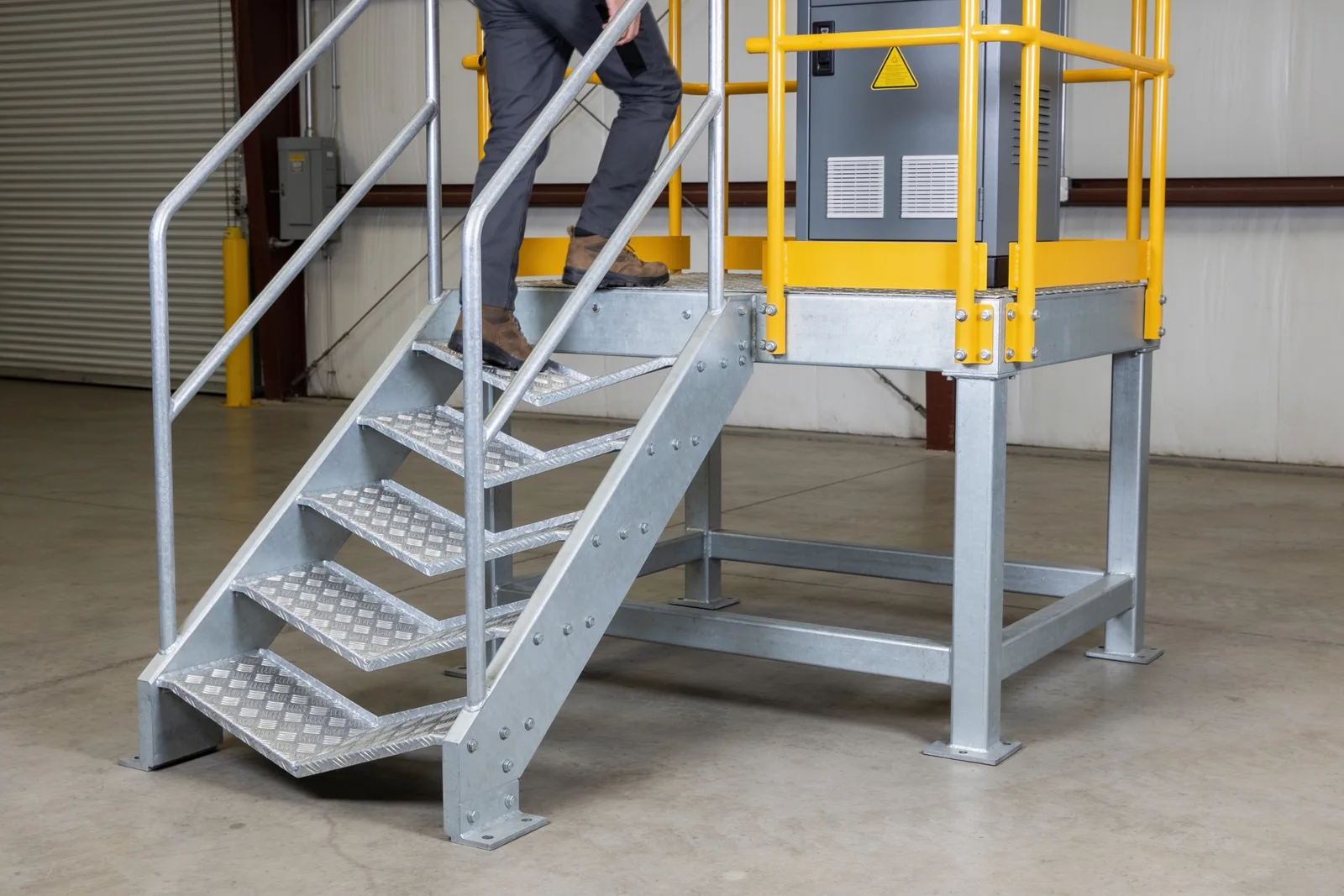
- Alternating tread stairs: factory units from about $3,055 to $6,033 depending on height, angle, and material (aluminum, carbon, galvanized, stainless)
- Self-closing gates: $406–$567 powder-coated, $836–$1,188 stainless, plus optional toeboard kits
- Ships ladders: every major vendor prices by quote only — no published figures to report
Compare against the stair budget in our mezzanine stairs guide — a code stair costs multiples of a ladder, which is exactly why the classification question above comes first: the access device follows from what the platform legally is, not from the budget.
The decision in four steps
- Classify the platform first — occupied mezzanine or unoccupied equipment platform (IBC 505.3). This decides everything.
- Occupied mezzanine? Plan on compliant stairs; consider the alternating-tread exception only if you're in F/H/S at ≤250 sqft and ≤5 occupants.
- Equipment platform? A 1910.23-compliant fixed ladder is legal and cheapest — add the self-closing gate, and mind the 24-foot/2036 rule on taller runs.
- Get the AHJ's read early — classification calls are theirs, and permit reviewers check access first.
What to read next
- Mezzanine stairs requirements: IBC vs OSHA — the full geometry and cost picture for compliant stairs
- Mezzanine safety gates — pallet gates and self-closing gates, specified properly
- OSHA mezzanine requirements — the complete 1910 picture for platforms
Put this guide into practice
Frequently asked questions
- Can I use a ladder instead of stairs to access my mezzanine?
- Usually not for an occupied mezzanine — the IBC bars permanent ladders from serving as means of egress from occupied spaces, with narrow exceptions like equipment-only areas. Unoccupied equipment platforms under IBC 505.3 may use ladder access, and small mezzanines in factory, high-hazard, and storage occupancies can use an alternating tread device.
- What is the OSHA 2036 fixed ladder rule?
- On and after November 18, 2036, OSHA 1910.28(b)(9) requires every fixed ladder extending more than 24 feet above a lower level to have a personal fall arrest system or ladder safety system — cages and wells stop counting as fall protection on that date. Ladders installed since November 19, 2018 already need one of those systems.
- Do I need a safety gate at the top of a mezzanine ladder?
- Yes. OSHA 1910.28(b)(3)(iv) requires ladderway openings to be guarded on all exposed sides, with a self-closing gate or offset at the entrance — and 1910.29(b)(13) specifies the gate must slide or swing away from the hole and have a top rail and midrail.
- What is the difference between a ships ladder, an alternating tread stair, and a fixed ladder?
- They occupy different angle bands: OSHA standard stairs run 30–50 degrees, ship stairs and alternating tread stairs 50–70 degrees, and fixed ladders up to 90 degrees. The steeper the device, the less floor space it needs — and the fewer situations where code allows it.
- How much does a mezzanine ladder cost?
- Published list prices run about $1,385–$4,017 for fixed caged ladders between 10 and 29 feet, roughly $200–300 more for walk-through versions, and about $3,000–$6,000 for factory alternating tread stairs. Add $400–$1,200 for the self-closing safety gate at the top.
Continue planning your mezzanine
All Code & Permits guides →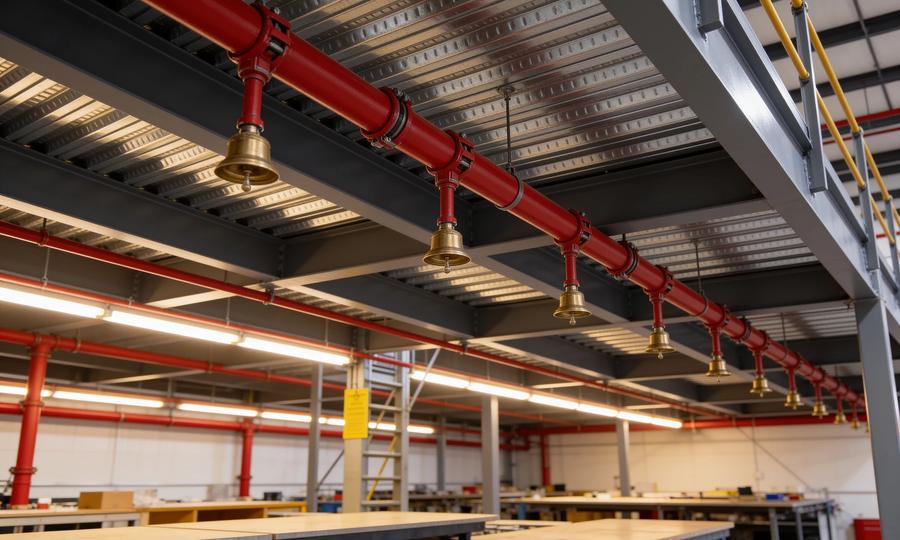
Code & Permits
Mezzanine Fire Sprinkler Requirements: NFPA 13 Guide
Review mezzanine sprinkler requirements, below-deck obstructions and open grating. Understand the design questions to resolve with your fire-protection team.

Code & Permits
Mezzanine Permit Requirements: Drawings & Approvals
Prepare a mezzanine permit application: drawings, structural review, building codes and inspections. Find state resources and understand the approval process.
Code & Permits
IBC 2024 Mezzanine Requirements: Area, Height & Egress
Review IBC mezzanine area, height, openness and egress requirements. Find the related OSHA, sprinkler and permit guides, plus a project planning checklist.