

Resin deck for mezzanines: ResinDek and its alternatives, honestly compared
ResinDek is an engineered wood fiber composite, not structural OSB — and its load tables carry footnotes that change the numbers. What the specs say, and where steel still wins.
Editorial & Engineering Team
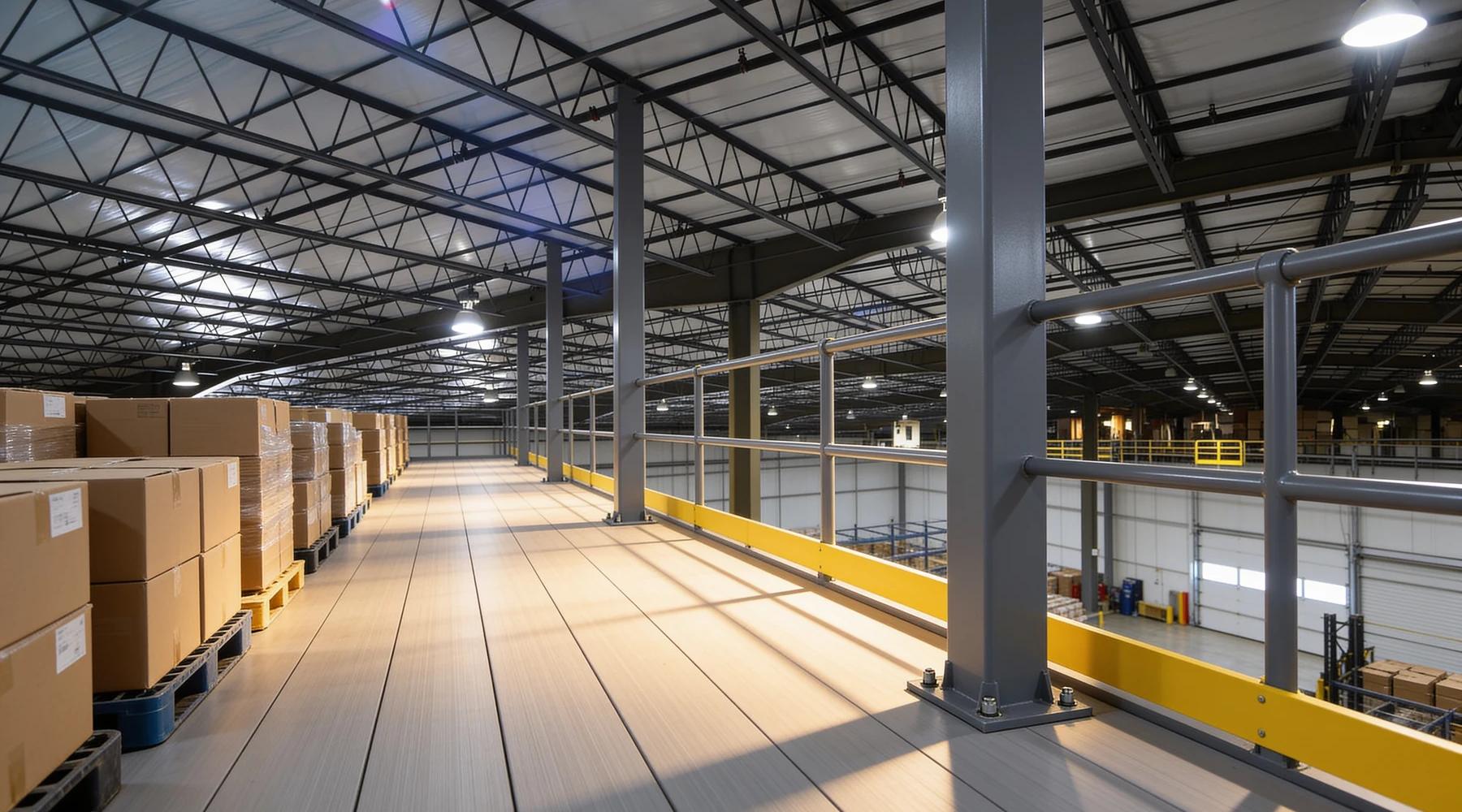
ResinDek is a brand name, not a material category — and treating it as generic "resin board" is where most decking comparisons go wrong. It is a high-density engineered wood fiber composite manufactured by Cornerstone Specialty Wood Products, and the published product line is rated for rolling loads up to 8,000 pounds and for autonomous mobile robots. That is not what structural OSB does.
This page is the product-level deep dive: what the panels actually are, what the load tables say once you read the footnotes, which finishes exist and why, and where the alternatives still win. For the four-way material decision across deck types, see mezzanine decking options; for how the deck layer and the finish layer split the job, see mezzanine flooring. This article stays on the resin panel itself.
What is ResinDek made of?
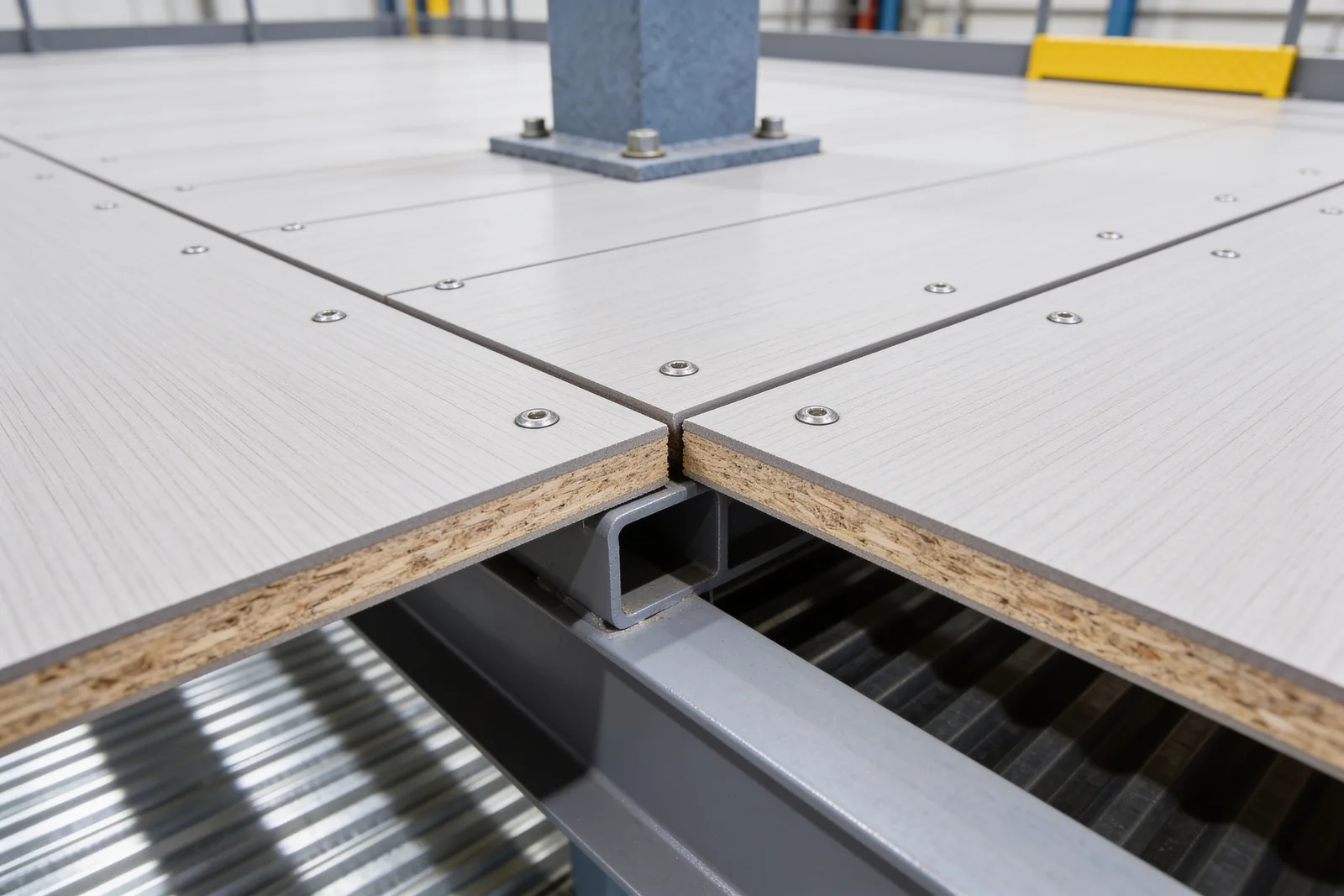
A high-density engineered wood fiber composite — not plywood, not OSB, and not a laminate over a core. Cornerstone states the panels are manufactured with "mostly recycled and recovered wood fibers, environmentally friendly resins with no added urea formaldehyde, and a wax emulsifier for moisture resistance", combined and compressed under extremely high pressure and temperature.
The company has produced the panels since 1994 and is now a subsidiary of Apogee Enterprises. The line runs seven panels: LD, MD, HD, WR and MAX plus Xspan / Xspan FR and the 1/4-inch ReShield overlay. LD, MD, HD and WR are 3/4 inch thick; MAX is 1-1/2 inch, Xspan 1-1/8 inch. The WR variant swaps in phenolic resins for decay and termite resistance.
Panels are custom made up to 4 by 10 feet with proprietary coatings, or 4 by 8 feet with MetaGard steel surfaces, with tongue-and-groove on the two long edges as standard — a profile that exists specifically to "promote panel to panel wheel load transfer". They ship 1/8 inch under nominal dimensions so that a properly gapped 4-by-8 panel occupies exactly 48 by 96 inches of floor.
How much weight can a resin deck panel hold?
Published pallet jack ratings run 2,000 to 8,000 pounds and robot ratings 500 to 6,000 pounds — but every headline number assumes 36-inch beam spacing. That footnote does more work than the table above it, and it is the first thing to check against your actual joist layout.
| Panel (B-deck ga) | Pallet jack + product | Robot + product | Max contact pressure | Weight psf |
|---|---|---|---|---|
| LD (20 ga) | 2,000 lb | 500 lb | 500 psi | 2.8 |
| MD (20 ga) | 2,500 lb | 2,000 lb | 750 psi | 3.5 |
| MD (18 ga) | 3,500 lb | 3,000 lb | 1,000 psi | 3.5 |
| HD (18 ga) | 4,500 lb | 4,000 lb | 1,200 psi | 3.8 |
| MAX (18 ga) | 8,000 lb | 6,000 lb | 1,500 psi | 7.6 |
| Xspan (no B-deck) | 3,000 lb | 2,500 lb | 900 psi | 5.2 |
| WR (20 ga) | 2,000 lb | 500 lb | 500 psi | 3.09 |
Source: ResinDek product selection chart. The governing footnote reads: "load values are calculated on 36 inch beam spacing; increased spacing will increase deflection and/or decrease capacity."
There is a second layer to this. In a conventional ResinDek floor the panel is not carrying the uniform load on its own — the corrugated deck beneath it is. Cornerstone publishes that table too: 1.5-inch 20 gauge B-deck in a single span allows 565 psf at 36 inches but only 203 psf at 60 inches, and the load producing L/240 deflection falls from 462 psf to 100 psf across the same range. So the honest division of labour is that the B-deck and joist spacing govern uniform load, while the panel governs rolling and point load. Cornerstone's own FAQ concedes which one usually decides the specification: asked whether uniform or pallet jack loads matter more, it answers that pallet jack loads are usually more critical because the load is concentrated and dynamic.
Cornerstone also states plainly that these figures "cannot be used as a reference in structural studies" and directs buyers to an accredited engineering office. Treat the tables as selection guidance and the stamped drawings as the design. Our load calculator and mezzanine load capacity explained cover how live, dead and point loads combine before any deck is chosen.
Does resin deck need B-deck underneath?
Usually yes — the common panels are wear surfaces, not structural ones. LD, MD, HD, WR and MAX must be installed over corrugated metal deck or an existing floor, with 20 gauge the minimum and 18 gauge recommended for loads above 2,500 pounds.
Only the 1-1/8 inch Xspan and Xspan FR panels are approved to span bar joists or beams directly, and their published load-span table shows exactly what spacing costs you:
| Beam spacing | 16 in | 24 in | 32 in | 40 in | 48 in |
|---|---|---|---|---|---|
| Uniform load (psf) | 375 | 225 | 125 | 75 | 50 |
| Pallet jack + product (lb) | 3,000 | 2,700 | 2,300 | 2,000 | 1,500 |
| Robot + product (lb) | 2,500 | 2,000 | 1,500 | — | — |
Source: Xspan FR spec sheet. Uniform capacity falls 7.5-fold from 16 to 48 inches — which is why column and joist spacing is a deck decision as much as a steel one. A steel-bottom Xspan FR variant lifts those figures to 450 psf at 16 inches and 125 psf at 48 inches.
Installation carries hard warranty conditions: 1/8 inch minimum gaps between panels using the supplied metal spacers, a 1/4 to 1/2 inch perimeter gap, a minimum of 20 screws per 4-by-8 sheet, and panel joints landing on the ribs of the corrugated deck — placing joints on valleys without proper valley shims voids the warranty. Panels are field-cuttable with a carbide-tipped circular saw.
What rolling loads is resin deck actually rated for?
Manual pallet jacks, AGVs and AMRs — not forklifts. No forklift rating is published at any panel grade. The load figures state explicitly that "these values are based on a standard manual pallet jack", and the warranty adds that electric pallet jacks "are not addressed in this warranty" and need a separate one — the MAX panel is the product marketed for that duty.
Two more conditions decide whether the rating survives contact with your fleet:
- Wheel material is a warranty term. Testing was completed with polyurethane casters, and crowned, steel or plastic wheels "could void the warranty".
- Contact pressure is the robot-side limit, published from 500 to 1,500 psi and offered as a guide rather than a guarantee. Flatness matters too: default to plus or minus 1/8 inch over 36 inches on robotic floors absent a robot maker's spec.
Not every panel takes robots. The product index flags LD, HD and WR as "not suitable for AGVs" — HD carries 4,000 lb robot loads over 18 gauge B-deck, but its no-B-deck single-panel configuration is rated for AMRs only, up to 750 lb. If the platform has to take a truck, that is a different structure entirely — see can a forklift drive on a mezzanine.

Which surface finish do you actually need?
The finish decides wet slip resistance, static control and robot service life — and the published wet numbers vary by more than double. Cornerstone publishes real test data, which is rare enough to be worth reading closely.
| Finish | DCOF dry / wet | Taber abrasion | Robot passes (AMR / AGV) |
|---|---|---|---|
| TriGard ESD | 0.62 / 0.28 | 6,000 revolutions | up to 20 M / 5 M |
| TriGard ESD Ultra | 0.62 / 0.47 | 24,000 revolutions | up to 50 M / 20 M |
| MetaGard SST (stainless) | 0.77 / 0.68 | over 50,000 revolutions | up to 100 M / 50 M |
Source: ResinDek coatings and finishes. Note the wet column — a floor that measures 0.62 dry can measure 0.28 wet, so ask for the wet figure specifically rather than the marketing one.
The ESD versions are the reason many electronics and pharmaceutical operations specify these panels at all: Gray Diamond Seal ESD averages 6.6 million ohms point-to-point with voltage decay from 5,000 V to under 50 V in less than half a second, compliant with ANSI/ESD S7.1, S20.20 and STM97.1. Finish choice is also a navigation decision — TriGard ESD is specified for lidar-guided AMRs because its reflectivity does not impair laser-based navigation sensors.
Does a solid resin deck change your sprinkler requirements?
No building code requires sprinklers under a mezzanine purely because the deck is solid — but on rack levels, solid decking triggers real NFPA 13 penalties, and insurers apply their own rule. This is the most expensive misunderstanding in deck selection, so it is worth separating the three regimes.
On rack levels, NFPA 13 draws the line at 20 square feet and 50 percent open. Shelving that is less than 50 percent open, or greater than 20 square feet measured between flue spaces, is treated as solid shelf rack. The penalty then escalates: between 20 and 64 square feet with CMDA ceiling sprinklers, in-rack sprinklers go in at intermediate levels not more than 6 feet apart vertically; above 64 square feet, below each level of solid shelving. Under CMSA or ESFR ceiling sprinklers there is no partial credit at all — in-racks go beneath all tiers under the highest solid shelf. Slatted shelves get no relief; the standard counts them as solid. The fire code threshold for this rule dropped from 32 to 20 square feet between the 2014 and 2018/2019 editions, so older guidance is wrong on the number. Section numbering has moved between NFPA 13 editions — rely on the thresholds and verify the section against your adopted edition.
Insurers, not codes, address solid mezzanines directly. FM Global Data Sheet 2-0 instructs users to install quick-response sprinklers under solid mezzanines with combustible construction and/or a combustible occupancy below, plus a perimeter draft curtain. The same document is where the open-deck exemption lives, and it is narrower than the industry's "grating passes water" shorthand: an open grid escapes sprinklers only if it is at least 70 percent open, no more than 1/2 inch deep, at least 3 feet below the ceiling sprinkler deflectors and the flow rate condition is met — with the depth limit tightening to 1/4 inch for storage. Standard 1-inch bar grating clears the open-area test comfortably and fails the depth test.
The IBC's own hook is narrower still. Section 505.3.2 requires equipment platforms in sprinklered buildings to be protected above and below — triggered by the platform, not by the deck material. Separately, Group S-1 sprinkler thresholds count mezzanine area: sprinklers are required where combined S-1 fire areas on all floors "including any mezzanines" exceed 24,000 square feet.
As for the panels themselves, the fire rating is an assembly rating, and the wording matters: "the ResinDek panels plus the corrugated metal deck assembly meet Class A criteria for an interior finish". Panel-only results are mixed — Xspan is Class C, Xspan FR is Class A. Systems can be UL classified up to a 2-hour rated assembly under UL Design L701, and the product carries IAPMO UES evaluation report ER-467. Our fire sprinkler requirements guide covers where that review happens; wire mesh decking and bar grating cover the open-deck alternatives.
How does resin deck compare on weight and cost?
On dead load it is roughly eight times lighter than concrete on steel deck — and that cascade into joists, columns and footings is the real economic argument. Cornerstone puts its own system at about 5 psf against 45 psf for concrete on corrugated deck; Vulcraft's tables independently put a 3-1/2 inch normal-weight slab on 1.5 inch deck at 37.5 to 39.2 psf.
| Deck surface | Weight (psf) |
|---|---|
| APA 3/4 inch plywood | 2.3 |
| ResinDek LD 3/4 inch | 2.8 |
| ResinDek HD 3/4 inch | 3.8 |
| Bar grating 1 in x 1/8 in (19-W-4) | 4.9–5.0 |
| ResinDek plus B-deck system | about 5 |
| Bar grating 1 in x 3/16 in | 7.0–7.2 |
| ResinDek MAX 1-1/2 inch | 7.6 |
| 1/4 inch steel checker plate | 11.3 |
| B-deck plus 3-1/2 inch normal-weight concrete | 37.5–39.2 |
| B-deck plus 6 inch normal-weight concrete | 67.7–69.4 |
Sources: ResinDek product chart, APA Panel Design Specification, Ohio Gratings, WM Steel, Vulcraft. One honest gap: no wire mesh deck manufacturer publishes a weight per square foot or an open-area percentage, which makes wire deck impossible to place accurately in either this table or FM's 70 percent test.
On price, published figures are thin and should be labelled for what they are. A study by Rescorla Engineering modelling three 225 by 225 foot platforms at 125 psf put ResinDek over cold-formed c-channels at $22.29 per square foot against $29.24 for concrete over the same framing — but it is vendor-published and whole-system, not a deck unit price. The one third-party per-sheet figure found is about $90 per 4-by-8 ResinDek sheet against $73 for AdvanTech, dated November 2021. Everything else — B-deck, grating, FRP, wire deck, plywood — is quote-only; no manufacturer publishes unit pricing. Model the whole platform with the cost calculator rather than a deck line item, and use the decking selector to narrow the material first.
Where does resin deck fail?
Water, and the buckling that follows it. The manufacturer's own warning is unusually direct: under extreme humidity the panels may expand, and "because ResinDek panels are extremely dense and don't crush under load, they are particularly susceptible to buckling if the panels expand into adjacent panel edges." That is why the gapping rules are warranty conditions rather than good practice.
The remaining limits, in the manufacturer's own words:
- Interior only. "ResinDek is not intended for exterior applications." The warranty excludes prolonged exposure to standing water, and hosing down is prohibited.
- Moisture resistance is graded, not binary. LD, MD, HD, MAX, Xspan and ReShield are MR50 — retaining at least 50 percent of original modulus of rupture after a 24-hour test. Only WR is MR90, and only WR carries a published outdoor window, of up to 120 days.
- Cold storage is supported — panels are engineered down to minus 20°F and offered for environments below 40°F, a genuine advantage over the alternatives in freezer applications.
- Overload damage may not be repairable. Cracks and holes are "primarily due to loads in excess of ResinDek recommendations" and may require replacement. Single-panel replacement is possible but is a 17-step cut-and-shim procedure, not a lift-and-swap.
Whatever the deck, OSHA's duty runs to the finished surface: each walking-working surface must support its maximum intended load, and surfaces must be kept free of hazards including "loose boards." The live load target itself comes from use, not from the word mezzanine — IBC Table 1607.1 sets 125 psf for light storage and 250 psf for heavy storage, and there is no mezzanine row in it at all. A storage mezzanine is loaded by what it stores.
Deck selection, load rating and fire strategy are engineering and code decisions specific to your building. Everything above reports published manufacturer specifications and code text; a licensed structural engineer and your authority having jurisdiction decide what applies to your project.
What to read next
- Mezzanine decking options compared: B-deck, bar grating, resin, concrete — the four-way material decision this article sits inside
- Mezzanine flooring: the deck layer and the finish layer — how the structural deck and the wear surface split the specification
- Wire mesh decking: capacity ratings and the fire-code rule — the open-deck alternative and the ANSI MH26.2 rating method behind it
Put this guide into practice
Frequently asked questions
- What is ResinDek made of?
- ResinDek panels are a high-density engineered wood fiber composite — mostly recycled and recovered wood fibers combined with resins containing no added urea formaldehyde and a wax emulsifier for moisture resistance, then compressed under high pressure and temperature. It is not plywood, not OSB, and not a laminate bonded over a separate core.
- How much weight can a ResinDek floor hold?
- Published pallet jack ratings run from 2,000 pounds on the LD panel to 8,000 pounds on the 1-1/2 inch MAX panel, and robot loads from 500 to 6,000 pounds. Every one of those figures is calculated at 36-inch beam spacing over corrugated B-deck; wider spacing lowers capacity and increases deflection.
- Does ResinDek need B-deck underneath it?
- Usually yes. The LD, MD, HD, WR and MAX panels are wear surfaces, not structural panels — they install over corrugated metal deck or an existing floor, with 20 gauge the minimum and 18 gauge recommended above 2,500 pounds. Only the Xspan and Xspan FR panels are approved to span joists or beams directly.
- Can you drive a forklift on a resin deck mezzanine?
- No — the manufacturer publishes no forklift rating at any panel grade. The published ratings cover manual pallet jacks, AGVs and AMRs; electric pallet jacks are excluded from the standard warranty and require a separate one. Forklift traffic is a job for steel deck with concrete fill.
- Does solid mezzanine decking require sprinklers underneath?
- No building code requires it purely because the deck is solid. The rules that bite are NFPA 13's solid-shelving thresholds on rack levels and FM Global's Data Sheet 2-0, which directs quick-response sprinklers under solid mezzanines with combustible construction or a combustible occupancy below. Your AHJ and insurer decide.
Continue planning your mezzanine
All Engineering guides →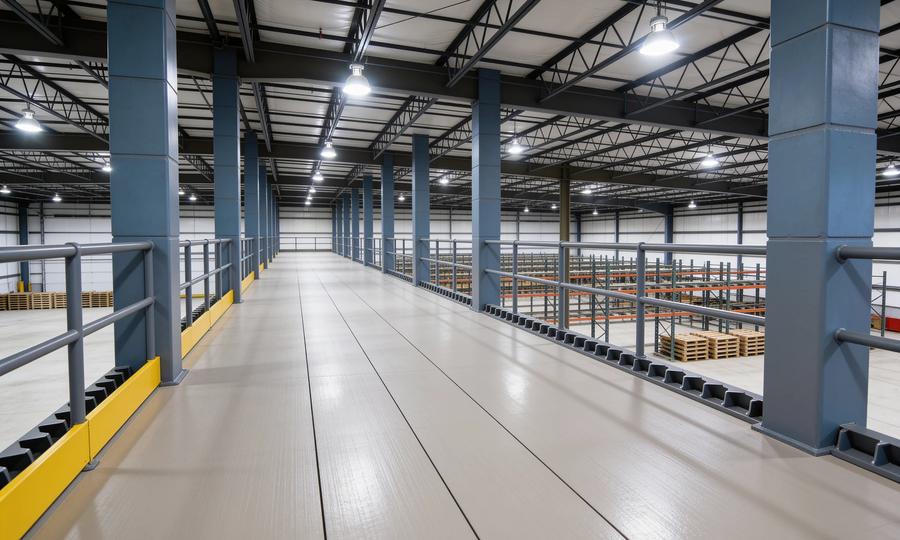
Engineering
Mezzanine Flooring: Structural Decks & Surface Finishes
Choose mezzanine flooring for storage, pallet jacks or automation. Review the structural deck, surface finish, rolling loads and the specifications to compare.
Engineering
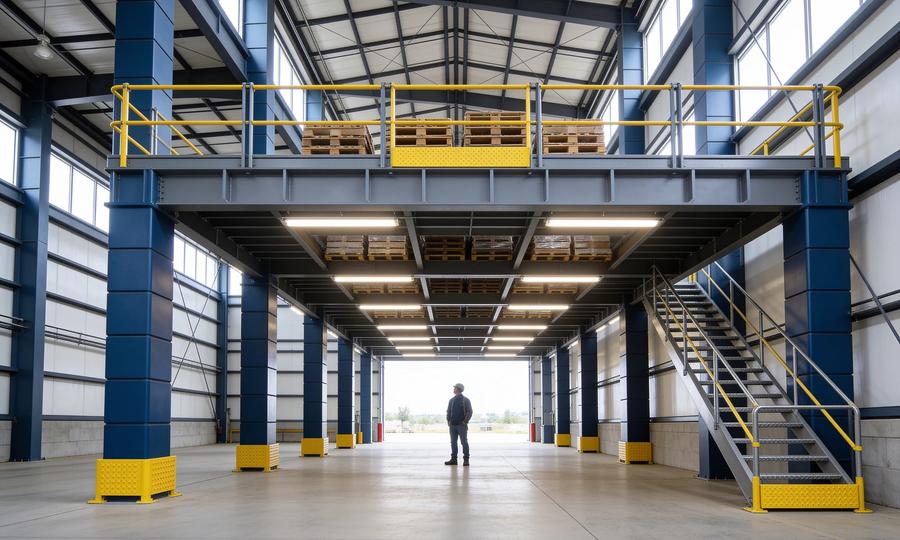
Mezzanine Ceiling Height Requirements & Clearance
Work through mezzanine ceiling height requirements, clear headroom and framing depth. Check sprinkler obstructions and forklift clearance before planning.
Engineering
Mezzanine Load Capacity: PSF Ratings & Point Loads
Understand mezzanine load capacity, PSF ratings, live loads and point loads. Learn what to specify for storage, pallet racks and handling equipment.