

Pallet jacks on mezzanines: wheel loads and route planning
Prepare a pallet-jack review with the actual truck configuration, wheel loads, floor assembly and travel route. Use a practical equipment-and-route checklist.
Editorial
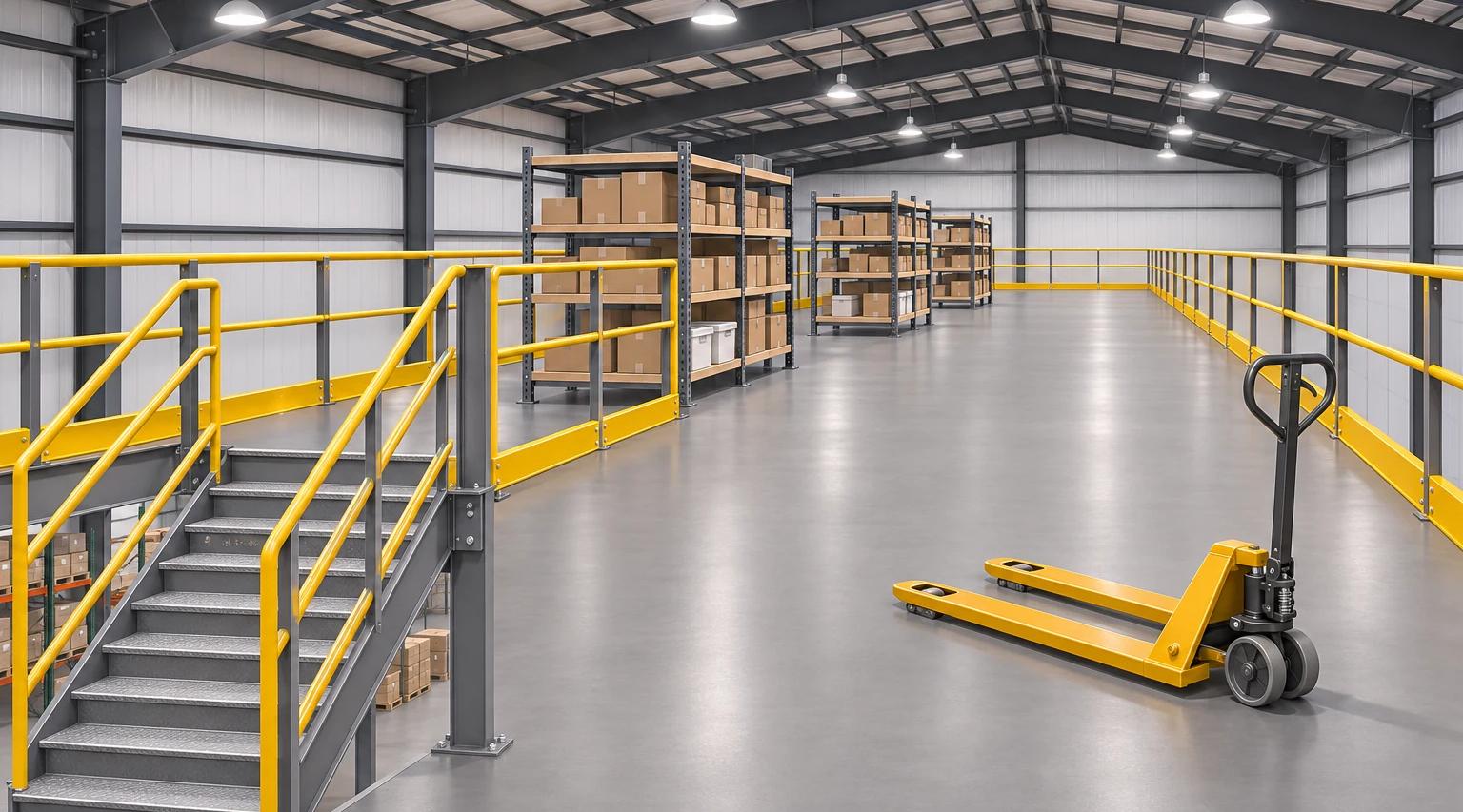
Using a pallet jack on a mezzanine requires a review of the actual truck, wheel loads, floor assembly and travel route. Start with an equipment-and-route brief. The lifting capacity printed on the truck does not describe the forces its wheels apply to your particular floor.
This guide explains what to collect for that review. The load-capacity guide explains distributed and concentrated loading; the flooring guide covers assembly and finish selection. Neither a generic product label nor this checklist replaces the installation's approved design and operating limits.
All three images are AI-generated concept illustrations, not project photographs, load tests or approved layouts. This Cogan-affiliated editorial guide claims no named technical review. Have the responsible structural designer, equipment supplier and site safety team assess the proposed use under the applicable requirements.
Can a floor's PSF rating answer the pallet-jack question?
A uniform rating does not establish a specific wheel-load capacity. Keep the equipment review separate from simple distributed-load arithmetic. Give the designer the actual truck configuration and its intended movement, together with the documents describing the existing floor.
The Storage Manufacturers Association FAQ explains that point-load capacity depends on the deck, framing and concentrated-load arrangement. Its powered-pallet-jack guidance calls for actual maximum wheel loads, including product, and consideration of static and dynamic effects. The FAQ is advisory industry guidance, not a project approval.
Use the load calculator and blank load brief to organize the documented information. The calculator multiplies an existing distributed rating by its corresponding area; it does not convert that result into permission for a rolling vehicle. Put the pallet-jack review reference beside the equipment entry so the two checks cannot be confused later.
What equipment information should you request first?
Identify the exact truck and configuration before requesting reactions or selecting a floor product. Include the attachments, battery where applicable, wheel options and intended pallet loads. A photograph helps identify the equipment, but retain the supplier's model-specific documents as the technical record.
As an example of the information available, Crown's published WP 3000 specification sheet separately lists truck weight, battery information, loaded and unloaded axle loads, wheel sizes and counts, fork dimensions and turning geometry. This is a UK-market document used to illustrate data fields, not a recommendation to apply its values to a different truck or region.
Prepare a request table like this:
| Information | Document or answer to obtain | Record beside it |
|---|---|---|
| Equipment identity | Model, serial/configuration reference and installed options | Supplier and document revision |
| Operating weight | Truck, battery and attachment details | What is included or excluded |
| Payload | Intended pallet/product combination and load position | Normal and maximum proposed cases |
| Wheel system | Wheel locations, sizes, materials and single/tandem arrangement | Actual fitted configuration |
| Reactions | Loaded and unloaded wheel/support data | Units, load case and source |
| Movement | Turning, stopping and other intended operating conditions | Supplier limitations and designer questions |
| Route | Plan showing travel, staging and transfer interfaces | Drawing revision and responsible reviewer |
Do not leave an unexplained number in the file. Label whether it is a payload rating, vehicle weight, axle reaction or individual wheel reaction. Ask the supplier to resolve ambiguous terminology before the designer uses it.
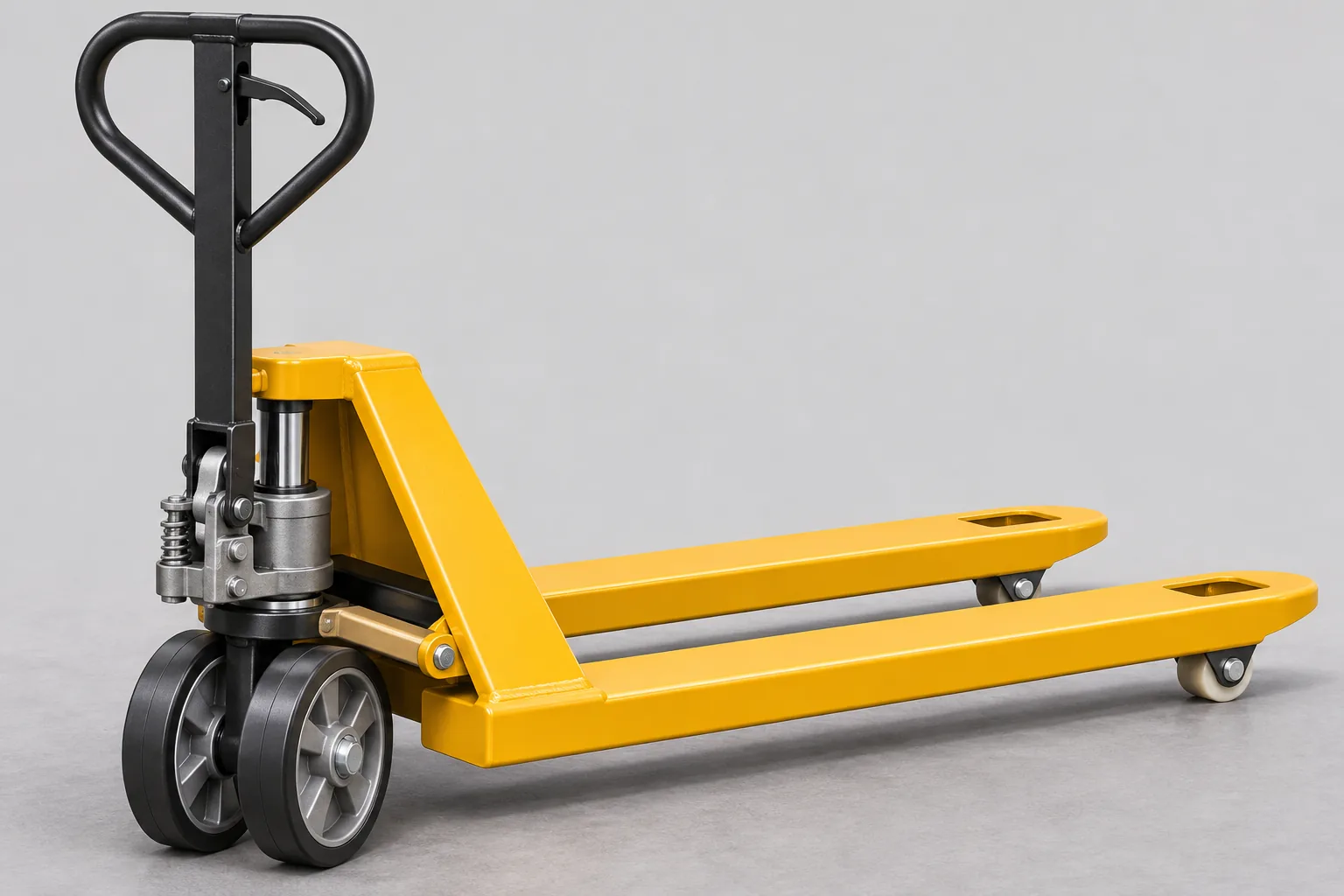
Illustrative wheel arrangement only. Use the actual equipment's drawings and supplier data for the review.
Why request both loaded and unloaded information?
Different operating cases belong in the brief, and a single total weight does not describe every support reaction. Request the supplier's data for the relevant configurations and have the designer decide which cases govern. Keep any assumptions visible rather than treating a worked example as a machine specification.
SMA explicitly describes manual pallet-jack wheel loading as case-specific before offering an illustrative distribution. Do not turn that example into a universal formula. Likewise, an axle value is not automatically an individual wheel value when multiple wheels or rollers share that support.
The Crown sheet distinguishes loaded from unloaded axle data and includes configuration-dependent notes. Use that separation as a document-reading habit: check the table heading, option and footnotes before extracting a value. Confirm the installed configuration with the supplier, especially when records and the machine in the warehouse differ.
For example, a brief that says only “manual jack, full pallet” remains incomplete. A useful version identifies the equipment, pallet configuration, source documents and missing reaction information. Its purpose is to make the engineering question answerable, not to manufacture a reassuring number.
Does a pallet-jack-rated panel approve the entire floor?
A flooring product's stated capability must be checked against the actual installation and complete supporting structure. Provide the deck and framing records alongside the equipment information. Ask the responsible reviewer to identify the accepted assembly rather than selecting a panel from a headline rating alone.
The manufacturer's ResinDek MAX product page illustrates this distinction: it describes electric-pallet-jack applications and also specifies a corrugated metal B-deck installation requirement. That product-specific condition is not a universal recipe for another panel, another support arrangement or an existing mezzanine.
Keep product selection, structural assessment and installation records together. If a proposed overlay changes the assembly, submit that proposal for review before treating it as a capacity upgrade. The floor-design guide covers the wider design brief; this equipment record supplies one part of it.
How should you document the travel route?
Mark where the truck travels, turns, stops, stages and transfers its load. Include the load's outline and the operator's working space in the review. A straight empty aisle does not show the full task at a transfer point or a tight turn.
CCOHS handcart guidance discusses floor condition, ramps, maneuvering space, wheel characteristics and the effort needed to start, sustain and stop movement. It also considers travel distance and frequency. These are Canadian ergonomic planning considerations, not structural load ratings or a substitute for local requirements.
Use the floor-plan guide to mark the proposed route. Add observations about joints, transitions, surface damage and changes of level for the appropriate specialists to assess. Record nearby workstations and pedestrian crossings rather than considering the vehicle in isolation.
At a transfer opening, coordinate the equipment procedure with the safety-gate arrangement and any material lift. Identify what equipment and loads actually cross each interface. Do not infer approval for a pallet jack to enter a lift simply because the pallet itself fits.
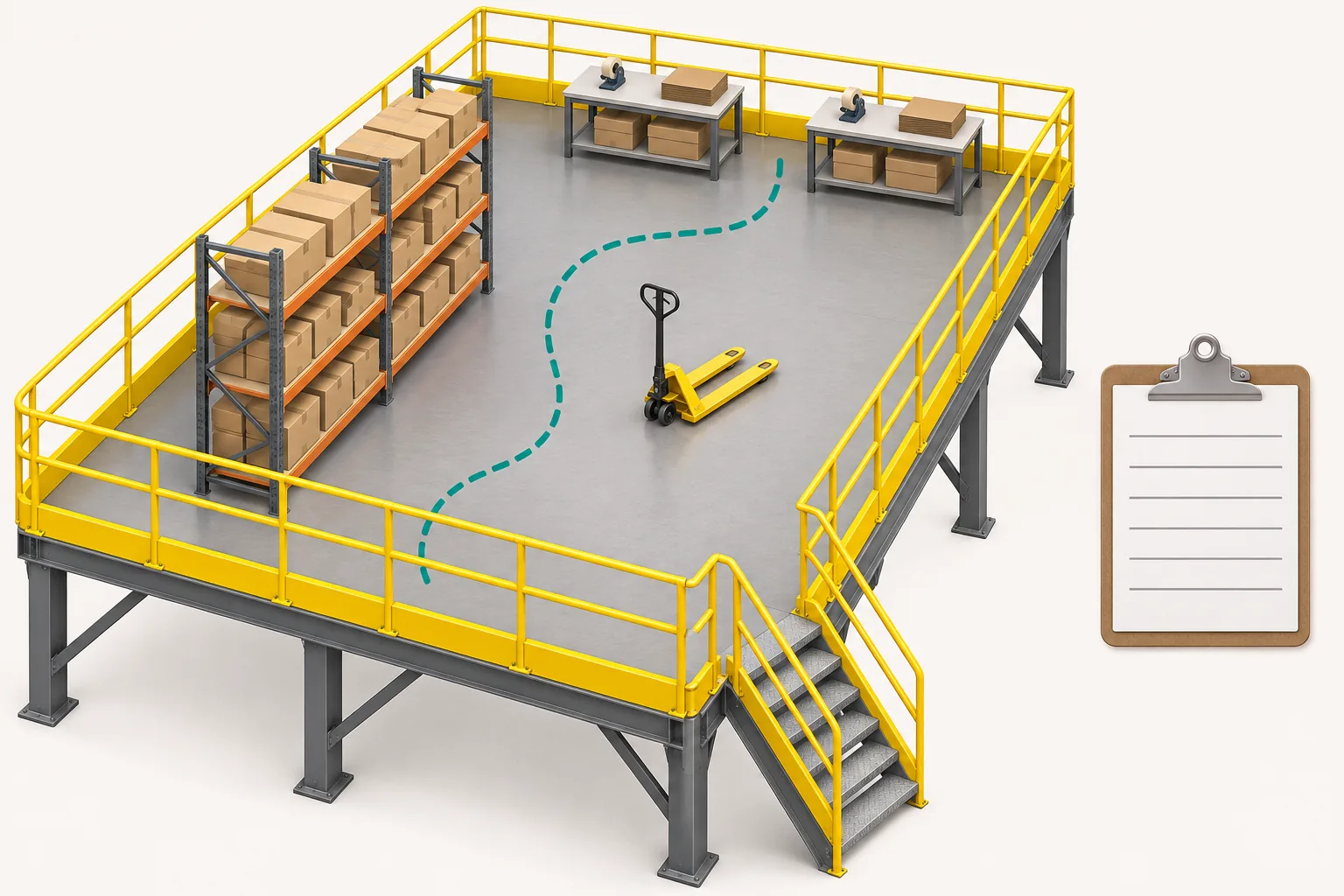
A route-documentation concept, not a scaled aisle design, turning analysis or operating authorization.
Manual and powered trucks need distinct operating reviews
A manual pallet jack and an electric walk-behind truck should not share an undifferentiated equipment entry. Record their actual operating instructions and the tasks assigned to each. The structural reviewer and safety team need to know which machine the proposal concerns.
For US workplaces within its scope, OSHA 1910.178 covers motorized hand trucks. Its training provisions address truck operation and workplace conditions, including surfaces, pedestrians, restricted areas and slopes, and require operator training and evaluation. Do not apply the powered-truck provision to a purely manual jack merely because both handle pallets.
Have the site team confirm jurisdiction-specific obligations, operating procedures and inspection responsibilities. Walking beside the equipment does not make a powered truck's review identical to manual handling. The forklift-on-mezzanine guide addresses the separate lift-truck planning question.
What should the final review record contain?
Retain a decision tied to a specific truck, loading case, floor assembly and route. Document limitations and unresolved items, then make the accepted arrangement available to operations. A later equipment substitution or route change should be visible as a new review question.
In applicable US workplaces, OSHA 1910.22 requires walking-working surfaces to support their maximum intended load. It also addresses inspection, hazardous-condition correction and qualified involvement in repairs affecting structural integrity. A damaged surface should not be treated as acceptable simply because an earlier equipment review exists.
Close the brief with these fields:
- Equipment/configuration and source-document revisions.
- Accepted load cases, floor assembly and route-drawing reference.
- Responsible reviewers and the scope of each decision.
- Operating limitations, inspection responsibilities and unresolved actions.
- Changes that require reassessment before implementation.
Use the inspection and maintenance guide to connect this record with ongoing checks. Do not use an informal loaded trial as a substitute for the documented review.
What to read next
- Mezzanine load capacity explained — distinguish distributed ratings from concentrated loads.
- Mezzanine flooring — coordinate the structural deck and wearing surface.
- Mezzanine commissioning and load testing — separate inspection, acceptance and any professionally specified testing.
Put this guide into practice
Frequently asked questions
- Can a pallet jack be used on a mezzanine?
- Only when the actual equipment, loads, floor assembly and intended use have been reviewed and accepted for that installation. A truck's lifting capacity or the floor's uniform PSF rating alone does not establish permission for rolling wheel loads.
- Can I divide the loaded pallet jack's weight equally between its wheels?
- Do not assume equal sharing. Obtain wheel or support reactions for the actual configuration and loading cases from the equipment supplier, and have the responsible designer assess them. Generic example distributions are not universal wheel-load rules.
- What pallet-jack information should I give the mezzanine designer?
- Provide the model and options, truck and battery weight, intended payload and load position, loaded and unloaded reactions, wheel arrangement and material, operating instructions, and the proposed route. Identify missing information rather than filling it with guessed values.
- Does a flooring panel's pallet-jack rating approve the whole mezzanine?
- No. Confirm the installed panel, supporting deck, framing, connections and relevant installation conditions, then have the responsible designer review the complete structure and use. A product rating must be read with its stated conditions.
- Does an electric walk-behind pallet jack need an operating review?
- Yes. Review the actual powered truck and workplace, including training, traffic, surfaces, controls and maintenance. In US workplaces within its scope, OSHA 1910.178 covers motorized hand trucks and includes operator training and evaluation requirements. Confirm the rules applicable to the site.
Continue planning your mezzanine
All Engineering guides →
Engineering
Mezzanine Flooring: Structural Decks & Surface Finishes
Choose mezzanine flooring for storage, pallet jacks or automation. Review the structural deck, surface finish, rolling loads and the specifications to compare.
Engineering
Mezzanine Load Capacity: PSF Ratings & Point Loads
Understand mezzanine PSF ratings, uniform live loads and point loads. Use documented ratings, prepare a load brief and avoid unsupported capacity assumptions.
Engineering
Mezzanine Ceiling Height Requirements & Clearance
Work through mezzanine ceiling height requirements, clear headroom and framing depth. Check sprinkler obstructions and forklift clearance before planning.