

Automotive parts mezzanines: storage and replenishment planning
Plan an automotive parts mezzanine around packaged dimensions, picking units, replenishment routes and returns. Use a practical inventory and workflow brief.
Editorial
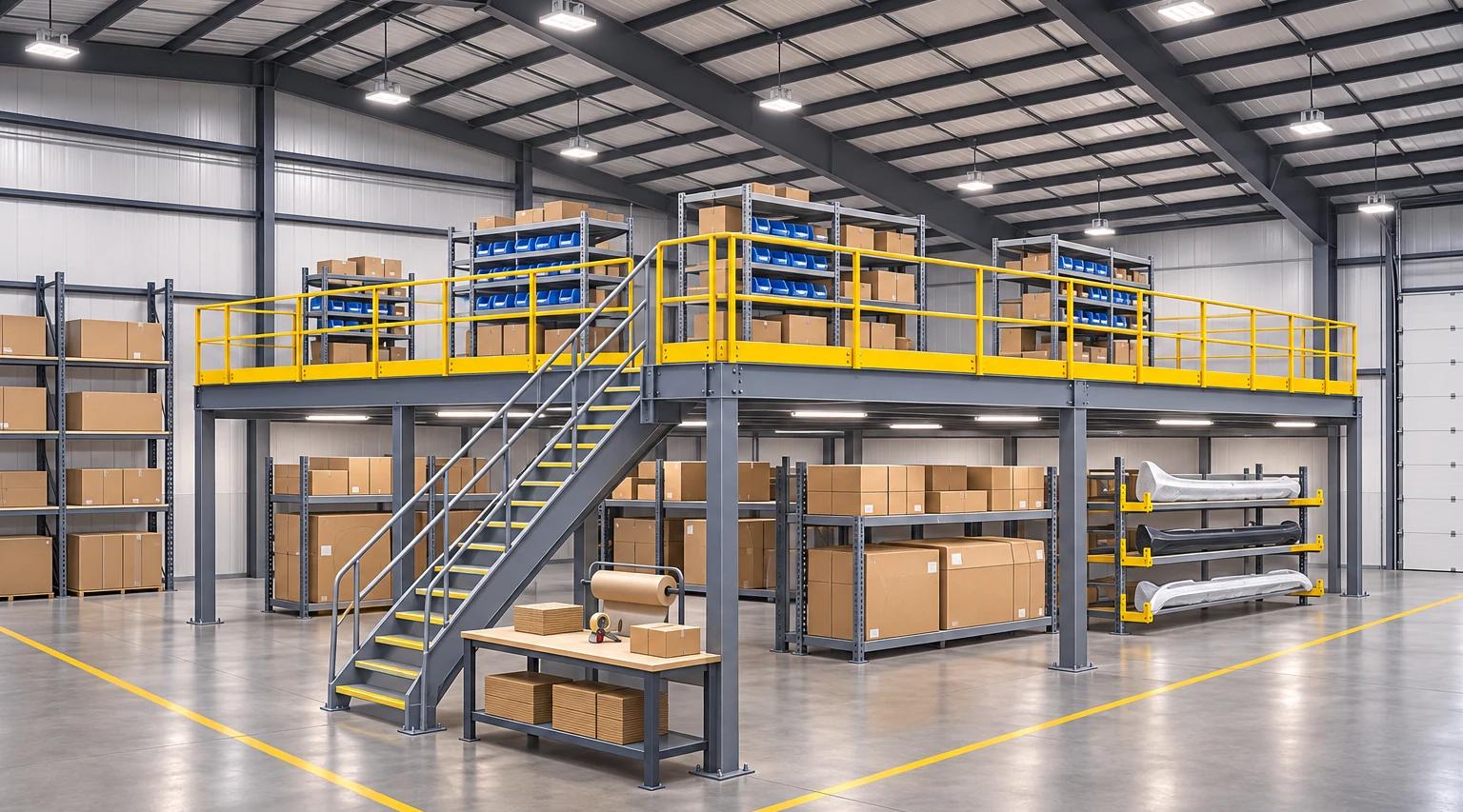
An automotive parts mezzanine should be planned from the inventory and its handling sequence, not from the number of shelves that fit upstairs. Record packaged dimensions, weights, picking units and replenishment routes before choosing which activities move to another level. Keep bulky, sensitive and exception stock visible in the brief.
This guide focuses on commercial vehicle-parts distribution: small bins, mixed cartons, larger components and replenishment to pick locations. The warehouse mezzanine guide covers structural options and general warehouse use; the distribution-center guide covers broader receiving and staging. Maintenance stores for an organization's own equipment are a different operating brief.
All three images are AI-generated concept illustrations, not project photographs, approved layouts or measured results. This Cogan-affiliated editorial guide claims no named technical review. Have the responsible designers, equipment suppliers and site safety team review the actual loads, handling arrangements and applicable requirements.
Which parts should be considered for the upper level?
Group inventory by the way it is stored, picked and replenished, then evaluate each group against the proposed layout. A small carton and a long body component can require different handling arrangements even when both belong to the same vehicle family. Do not force every item into one storage module.
Start with representative packaged items, including awkward shapes and the largest proposed replenishment unit. Record their dimensions in the condition in which workers actually receive and move them. Keep a separate field for packaging that must stay with the part.
The following is an editorial planning worksheet, not an approved allocation:
| Inventory group | Information to collect | Layout question |
|---|---|---|
| Bagged clips and fasteners | Picking unit, bin quantity and identity controls | Can nearby similar items be distinguished reliably? |
| Filters and boxed service parts | Packaged size, carton quantity and replenishment frequency | Is the pick location sized for the intended stock unit? |
| Dense boxed components | Actual stored weight and handling method | What shelf, support and floor information needs review? |
| Long or bulky components | Packaged envelope, support needs and turning space | Does the complete handling route accommodate the item? |
| Returns and exchange cores | Identity, condition, status and supplier instructions | Where will assessment and disposition occur? |
| Products with special hazards | Applicable product information and restrictions | Which specialist review is required before placement? |
Use the same groups when comparing ground-floor and elevated arrangements. Record why a group is proposed for a location and what evidence would change that decision. The floor-plan guide helps turn these questions into a shared drawing.
How should the pick location and stock unit be defined?
Specify what the worker takes and what replenishment delivers. A bin picked by the piece and a reserve location replenished by the case need an explicit conversion and identification process. Do not let the word “box” stand for several different quantities in the same brief.
GS1 US packaging-level guidance distinguishes eaches, inner packs, cases and other packaging levels. It explains that these definitions support consistent identification, ordering and inventory management. Use the actual supplier and inventory records to establish the relationship between those levels for each item.
For visually similar parts, include a check of the part identifier, package unit and assigned location in the proposed picking process. Keep the organization's product-application or fitment verification process explicit; this layout guide does not determine whether a component fits a vehicle.
At the physical shelf, review reach and handling with the people doing the work. CCOHS storage-layout guidance discusses material flow, bin racks for small items, access space and convenient storage heights. It notes that a convenient height varies between people. These are ergonomic planning considerations, not a shelf load rating or a universal legal storage height.
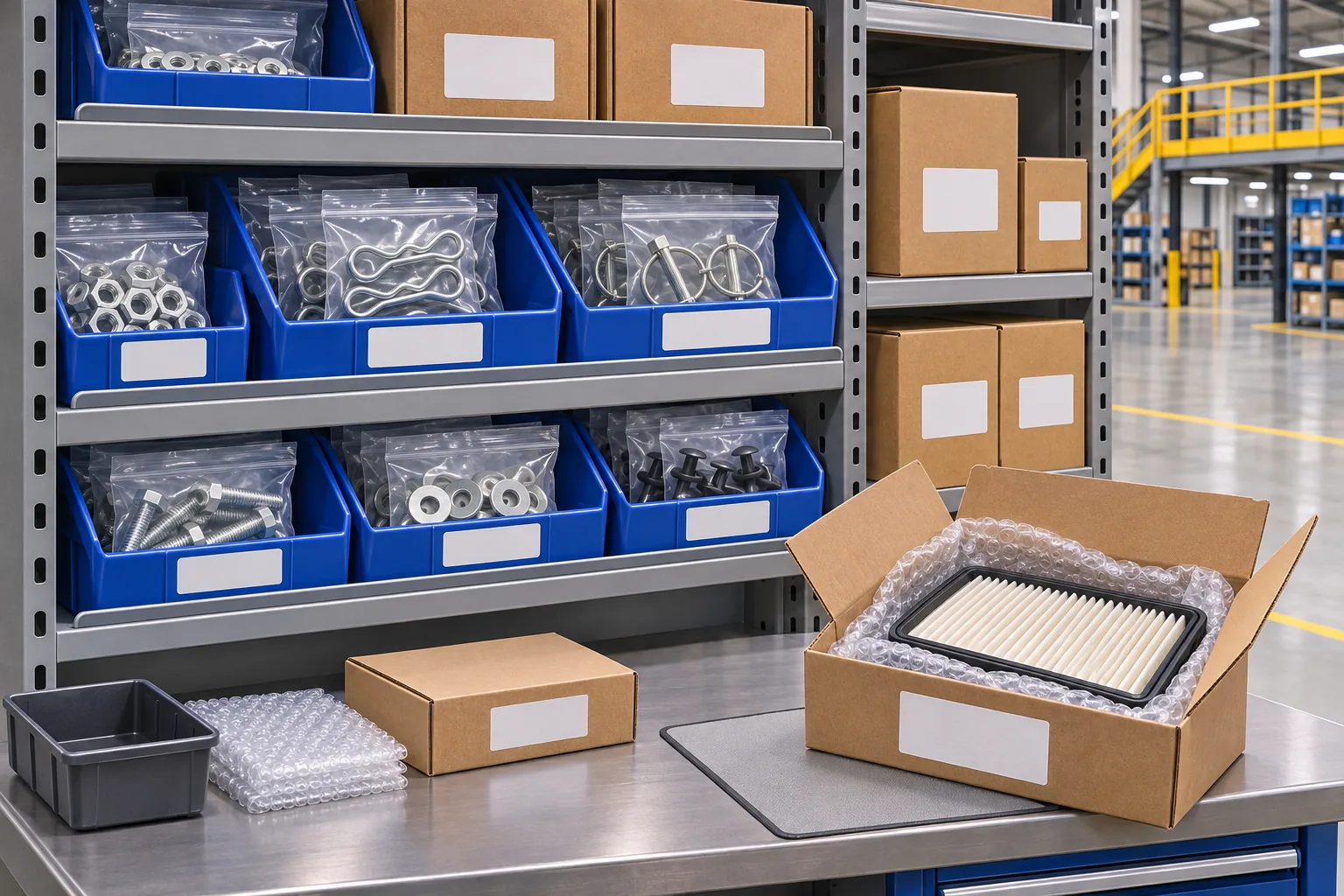
Illustrative storage and identification spaces. Blank label panels are placeholders, not a working barcode or inventory system.
How will reserve stock replenish the picking area?
Trace the replenishment unit from receipt to the final pick location, including its waiting points. Identify the equipment, staffing and responsibilities at each transfer. Evaluate that sequence alongside picking and dispatch instead of assuming the added level operates independently.
Mark reserve storage, the proposed transfer point, the destination and the empty-container return route. Ask what happens when replenishment arrives during an active picking period. A plan should show where goods wait and how the next person knows they are ready to move.
In applicable US workplaces, OSHA 1910.176(a) requires sufficient safe clearances for mechanical handling and clear, maintained passageways. Its storage provisions also address stability and housekeeping. Do not use an aisle or stair approach as unplanned overflow merely because it looks temporarily empty.
Review material-lift selection and transfer-opening protection with the actual load and operating sequence. If a pallet jack is proposed, use the equipment-and-route brief; fitting a pallet into the plan does not establish that the truck or floor arrangement is acceptable.
What load information belongs in the design brief?
Record the stored goods, storage equipment and handling equipment with their locations and support details. Keep a proposed shelf inventory separate from the floor's documented rating. A count of bins or cartons alone is not enough to describe the loading arrangement.
The Storage Manufacturers Association FAQ distinguishes distributed, concentrated and rolling loads and asks users to provide usage and loading information for platform design. It explains that both the decking and underlying structure can limit capacity. Its guidance is advisory, not approval for a particular automotive inventory.
Use the updated load-capacity guide and its records table to identify what is known about an existing mezzanine. Include the shelf or rack supplier's information and proposed layout in the same review package. Do not assign capacity from the product category “automotive parts” or from a photograph of another warehouse.
Where should returns and exchange cores go?
Give returns an identifiable status, assessment location and disposition owner before they enter ordinary replenishment. Distinguish a customer return awaiting examination from saleable stock and from a used core awaiting a supplier decision. Define who can change that status and what evidence they retain.
Bosch's starter and alternator core-return brochure provides a concrete supplier-program example: it describes identification and condition criteria and a Back-in-Box process using original eXchange packaging. The brochure is marked October 2025 and comes from Bosch's European program materials. Confirm the actual supplier and regional terms; it does not establish a universal North American return policy or guaranteed credit.
As a planning exercise, follow an unidentified return from arrival to a documented decision. Show where it waits, how it stays distinguishable from available inventory and how its packaging and records remain associated. Keep these locations in the space plan rather than letting exception stock accumulate beside pick bins.
Special-product exceptions need their own review
List any products whose hazards, packaging or handling requirements fall outside the ordinary dry-parts brief. Do not treat batteries, aerosols or packaged chemicals as interchangeable with inert boxed components merely because they arrive through the same receiving door.
Within its US scope, OSHA 1910.1200 addresses hazard communication. It includes provisions for operations handling sealed containers, covering incoming labels, safety-data-sheet information and relevant employee information and training. Applicability depends on the product and operation; the section is not a mezzanine fire-design specification.
Have the responsible team determine the required product, fire-protection and handling review for the inventory actually proposed. Record exclusions until those decisions are resolved. This guide supplies no blanket hazardous-product storage quantity, compartment arrangement or approval.
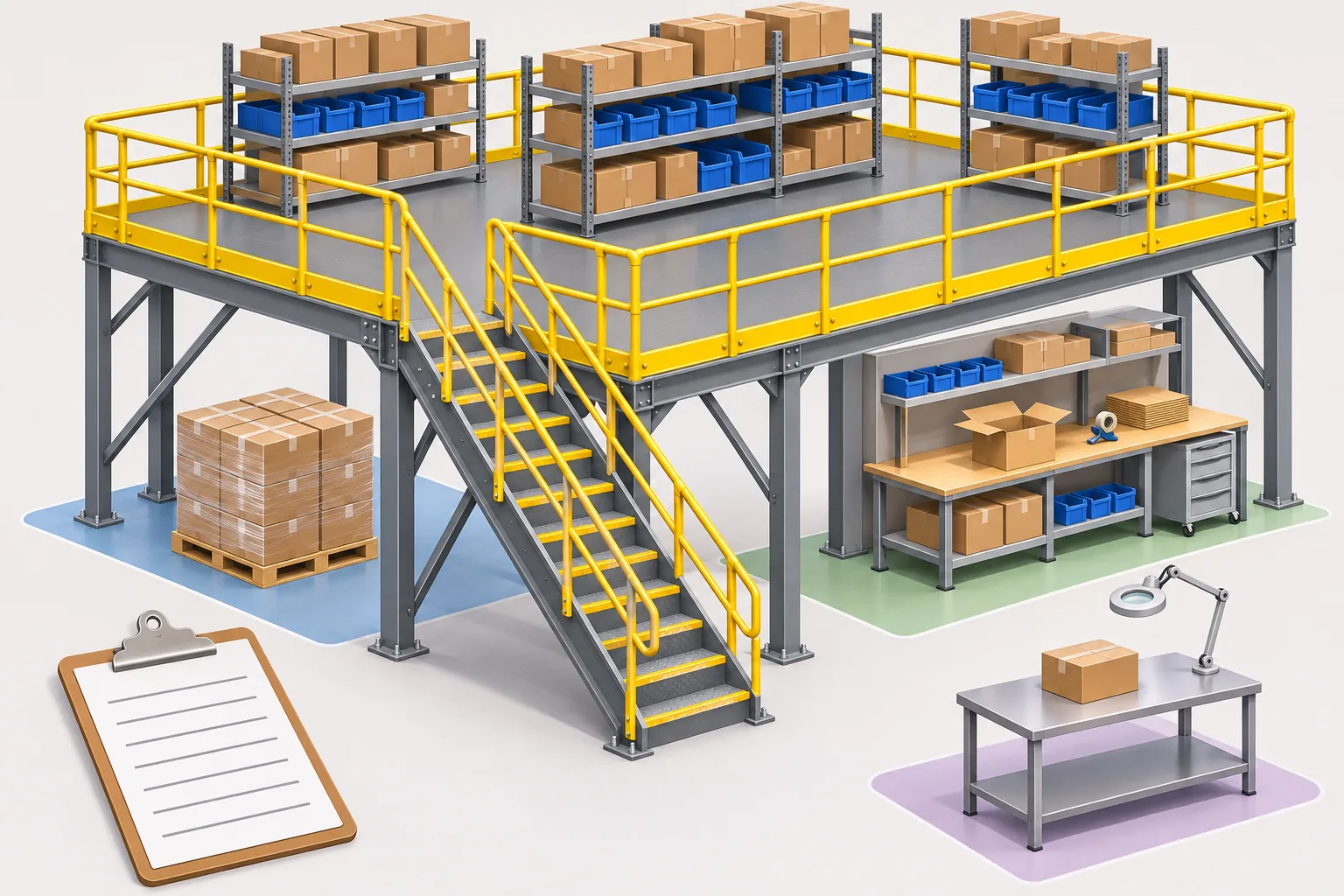
Concept areas for discussing the workflow. The illustration does not specify a transfer system, storage capacity or approved layout.
How should the proposed operation be checked before adoption?
Walk through representative orders and replenishment tasks, then record unresolved questions and the decisions needed to close them. Include awkward items and exception stock as well as routine small parts. Use real operating observations when available; label proposed scenarios as hypothetical.
For example, trace an order that combines bagged clips, a boxed filter and a bulky packaged component. Identify the pick unit, route and consolidation point for each. Then trace replenishment to the emptied location and a returned item arriving while that work is underway. This is an illustrative scenario, not a report of a completed project or measured improvement.
Agree on what the team will measure: travel, transfer waits, replenishment interruptions, identification errors and exception handling. Define the observation period and operating conditions so comparisons have meaning. Extra floor area does not by itself prove faster picking or fewer mistakes.
Close the project planning checklist with the inventory brief, reviewed layout, equipment information, responsibilities and outstanding items. Keep future changes to parts, packaging and handling methods visible as review triggers.
What to read next
- Warehouse mezzanines — compare the broader layout and structural options.
- Distribution-center mezzanines — coordinate receiving, staging and replenishment.
- Pallet-jack equipment and route planning — collect actual wheel and operating information.
Put this guide into practice
Frequently asked questions
- Which automotive parts should go on a mezzanine?
- Evaluate the actual packaged parts, quantities, handling tasks and replenishment routes before allocating locations. Small-item picking may be a candidate, but dimensions alone do not establish suitable loads, handling conditions or structural capacity. Keep exceptions visible for specialist review.
- Should fast-moving auto parts always be stored upstairs?
- No. Compare the complete receiving, replenishment, picking and dispatch sequence. Frequent demand can also mean frequent transfers, so evaluate the proposed route and transfer capacity rather than using sales frequency as the only placement rule.
- What inventory data does an automotive mezzanine brief need?
- Record part identity, packaged dimensions and weight, stock and picking units, quantities, handling method, replenishment pattern and status restrictions. Include the supplier document or observation behind each field and mark unknown information explicitly.
- Can returned cores share locations with saleable parts?
- Plan identifiable locations and a controlled disposition process so returned cores are not treated as saleable stock. Confirm the supplier's identification, packaging and return criteria for the actual program, and record who authorizes each status change.
- Does adding a mezzanine guarantee faster order picking?
- No. Compare measured travel, transfer waits, replenishment interruptions and picking errors under defined operating conditions. Extra floor area is a physical change; a productivity claim requires evidence from the actual operation.
Continue planning your mezzanine
All Complete Guide guides →
Complete Guide
Warehouse Mezzanine Floors: Storage, Layout & Costs
Plan a warehouse mezzanine floor for storage, picking, packing or offices. Compare layouts, material flow, project examples and the scope of supplier quotes.
Complete Guide
What Is a Mezzanine Floor? Meaning, Types & Uses
What is a mezzanine floor? Learn its meaning, industrial types and warehouse uses, then compare flooring, material lifts and the questions to ask before buying.
Engineering
Free-standing vs rack-supported vs structural mezzanines: a buyer's decision framework
The three structural types of industrial mezzanine — free-standing, rack-supported, and structural — solve different problems. Here's how to pick the right one based on use case, flexibility, cost, and code path.