

Mezzanine railing requirements: the 42-inch rules, and the exceptions nobody publishes
The IBC wants a guard at 30 inches; OSHA waits until 4 feet. Both say 42 inches tall — then disagree on openings and strength. The exceptions, sourced.
Editorial & Engineering Team
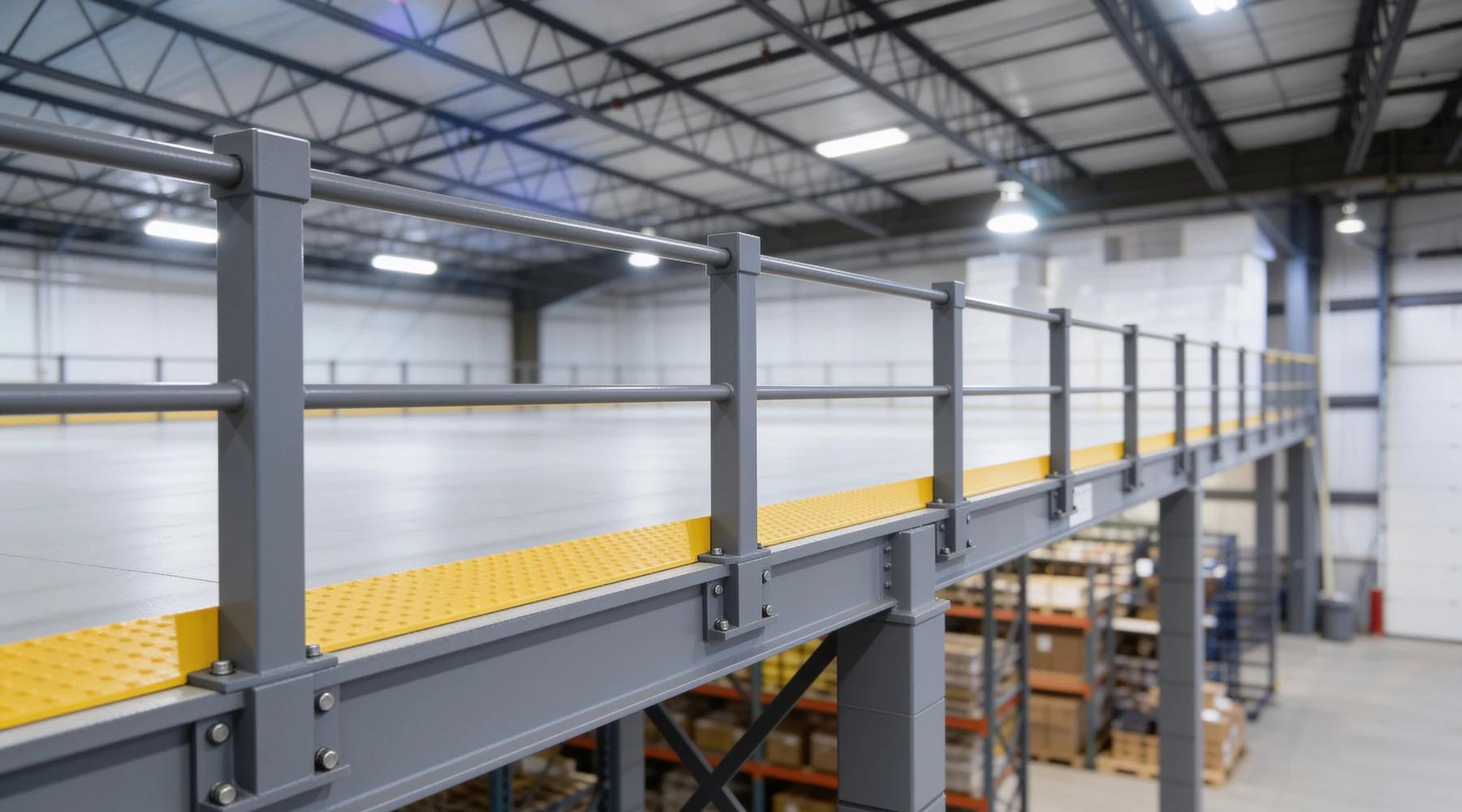
Search "mezzanine railing" and every result prints the same four numbers: 42 inches, plus or minus 3, 200 pounds, 4-foot trigger. Those numbers are real. They are also the easy half of the problem, and several page-one results attach them to the wrong regulation entirely.
The harder half is that two separate rulebooks govern the same piece of steel, and they disagree on when it's required, what the gaps can be, and how strong it has to be. This article is the comparison, worked from the code text, with the exceptions that actually change what gets built. Our OSHA mezzanine requirements guide is the single-rulebook reference for 1910 — this one is the collision between 1910 and the building code, and the carve-outs buried in both.
At what height does a mezzanine need a railing?
The two rulebooks trigger at different heights, and the building code triggers first. IBC 1015.2 requires a guard where the drop exceeds 30 inches. OSHA 1910.28(b)(1)(i) doesn't trigger until 4 feet. An 18-inch gap where the IBC applies and OSHA doesn't.
The IBC's wording is more specific than most summaries admit. Guards are required along open-sided walking surfaces — the section names "mezzanines, equipment platforms, aisles, stairs, ramps and landings" explicitly — located more than 30 inches above the floor below "at any point within 36 inches horizontally to the edge of the open side." That horizontal qualifier matters: a deck 30 inches above a raised platform that itself drops further away is measured against the lower surface if it falls inside that 36-inch band.
OSHA's trigger is simpler and higher. At 4 feet or more above a lower level, an employee must be protected by "guardrail systems; safety net systems; [or] personal fall protection systems" — a menu, not a mandate for railing.
And federal OSHA is not the floor everywhere. California's Title 8 §3210(a) applies its fall-protection requirement to "working levels more than 30 inches above the floor, ground, or other working areas" inside buildings — matching the IBC, not federal OSHA. If you operate in a state-plan state, check the state text before assuming 4 feet.
For practical purposes on a mezzanine this argument is usually academic: almost no mezzanine is under 4 feet. It stops being academic on low equipment platforms, transfer decks, and the intermediate landings covered in our work platform and catwalk comparison.
How high does a mezzanine railing have to be?
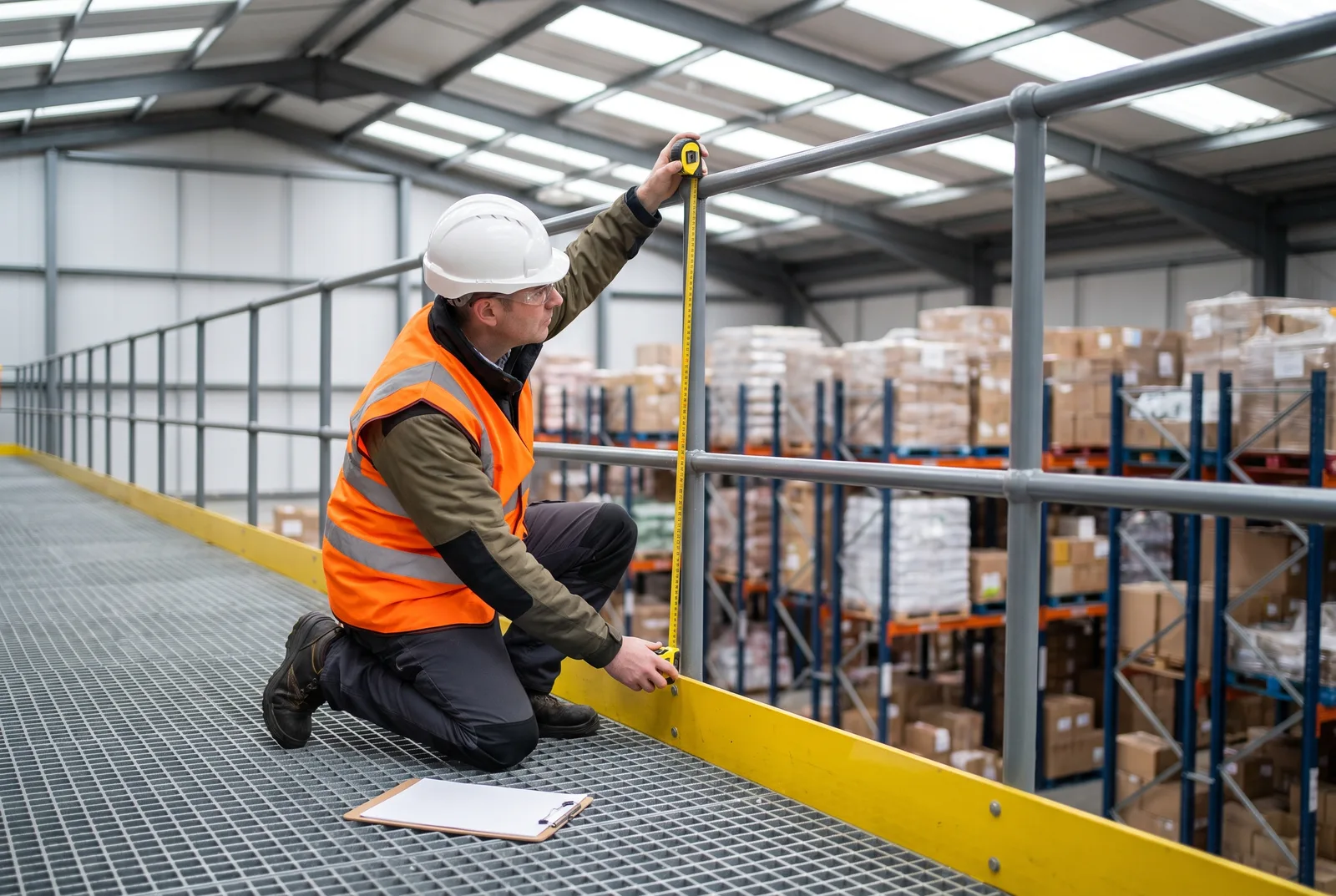
Both say 42 inches — but only one of them allows you to miss. OSHA 1910.29(b)(1) specifies 42 inches "plus or minus 3 inches," making 39 to 45 inches compliant. IBC 1015.3 sets 42 inches as a minimum with no tolerance below it.
So a 39-inch rail passes an OSHA inspection and fails a building inspection. Build to 42 and the question disappears.
Two wrinkles worth knowing:
- OSHA permits a top rail higher than 45 inches provided the system still meets every other criterion in 1910.29(b).
- The IBC has a Group F carve-out at 1015.3 Exception 6: in factory occupancies where exit access stairways serve fewer than three stories and aren't open to the public, and the top of the guard also serves as the handrail, the guard may be 34 to 38 inches. It's the one place the code lets a guard sit below 42.
There's also a quiet interaction with the mezzanine definition itself. IBC 505.2.3 requires a mezzanine to be open and unobstructed to the room below "except for walls not more than 42 inches in height". Your guard is required to reach 42 inches and your enclosure is capped at 42 inches — the same number doing two different jobs. Solid infill above that line stops being a guard and starts being a wall, with consequences for the openness test covered in our IBC mezzanine requirements guide.
Do the openings in a mezzanine guard have to stop a 4-inch sphere?
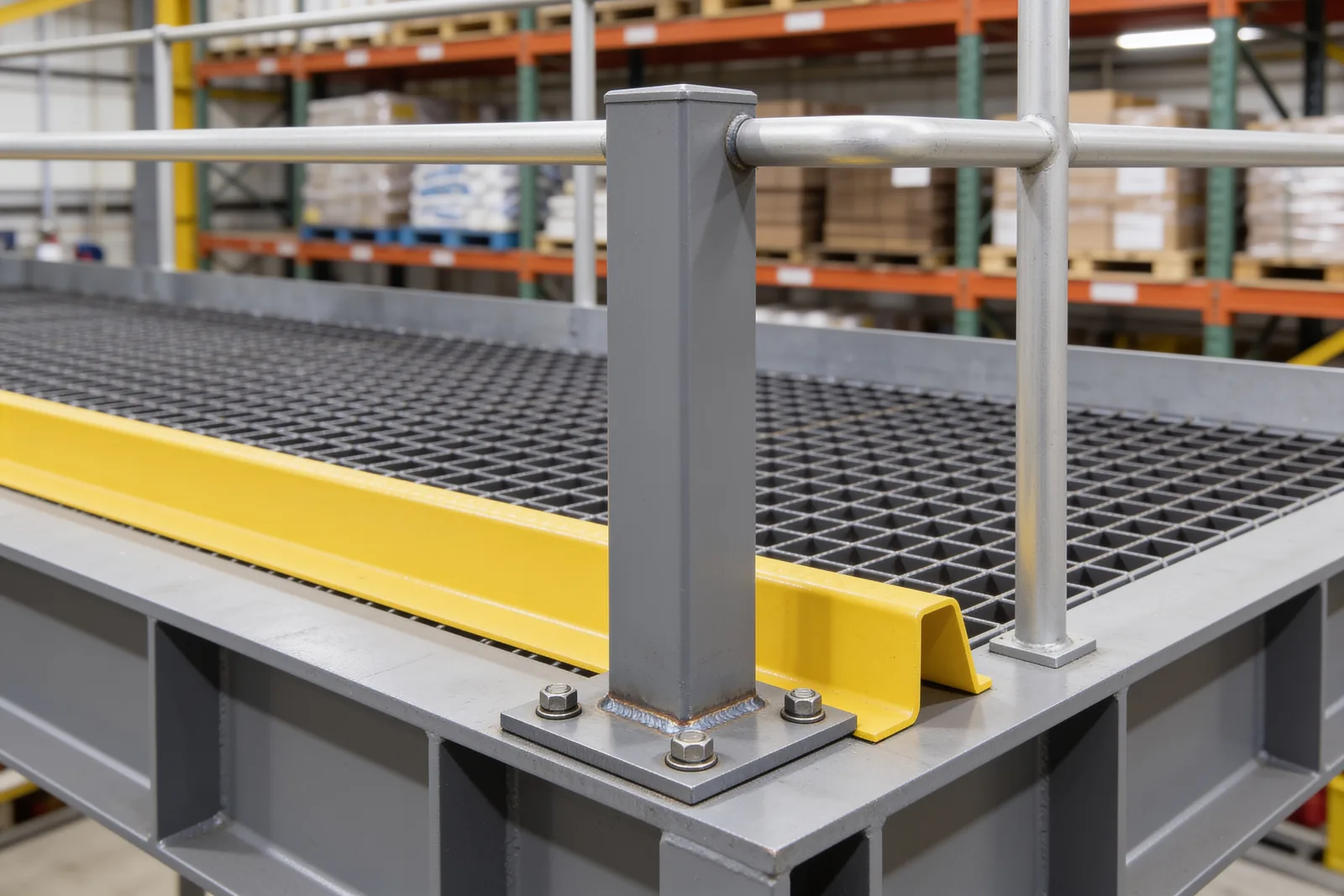
In a warehouse, usually not — and this is the single most valuable exception in the topic. IBC 1015.4 sets the 4-inch sphere rule. Exception 4 raises it to a 21-inch sphere in areas not open to the public within Group I-3, F, H and S occupancies.
The full text: "In areas that are not open to the public within occupancies in Group I-3, F, H or S, and for alternating tread devices and ships ladders, guards shall not have openings that allow passage of a sphere 21 inches in diameter."
ICC's own commentary states the consequence plainly — the exception "allows the use of one horizontal intermediate member with the standard top-of-guard height of 42 inches." In other words: a plain two-rail industrial guard, top rail and one midrail, is IBC-compliant on a non-public factory or storage mezzanine. You do not need picket infill or mesh. Nobody ranking for this query says so.
The other openings exceptions in 1015.4, for completeness:
| Condition | Sphere limit |
|---|---|
| General requirement, walking surface to guard height | 4 in |
| Between 36 in and 42 in above the walking surface | 4⅜ in |
| Triangular opening at the open side of a stair (riser, tread, bottom rail) | 6 in |
| Elevated access to electrical, mechanical or plumbing equipment | 21 in |
| Non-public areas in Group I-3, F, H, S; alternating tread devices; ships ladders | 21 in |
OSHA approaches the same problem differently. 1910.29(b)(2) requires intermediate protection only when there's no wall or parapet at least 21 inches high, and then offers four ways to provide it: a midrail installed midway, a screen or mesh filling the full opening, intermediate vertical members no more than 19 inches apart, or equivalent members with openings no more than 19 inches wide.
That 19-inch figure is widely misread as a maximum gap for any guard. It isn't — it governs vertical members and equivalent members. A midrail installed midway is a separate compliance path under (b)(2)(i), which is why a standard 42-inch two-rail guard with the midrail near 21 inches leaves roughly 19½ inches clear above and below and is still compliant. Manufacturers build to exactly that geometry: Cogan's published mezzanine specification lists a 19½-inch clear opening for its two-rail system and 10½ inches for the three-rail version.
How strong does a mezzanine railing have to be?
The IBC's load case is the harder one, and it has no OSHA equivalent. OSHA tests a point: 200 pounds. The IBC tests the whole rail: 50 pounds per linear foot along the top, per 1607.9.1 in the 2021 edition.
Run the arithmetic at a real post spacing. Cogan specifies posts at no more than 72 inches on center; California's §3209 caps metal-post spacing at 8 feet. At 6-foot spacing, the IBC's 50 plf delivers 300 pounds to a single bay — one and a half times OSHA's entire point-load test, applied continuously. A rail that passes 1910.29(b)(3) is not automatically a rail that passes 1607.9.1.
The IBC softens this for industrial buildings, too. Exception 2 to 1607.9.1 drops the requirement to 20 plf in Group I-3, F, H and S occupancies with an occupant load under 50 that aren't accessible to the public — the same 20 plf figure California uses. Two exceptions, same occupancy list, both unmentioned on page one.
The complete load picture:
| Load case | IBC (2021) | OSHA 1910.29 |
|---|---|---|
| Trigger height | >30 in, within 36 in horizontally | ≥4 ft |
| Minimum height | 42 in, no tolerance | 42 in ±3 in (39–45 in legal) |
| Uniform load on top rail | 50 plf (20 plf, non-public F/H/S/I-3, OL<50) | none specified |
| Concentrated load | 200 lb | 200 lb, within 2 in of the top edge |
| Deflection limit | not specified as a height floor | must not deflect below 39 in |
| Intermediate rail / infill | 50 lb on 1 ft², non-concurrent | 150 lb |
| Openings | 4-in sphere (21-in sphere, non-public F/H/S/I-3) | 19 in for vertical/equivalent members |
| Toeboard | not in §1015 | 3.5 in min, ≤¼-in floor gap, 50 lb |
| Alternatives permitted | Z359.1 anchorage, at 1015.6 and 1015.7 only | nets or personal fall protection |
Two notes on that table. The IBC's infill load — 50 pounds applied to any 1 square foot, "including openings and space between rails" — is explicitly not required to act concurrently with the 50 plf or 200 lb cases, so it's checked separately, not stacked. And section numbering moves between editions: 1607.9.1 is the 2021 and 2024 location, and earlier editions number it differently. Confirm against the edition your jurisdiction actually adopted, which our permit lookup tool will help you identify.
Is a handrail the same thing as a guardrail?
No — and ICC's commentary says so directly. Handrails "are sometimes incorrectly called 'guardrails'"; the handrail is grasped during vertical travel, while a guard exists to stop a fall from an elevated edge. Different heights, different jobs, and a stair frequently needs both.
- IBC handrail: 34 to 38 inches above the tread nosings (1014.2); 30 to 34 inches for alternating tread devices and ships ladders
- OSHA handrail: 30 to 38 inches from the leading edge of the tread, with at least 2.25 inches of hand clearance
- OSHA stair rail system: this is where installation date decides the answer. Systems installed before January 17, 2017 need a top rail at least 30 inches. Systems installed on or after that date need 42 inches, with a separate handrail — the top rail may double as the handrail only when it falls in the 36-to-38-inch band. OSHA restated this split in a 2019 letter of interpretation and said it would use enforcement discretion pending a clarification.
That date is why so many older mezzanine stairs measure 30-something inches at the rail and were legal when built. Retrofit triggers the current rule. Our mezzanine stairs guide works the full stair geometry.
Can cable railing, or a harness, replace the guard?
A widely-cited OSHA rule about wire rope does not apply to your warehouse. The requirement to flag wire-rope top rails "at not more than 6-foot intervals with high-visibility material" lives in 1926.502(b)(9) — the construction standard. A mezzanine in an operating facility falls under 1910, and 1910.29(b) contains no wire-rope provision at all.
What 1910.29(b) does say about materials is narrower and stricter than most people expect: steel banding and plastic banding are prohibited as top rails or midrails, rails must be at least ¼ inch in diameter or thickness, and manila or synthetic rope used as a rail must be inspected as necessary to keep meeting the strength criteria. Cable is not addressed — which means it must be shown to meet the 200/150-pound criteria on its own merits, not assumed compliant by analogy to the construction rule.
On harnesses: OSHA offers personal fall protection as a co-equal alternative to guardrails. The IBC generally does not — with two documented exceptions. Sections 1015.6 and 1015.7, covering mechanical equipment and roof hatches within 10 feet of an edge, both state that guards are not required "where personal fall arrest anchorage connector devices that comply with ANSI/ASSE Z359.1 are installed." Narrow, but real, and it falsifies the flat "the IBC never allows PFAS" claim printed on several competing pages.
Openings in the guard line get their own rules. OSHA 1910.29(b)(10) requires a removable guardrail section with a top rail and midrail across a hoist-area access opening whenever hoisting isn't in progress — a chain does not qualify. Ladderway openings under (b)(13) need a self-closing gate that slides or swings away from the hole, or an offset that prevents walking straight into it. Both are covered in depth in our mezzanine safety gates and mezzanine ladder guides.
What do manufacturers actually build?
Published specifications, cited by name, so you can compare a quote against something:
| Manufacturer | Rail section | Posts / spacing | Kick plate |
|---|---|---|---|
| Cogan | 1½-in square profile | ≤72 in o.c., bolted to beam web or top flange | 6 in |
| Wildeck | 14-ga 1½-in square tube | 2½ × 2½ × ⅛ HSS uprights, ½-in A325 bolts | 14-ga formed angle, 2×5 to 6½×6½ |
| Panel Built | 1½-in × 11-ga square tube | not published | 4 in × 14 ga |
| PortaFab | 2-in round pipe, top and center | panelized factory-welded sections | 2 × 4 rectangular tube |
The most telling line in that whole set isn't a dimension. Panel Built's specification states that "Standard handrail designs include OSHA, IBC Factory Use Group, IBC Merchantile Use Group, and BOCA." A manufacturer sells the OSHA rail and the IBC rail as different products — which is this article's thesis, printed on a price sheet. PortaFab draws the same line, offering two-rail designs for IBC and OSHA and three-rail for the UBC.
Wildeck's CSI guide specification makes the same point by leaving a blank: the system "shall conform to OSHA requirements. (If applicable code exceeds OSHA requirements, specify here: ______)." The manufacturer will not guess which rulebook you're under. That is the specifier's call, and it belongs in the quote before fabrication, not after — see our buying guide on what a quote assigns to you.
On price: no manufacturer publishes a cost per linear foot. We checked Wildeck, PortaFab, Cisco-Eagle, Panel Built, Steele Solutions and Cogan. Even distributor listings for stock 42-inch two-rail handrail show "Call for Price." Figures circulating in AI summaries and vendor blogs are not traceable to a published source, so we're not repeating them.
What does getting it wrong cost?
Current OSHA maximums, effective for penalties assessed after January 15, 2026: $16,550 per serious or other-than-serious violation, $16,550 per day for failure to abate, and $165,514 for willful or repeated violations.
Worth an honest caveat, though. Neither 1910.28 nor 1910.29 appears in OSHA's FY2025 top-10 most-cited standards — the number-one entry is 1926.501, the construction fall standard. General-industry guardrail failures are not a high-frequency citation. The realistic downside of a wrong rail isn't usually a fine; it's a plan reviewer rejecting the drawings, or a certificate of occupancy held while a compliant rail is fabricated and installed. That sequence is why the code question belongs at the permit stage, not at punch list.
Nothing here is a substitute for a licensed design professional or your local AHJ. Guard loads are structural design, editions and amendments vary by jurisdiction, and the occupancy classification that unlocks every exception above is the AHJ's call, not the vendor's.
The four decisions, in order
- Establish the occupancy group and whether the area is public. Every meaningful exception — the 21-inch sphere, the 20 plf load, the 34-to-38-inch Group F guard — hangs on this and nothing else.
- Confirm the code edition your jurisdiction adopted. Section numbers move; 1607.9.1 is the 2021 and 2024 address for guard loads.
- Specify to the stricter of the two rulebooks, in writing. 42 inches flat, and design the rail to the IBC's uniform load, not just OSHA's point load.
- Handle the openings deliberately — hoist gaps, ladderways, and stair entries fail more inspections than the straight runs do. See our load capacity guide for how rail loads sit alongside deck loading.
What to read next
- OSHA mezzanine requirements — the complete 1910 picture for platforms, gates, and egress
- Mezzanine safety gates — swing, sliding, lift-out and pivot gates, and the rule that disqualifies half of them
- Mezzanine stairs requirements — IBC vs OSHA stair geometry, with the numbers
Put this guide into practice
Frequently asked questions
- How high does a mezzanine railing have to be?
- Both rulebooks land on 42 inches, but not identically. OSHA 1910.29(b)(1) specifies 42 inches plus or minus 3 inches, so anything from 39 to 45 inches complies. IBC 1015.3 sets 42 inches as a flat minimum with no downward tolerance. Build to 42 inches and you satisfy both.
- At what height does a mezzanine need a guardrail?
- It depends which rulebook you are under. IBC 1015.2 requires a guard wherever the drop exceeds 30 inches measured at any point within 36 inches horizontally of the edge. OSHA 1910.28(b)(1)(i) does not trigger until 4 feet. California is stricter than federal OSHA at 30 inches indoors.
- Do mezzanine guard openings have to block a 4-inch sphere?
- Often not. IBC 1015.4 sets the 4-inch sphere rule, but Exception 4 raises it to a 21-inch sphere in areas not open to the public within Group I-3, F, H and S occupancies. ICC's own commentary says this allows one horizontal intermediate member at the standard 42-inch guard height.
- How strong does a mezzanine guardrail have to be?
- OSHA requires 200 pounds applied within 2 inches of the top edge, with the rail not deflecting below 39 inches. The IBC adds a load OSHA has no equivalent for: 50 pounds per linear foot along the top, reduced to 20 plf in non-public F, H, S and I-3 areas with an occupant load under 50.
- Is a handrail the same thing as a guardrail?
- No, and ICC's commentary says the two are commonly confused. A guard keeps people from falling off an elevated edge and sits at 42 inches minimum. A handrail is grasped for support during vertical travel and sits at 34 to 38 inches under IBC 1014.2. A stair often needs both.
Continue planning your mezzanine
All Code & Permits guides →
Code & Permits
Mezzanine Fire Sprinkler Requirements: NFPA 13 Guide
Review mezzanine sprinkler requirements, below-deck obstructions and open grating. Understand the design questions to resolve with your fire-protection team.
Code & Permits
Mezzanine Permit Requirements: Drawings & Approvals
Prepare a mezzanine permit application: drawings, structural review, building codes and inspections. Find state resources and understand the approval process.
Code & Permits
IBC 2024 Mezzanine Requirements: Area, Height & Egress
Explore IBC 2024 mezzanine requirements for floor area, clear height, openness and egress, with links to stair, sprinkler and state permit guides.