

Pallet rack inspection: the RMI rules, the code that adopts them, and the duty that attaches when rack carries a walkway
OSHA has no pallet rack inspection standard — but MH16.1 reaches US law through the IBC, and a rack carrying a walkway triggers a mandatory federal duty.
Editorial & Engineering Team
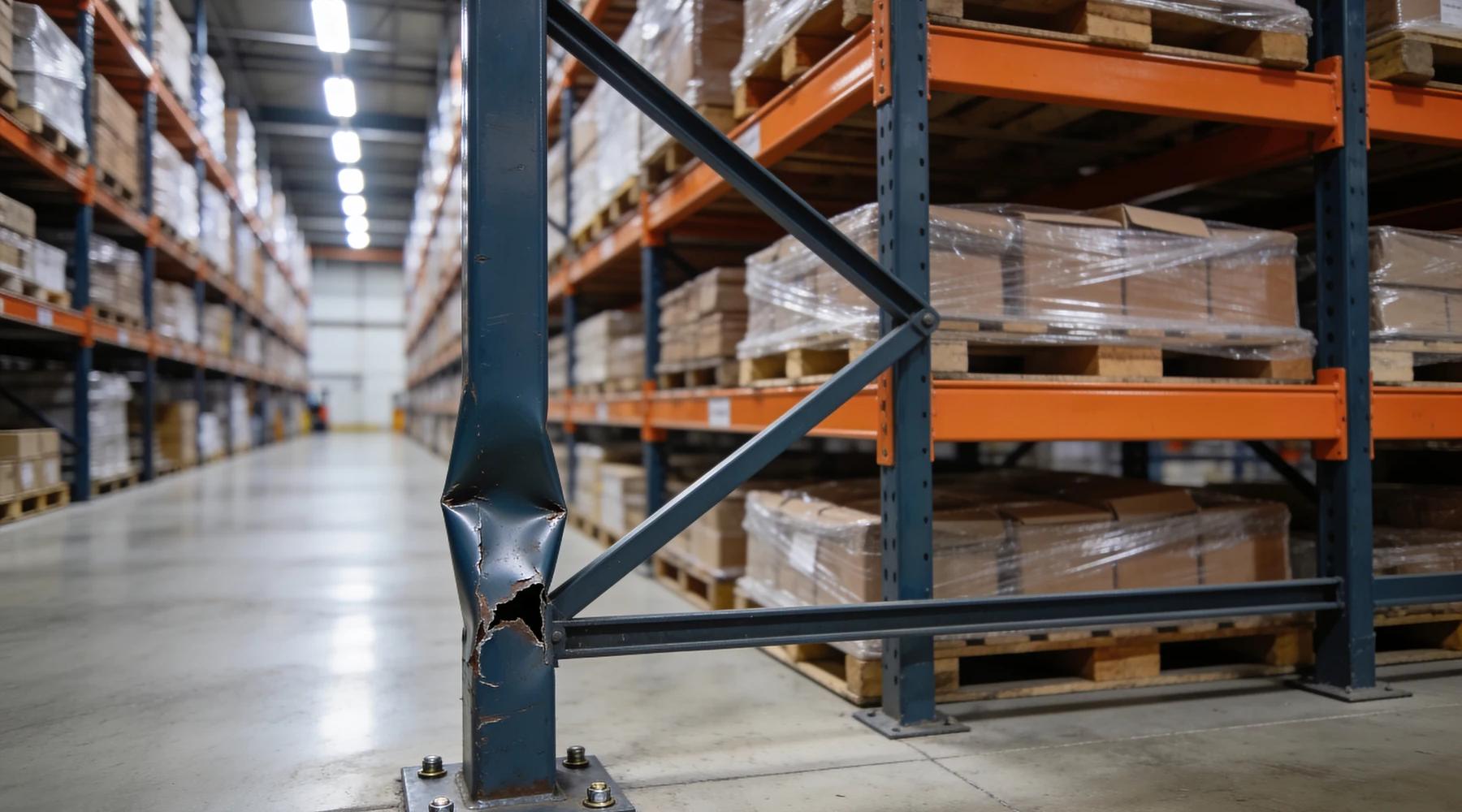
Search "pallet rack inspection" and every result argues the same question: does OSHA require it? The honest answer is no — there is no OSHA standard written for storage racks. But that answer sends readers to the wrong place, because it misses where the enforceable duty actually lives.
This article covers the rule stack for pallet rack inspection and, specifically, what changes when that rack is holding up a walking surface — a pick module, a catwalk, or a rack-supported mezzanine. That is the distinct angle here: our ANSI MH16.1 vs the IBC guide covers which code governs a rack-supported structure at design time; this one covers the owner's duty afterward, for the life of the structure.
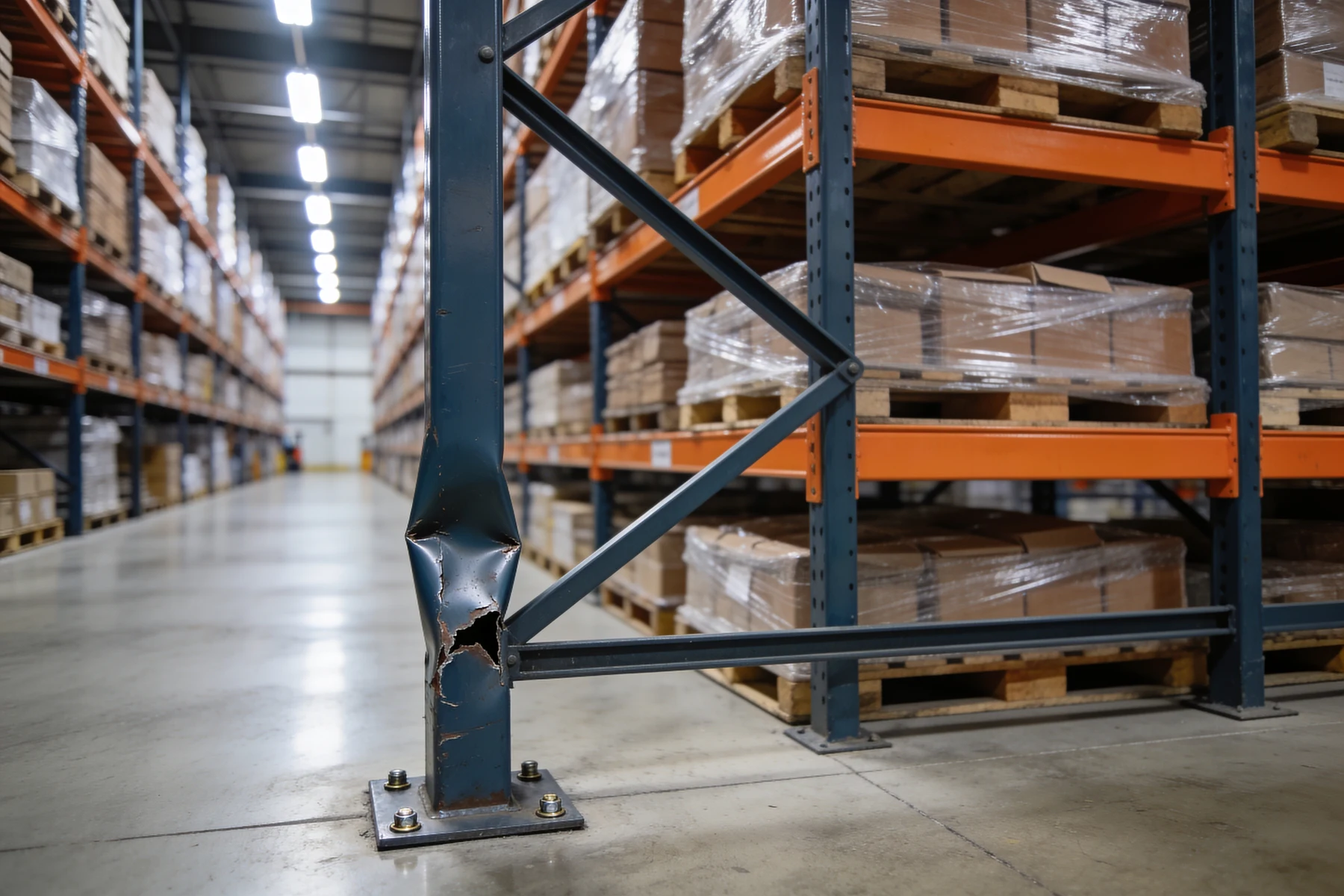
Does OSHA require pallet rack inspections?
Not as such. No OSHA standard is written for storage racks, and no federal rule prescribes a rack inspection interval. OSHA reaches rack conditions through general provisions instead — and through one specific standard that becomes mandatory the moment people walk on the structure.
The general-industry hooks are these:
- Section 5(a)(1) of the OSH Act, the General Duty Clause, requires each employer to furnish a workplace "free from recognized hazards that are causing or are likely to cause death or serious physical harm".
- 29 CFR 1910.176(b) requires that "Storage of material shall not create a hazard" and that material stored in tiers be stacked, blocked, interlocked and limited in height so it is stable and secure against sliding or collapse. Read it closely: it governs the stored material, not the rack steel.
- 29 CFR 1910.176(a) requires sufficient safe clearances for aisles, and that aisles be kept clear and in good repair.
OSHA also does something more interesting on its own warehousing page. Under "National Consensus Standards and Recommendations from other Professional Organizations," it lists ANSI MH16.1 and ANSI MH32.1 by name — while stating in an alert box directly above the list that "these are NOT OSHA regulations and compliance with them does not imply compliance with applicable OSHA standards." That is the precise legal posture: OSHA recognizes the standards as industry consensus, which matters for General Duty purposes, while denying them regulatory status.
What does ANSI MH16.1 actually require of a rack owner?
MH16.1 puts an affirmative inspection duty on the owner and requires immediate isolation of damage — but it names no interval. The 2023 edition's Section 4.4, as published by the Rack Manufacturers Institute on its own safety site, requires owners to "implement inspection, maintenance, and reporting procedures to identify any visible damage or other conditions that could affect the load capacity or structural performance" of the rack system.
What follows discovery is the part most checklists get wrong:
"Upon identification of such conditions, the owner shall immediately isolate the affected portions of the industrial storage rack system and initiate a mitigative response, such as repair or replacement of the affected portions of the rack system. Before allowing the storage rack system to be placed back into service, a registered design professional shall certify that the storage rack system and/or the repaired components have been restored to at least their original design capacity." — RMI, quoting MH16.1 §4.4
The verb is isolate, not "unload." And the exit criterion is not "looks fine now" — it is certification by a registered design professional that original design capacity has been restored.
RMI's Guidelines for the Assessment and Repair or Replacement of Damaged Rack v3.0, approved May 23 2023, fills in the roles. The owner is responsible for maintaining a safe rack system, keeping drawings and engineering documentation current, maintaining load capacity plaques, conducting regular inspections, and selecting a supervising engineer and repair provider. The supervising engineer is a defined role — a person who by degree, certificate, professional standing or extensive experience has demonstrated an ability to resolve problems in the subject matter — and MH16.1 "requires that all damaged storage rack systems be isolated and evaluated by a supervising engineer prior to repair or replacement."
RMI is also candid about its own authority, in the same document's preface: it "has no legal authority to require or enforce compliance," and its considerations "are not binding on any person and do not have the effect of law."
That disclaimer is true of RMI. It is not the end of the story.
When does MH16.1 become law?
When your jurisdiction adopts the International Building Code. IBC Section 2209.1 states that the "design, testing and utilization of steel storage racks made of cold-formed or hot-rolled steel structural members shall be in accordance with RMI ANSI/MH 16.1", with seismic design per ASCE 7 §15.5.3 where required.
The word doing the work is utilization. The code adopts more than the design math — it adopts the standard's provisions on how the rack is used and maintained, which is where the owner's inspection duty sits.
One trap: which edition applies is not the newest one. Chapter 35 of the 2021 IBC references ANSI/MH16.1—12 — the 2012 edition — at Section 2209.1, alongside ANSI/MH16.3—16 for cantilever rack. Meanwhile RMI's current published edition is MH16.1-2023. Three editions are live at once, so a bare section number cited without an edition is unreliable.
| Reference | Edition it points to |
|---|---|
| RMI's current published standard | ANSI MH16.1-2023 |
| 2021 IBC, Chapter 35 → §2209.1 | ANSI/MH16.1—12 |
| Cantilever rack, 2021 IBC §2209.2 | ANSI/MH16.3—16 |
The IBC also mandates one genuine rack inspection outright. Section 1705.13.7 requires that steel storage racks and cantilevered racks "8 feet (2438 mm) in height or greater and assigned to Seismic Design Category D, E or F shall be provided with periodic special inspection" per Table 1705.13.7 — covering materials against mill test reports, fabricated rack elements, anchorage installation against ANSI/MH16.1 §7.3.2, and the completed system against the approved construction documents. Note the scope honestly: this is a construction-phase special inspection, not an ongoing in-service obligation. If you are working out whether your jurisdiction pulls this in, our permit lookup tool is the starting point.
How often should pallet racking be inspected?
No US rule sets a number. MH16.1 requires procedures without naming a frequency, 1910.176 contains no inspection provision at all, and IBC §1705.13.7 is installation-phase. Any page telling you "OSHA requires annual rack inspections" is inventing it.
The annual figure that saturates this topic is real — it is just British. The UK Health and Safety Executive's Warehousing and storage: A guide to health and safety (HSG76) sets out a three-level hierarchy under a nominated "person responsible for racking safety" (PRRS):
| Level | HSG76's expectation |
|---|---|
| Immediate | Any employee reports damage to the PRRS as soon as it is observed (¶643) |
| Visual | PRRS ensures inspections "at weekly or other regular intervals based on risk assessment," with a formal written record (¶645) |
| Expert | "A technically competent person should carry out inspections at intervals of not more than 12 months," reporting in writing to the PRRS (¶646) |
HSG76 adds that inspections are normally carried out from ground level unless high-level problems are indicated (¶649), that records of inspections, damage and repairs should be kept (¶651), and — for automated and high-bay systems — that the expert inspection can run on a rolling basis at a minimum of 20% of the installation per year, so the whole system is covered within five years (¶650).
None of that is US law. It is a defensible, published basis for a program, and it is honest to adopt it as such — but it should be labelled, not smuggled in under an OSHA heading.
What actually counts as rack damage?
The traffic-light system everyone quotes is UK guidance, and its numeric thresholds are not published by the bodies usually credited with them. HSG76 ¶652 and Table 11 define the categories:
- Green — surveillance only: below the limit requiring capacity reduction or immediate repair; record as fit for service but flag for re-examination.
- Amber — hazardous damage requiring action as soon as possible: once load is removed, the component must not be reloaded until repaired. Critically, any amber-category damage must be redesignated red if remedial work has not been done within four weeks.
- Red — very serious: offload and isolate the area immediately until repaired, usually by replacement.
HSG76 publishes those categories but no millimetre thresholds; it defers to a SEMA survey guide. SEMA's own public materials confirm the categories and the four-week rule without publishing numbers, so the widely circulated figures (3mm/5mm/10mm over a 1000mm gauge) trace to third-party UK inspection firms rather than to the standards bodies.
Two numbers circulating in US content deserve correcting outright:
- The "½ inch over a 40-inch length" column criterion is not in MH16.1. It conflates two unrelated rules. The half-inch belongs to plumbness and straightness, which RMI states as "0.5 in. per 10 ft of height" — an erection tolerance, cross-aisle and down-aisle. The 40-inch gauge belongs to the European FEM 10.2.04 straightedge rule, where the limits are 1/8, 2/8 and 3/8 inch, not half an inch. (Even the section number is contested: RMI's own guidelines cite §4.11 while at least one manufacturer cites §4.10 of the same edition — which is why the tolerance and edition are worth more than the locator.)
- L/180 is not a damage threshold. RMI states plainly that its beam deflection limit "is not in place to ensure the structural integrity of the beam or rack" but so that personnel working around the rack feel safe seeing normal deflection. It is a serviceability limit measured under load. The permanent-deformation test is separate and effectively zero-tolerance: a beam that does not return to straight when unloaded has been overloaded.
Also worth publishing: no derating formula exists. RMI's requirement is binary — restore to at least original design capacity, certified. Any "X% damage equals Y% capacity loss" table is fabricated.
Why damage gets tolerated at all is stated well in RMI's own guidelines: "Rack damage might not be noticed or might be ignored because the rack structure continues to remain standing." The document records two fatal cases — one where an upright failed after a repair involving butt welding two portions of a column, one where an unprotected column was struck by a hand-operated truck that encroached on the main aisle.
RMI also documents an unengineered reconfiguration that cost 40% of capacity: an owner removed a push-back system's lower beam level for forklift clearance, which increased the unsupported span of the uprights and dropped rated capacity from 3,000 lb to 1,800 lb per pallet — while 3,000 lb pallets kept going up, "loaded 66% over its rated capacity" above the operators driving underneath. Changing a rack configuration is a re-engineering event, and it is worth checking the arithmetic against our load capacity guide and load calculator.

What changes when the rack holds up a walkway?
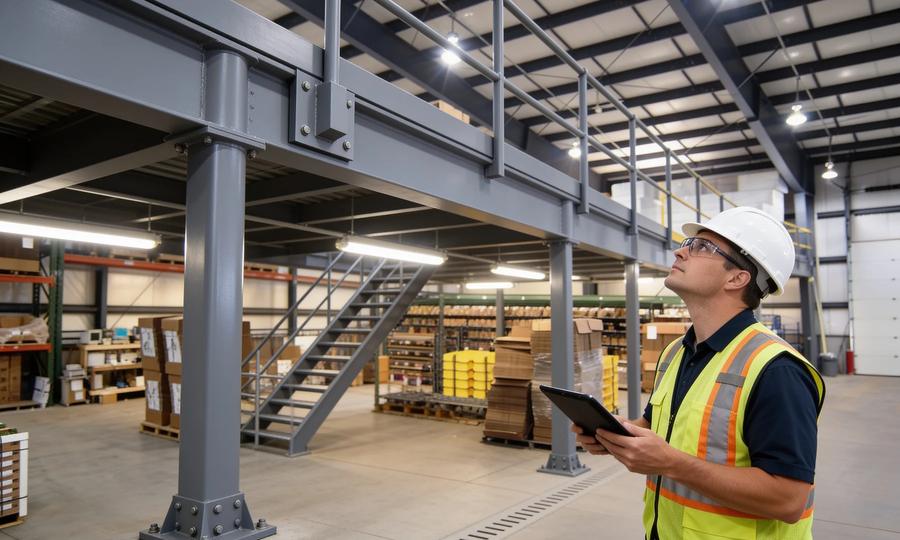
A discretionary inspection becomes a mandatory one. The instant an elevated walking surface sits on that racking, 29 CFR 1910.22(d) attaches — and unlike everything above, it is a federal requirement with no interpretation needed. The employer must ensure:
"(d)(1) Walking-working surfaces are inspected, regularly and as necessary, and maintained in a safe condition; (d)(2) Hazardous conditions on walking-working surfaces are corrected or repaired before an employee uses the walking-working surface again. If the correction or repair cannot be made immediately, the hazard must be guarded to prevent employees from using the walking-working surface until the hazard is corrected or repaired; and (d)(3) When any correction or repair involves the structural integrity of the walking-working surface, a qualified person performs or supervises the correction or repair." — 29 CFR 1910.22(d)
Read (d)(3) against MH16.1's supervising-engineer rule and they say the same thing from two directions. Paragraph (b) of the same section adds that each walking-working surface must support its maximum intended load.
The load path is the reason this matters. The uprights carrying your pallets are the same uprights carrying the deck, and MH16.1 says so in its own design language: the supervising engineer must account for external loading including "dead and live load from structures supported by the storage rack." A damaged column below a pick module walkway is not just a pallet-storage problem.
The access equipment on that platform carries its own duties:
- Ladders: 1910.23(b)(9) requires inspection "before initial use in each work shift, and more frequently as necessary," and (b)(10) requires any defective ladder be tagged and removed from service until repaired in accordance with §1910.22(d) — closing the loop back to the structural rule. More in our mezzanine ladder guide.
- Guardrails and stairs: ANSI MH32.1-2018 is the joint RMI/SMA standard for stairs, ladders and open-edge guards on material handling structures, and its scope explicitly names "industrial racking pick modules, decked-over platforms" among the structures it applies to.
And here is a conflict worth catching at inspection time. MH32.1 positions intermediate rails so as to prevent a 21-inch-diameter sphere from passing through. OSHA's 1910.29(b) requires that "intermediate vertical members (such as balusters) are installed no more than 19 inches (48 cm) apart." A guard built to the consensus standard is not automatically OSHA-compliant — exactly the trap OSHA's own "these are NOT OSHA regulations" disclaimer warns about. The full comparison is in our railing and guardrail requirements guide, and the gate side in our safety gates guide.
Two more items belong on the platform checklist:
- Load posting. IBC §106.1 requires that in commercial or industrial buildings, floors designed for live loads exceeding 50 psf have those design live loads "conspicuously posted by the owner or the owner's authorized agent" using durable signs, and that removing or defacing the notices is unlawful. MH16.1's load application and rack configuration (LARC) drawings and load plaques are the rack-side counterpart — RMI notes the plaques must be updated and reinstalled whenever the configuration changes.
- The pallet-shaped hole. HSG76 ¶657–658 covers rack-supported picking mezzanines specifically, and requires a timber or mesh shelf at the mezzanine picking location so that when a pallet is not in a location, an operator cannot fall into the aperture its removal creates. That hazard exists only on rack-supported picking levels, and it is absent from every general rack checklist we reviewed.

Can damaged rack be repaired, or does it have to be replaced?
Replacement with the original manufacturer's parts is RMI's first preference — but field welding is permitted, contrary to what much of the industry claims. RMI's published hierarchy runs: replace with OEM-identical components; do not interchange similar-looking components between manufacturers; use repair kits only after supervising-engineer evaluation; and then:
"Where replacement or repair kits are not an option, the owner could choose to perform a welded field repair on a rack system. Any field repairs should be supervised by a supervising engineer and welding should be performed by a certified welder so that the work is performed in accordance with applicable American Welding Society (AWS) standards." — RMI Guidelines v3.0 §5.5
Straightening is the technique RMI restricts: "Component straightening should not be considered as a repair technique unless it is expressly approved by the supervising engineer." UK practice is firmer still — SEMA does not recommend straightening uprights with hydraulic rams, because the steel may already have been weakened.
Three details that decide whether a repair holds:
- Verify plumbness under load afterward. RMI requires the repaired rack's plumbness and straightness be verified when loaded, across the full height of the frame — repaired section plus original members.
- Anchors have spacing rules. Replacement anchors go in the same hole, or in a new hole at least 3 times the larger anchor diameter away from existing holes (reducible to 1.5 diameters if old holes are filled with dry-pack mortar cured at least 7 days). And "it is not acceptable to leave a repaired rack unanchored."
- Design for the system, not the member. Repairs must address all loads that can be imparted on damaged members — static, seismic and the rest — "not just on the specific members being repaired."
Prevention deserves a line too: the aisle-level protections that keep impacts off the columns in the first place are cheaper than any of this, and the traffic side of the problem is covered in our forklift-on-mezzanine guide.
What does getting this wrong actually cost?
Enforcement is real, the "everyone does it this way" defense has already failed, and warehousing is under a renewed national emphasis program. Three verifiable data points:
- The industry-practice defense lost. After a February 2017 incident at a Walmart facility in Johnstown, NY — a worker seriously injured when a package fell from storage racks after a forklift in an adjacent aisle struck the supporting pallet — OSHA cited the secure-storage standard. The Occupational Safety and Health Review Commission affirmed on February 9, 2023, ordered abatement within six months, and rejected the argument that such racks were "standard in the industry." The penalty was $10,684.
- Damaged uprights show up in fatality cases. At Mitchell Industrial Tire in Elm Mott, TX, a forklift operator was struck by a falling pallet of tires after a three-tier rack system failed: "The vertical supports were damaged and the horizontal beam locks were missing." OSHA proposed 1 willful and 11 serious violations totalling $288,299.
- The inspection climate changed. OSHA's renewed Warehousing NEP, directive CPL 03-00-026, took effect July 31, 2026, runs five years, and states that all inspections under it "are comprehensive safety inspections," focused on hazards including powered industrial vehicle operations, material handling and storage, walking-working surfaces, and means of egress.
For scale, OSHA's maximum penalties effective January 15, 2026 are $16,550 for serious and other-than-serious violations, $16,550 per day beyond the abatement date for failure to abate, and $165,514 for willful or repeated violations.
One limit on all of the above: MH16.1 itself, and RMI's Considerations for the Planning and Use of Industrial Steel Storage Racks — the document RMI's guidelines defer to for detailed inspection procedure — are paid standards. Everything quoted here is either primary regulation text, code text, or RMI publishing its own standard's language. If you are building a formal program, buy the standards, and have your own engineer and safety professional set the protocol for your site. Nothing here is a substitute for that.
What to read next
- ANSI MH16.1 vs the IBC: which code governs a rack-supported mezzanine? — the design-time half of this article's code path, section by section
- Pallet rack mezzanines: how rack-supported platforms work — the structural pillar behind everything inspected here
- Mezzanine railing and guardrail requirements — the 42-inch rules, and where the IBC, OSHA and the consensus standards diverge
- Mezzanine inspection and maintenance — the same owner duty on a free-standing deck, where no MH16.1 equivalent exists to fill the gap
Put this guide into practice
Frequently asked questions
- Does OSHA require pallet rack inspections?
- Not directly — no OSHA standard is written for storage racks. OSHA reaches rack conditions through the General Duty Clause and 29 CFR 1910.176(b) on secure storage. But 29 CFR 1910.22(d)(1) does require that walking-working surfaces be inspected regularly and as necessary, which captures any rack-supported platform, catwalk, or pick module walkway.
- How often should pallet racking be inspected?
- No US regulation sets an interval, and ANSI MH16.1 requires inspection procedures without naming a frequency. The annual figure repeated across the industry comes from UK guidance — HSE's HSG76 calls for a technically competent person at intervals of not more than 12 months, plus visual inspections at weekly or other risk-based intervals.
- What does ANSI MH16.1 say about damaged rack?
- MH16.1 requires owners to implement inspection, maintenance and reporting procedures, and on finding damage to immediately isolate the affected portion and begin repair or replacement. Before the rack returns to service, a registered design professional must certify it has been restored to at least its original design capacity.
- Is ANSI MH16.1 legally binding in the United States?
- RMI itself states its guidance is not binding and does not have the effect of law. But IBC Section 2209.1 adopts ANSI/MH 16.1 by reference for the design, testing and utilization of steel storage racks, so in any jurisdiction that has adopted the IBC, the standard is incorporated into building law.
- Can a damaged rack upright be repaired by welding?
- RMI permits welded field repair where replacement parts or repair kits are not an option, provided a supervising engineer oversees the work and a certified welder performs it to applicable AWS standards. RMI separately advises that straightening a damaged component should not be used as a repair technique unless the supervising engineer expressly approves it.
Continue planning your mezzanine
All Code & Permits guides →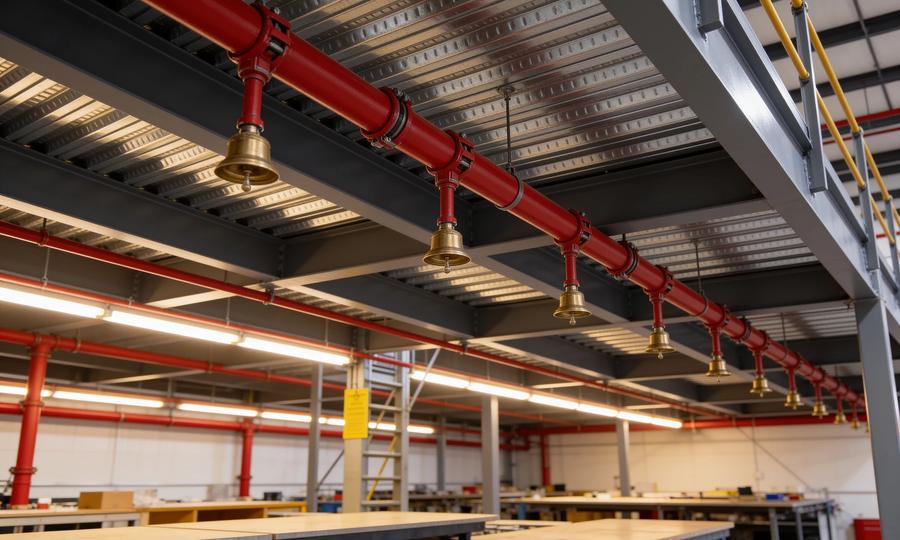
Code & Permits
Mezzanine Fire Sprinkler Requirements: NFPA 13 Guide
Review mezzanine sprinkler requirements, below-deck obstructions and open grating. Understand the design questions to resolve with your fire-protection team.
Code & Permits
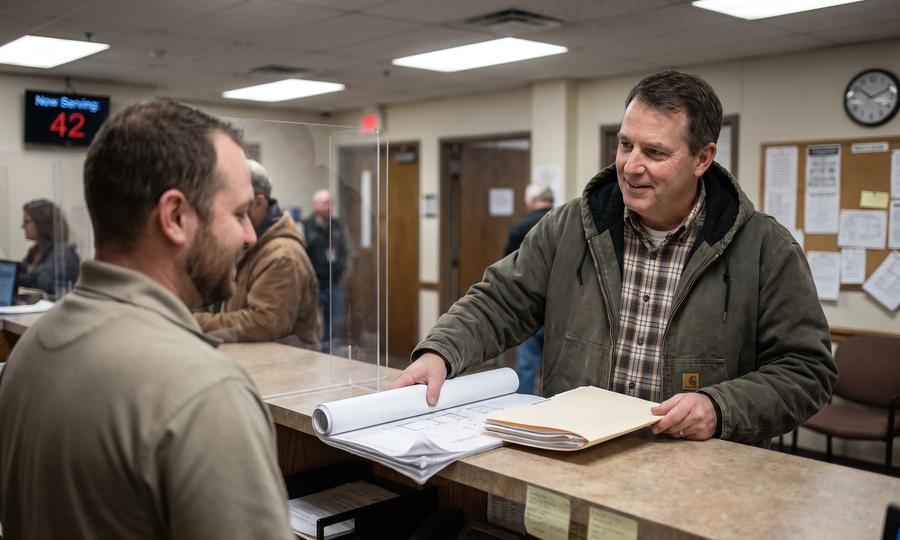
Mezzanine Permit Requirements: Drawings & Approvals
Prepare a mezzanine permit application: drawings, structural review, building codes and inspections. Find state resources and understand the approval process.
Code & Permits
IBC 2024 Mezzanine Requirements: Area, Height & Egress
Explore IBC 2024 mezzanine requirements for floor area, clear height, openness and egress, with links to stair, sprinkler and state permit guides.