

Wire mesh decking: how capacity is rated, why fire code favours it, and when it isn't enough
Wire mesh decking is rated by a rule most buyers never see, and its real advantage is a fire-code definition. Here are the standards, the specs, and the limits.
Editorial & Engineering Team

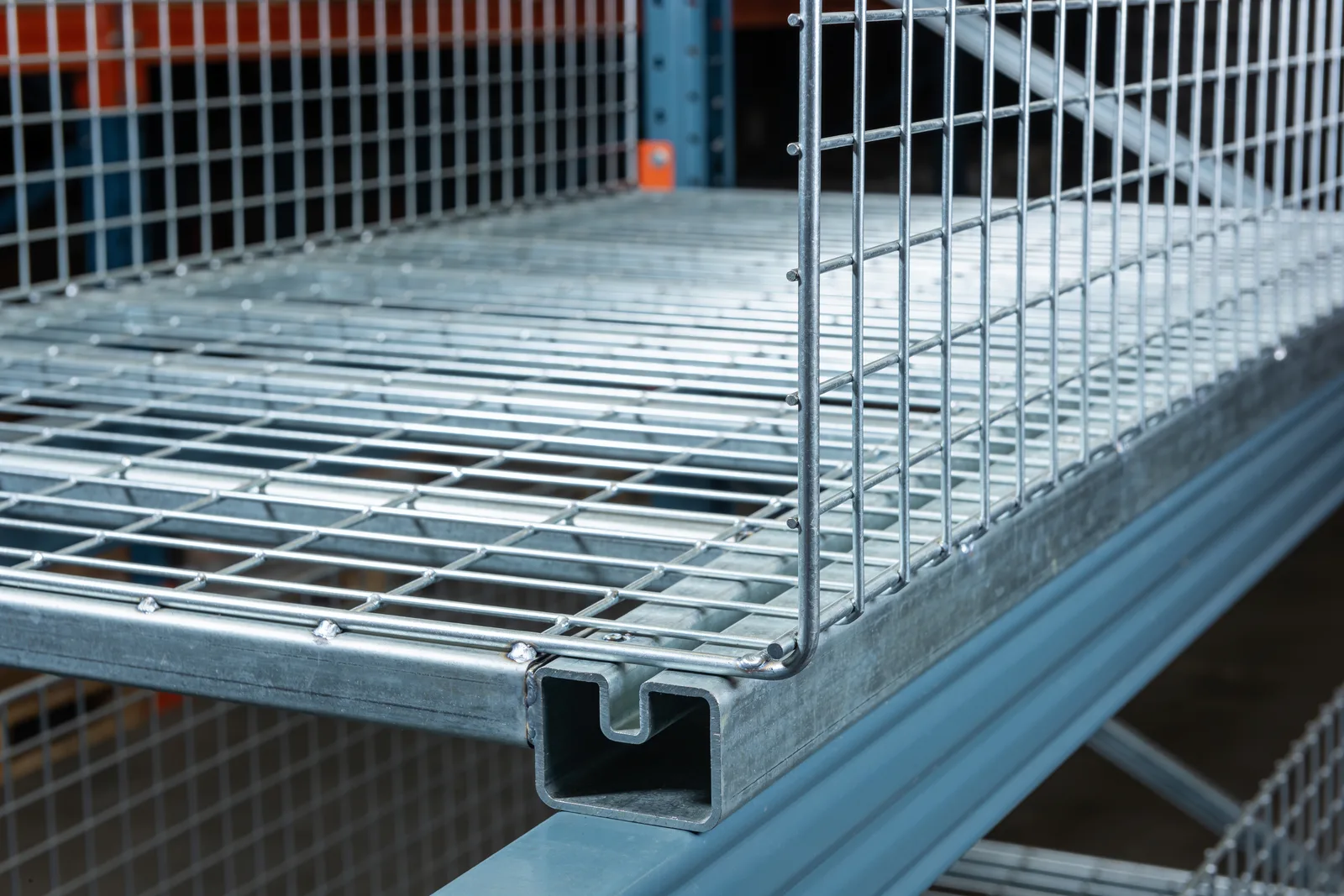
Wire mesh decking is the welded steel grid that sits on pallet rack beams so that cartons, totes and odd-shaped goods don't fall through. It is the cheapest component in a racking system and the one most often specified by habit rather than by number.
This article is about decking on rack beams — a rated component governed by its own ANSI standard, explicitly not a floor. If you're choosing the walking surface for a mezzanine, the sibling article on mezzanine decking options compares B-deck, bar grating, resin board and diamond plate for that job instead. The two decisions look similar and are not: as you'll see below, the industry's own standards body says flatly that you should not walk on wire deck.

What standard governs wire mesh decking?
ANSI MH26.2, published by the Rack Manufacturers Institute in conjunction with MHI. The current edition is MH26.2-2023, and it applies to decking used with pallet racks conforming to ANSI MH16.1 — the rack design standard the building code points to.
The 2023 revision matters more than the version bump suggests. RMI states that previous versions "only applied to welded-wire mesh decking and uniform loading practices" (RMI). The current edition covers welded wire with reinforcements, metal bar grating, composite engineered wood, corrugated metal and perforated sheet metal, and it adds seven load-distribution alternatives beyond uniform loading — partially distributed, linear, four-point and nine-point scenarios among them.
Most supplier literature still cites the 2017 edition. If a quote references MH26.2 without a year, ask which one. (One naming wrinkle: RMI titles the standard "Design, Testing, and Utilization of Industrial Storage Rack Decking," while the ANSI Webstore listing still carries the older "Welded Wire Rack Decking" wording.)
Nothing in the building code requires you to deck a rack at all. The pressure is indirect and comes from fire protection — covered below.
How is wire deck load capacity actually rated?
RMI states the rule directly: the rated uniformly distributed load is the lesser of the load at which maximum vertical deflection reaches 1/165 of the decking depth, or one half of the tested ultimate load at which structural collapse occurs (RMI).
That second term is a safety factor of 2.0, stated openly rather than buried. The first term is usually the binding one. Worked through: a 42-inch-deep deck is allowed a maximum deflection of 42 ÷ 165 = 0.25 inches, and the two candidate values are labelled W1 (the deflection load) and W2 (collapse ÷ 2), with the rating taken as the lesser (J&L Wire). The test applies load through hydraulic cylinders at equal intervals across the span, simulating distributed warehouse conditions rather than point loads.
Two consequences follow, and both get missed:
The rating is independent of the rack. RMI defines deck capacity as the maximum uniformly distributed static load "independent of the support system." A deck rated 2,500 lb sitting on beams rated 4,000 lb per pair does not give you a 4,000 lb level. RMI's guidance is that decking capacity should equal or exceed the beam rating so the deck isn't the weak point — verify both numbers, not one.
The load is supposed to land on the beams, not the deck. Pallets should bear on both the front and rear beams, with a 2- to 4-inch overhang over each (Damotech). The deck's job is containment. That distinction leads to a genuine disagreement in the industry: Damotech holds that wire mesh decking "is not typically designed to support pallet loads for a sustained period" and excludes deck capacities from its structural rack assessments entirely, telling owners to go back to the original manufacturer — while every manufacturer sells the deck as a rated load-bearing component. Both positions are defensible; they lead to different specifications. If your loads sit on the deck rather than spanning the beams, treat the published UDL as the controlling number and say so to your supplier.
MH26.2-2023's load definitions make the boundary explicit. A uniformly distributed load is one evenly distributed over the entire deck surface; a concentrated load covers less than the whole surface; a line load distributes along a line; a point load concentrates on a sufficiently small area (ITC Manufacturing). Point-load applications require custom engineering — they are outside what a catalogue rating describes.
Can you walk on wire mesh decking?
No. RMI's published answer is "in a single word, the answer is 'no'" (RMI). A person stepping onto a deck creates a point load against a rating calculated for distributed static load; RMI warns the deck can buckle, bow, sag and fall through the rack beams, and notes this holds even for decking rated above 1,000 lb.
There is a regulatory edge to this as well. OSHA defines a hole as "a gap or open space in a floor, roof, horizontal walking-working surface, or similar surface that is at least 2 inches (5 cm) in its least dimension" (29 CFR 1910.21). A standard 2" × 4" mesh opening meets that definition at its least dimension. OSHA also requires that each walking-working surface support the maximum intended load for that surface (1910.22) — which a deck rated for distributed pallet load demonstrably does not do for a concentrated foot load. RMI adds the blunter version: the mesh spacing is often wider than a human foot, making it a trip hazard.
If people need to walk on the level, that is a different product and a different design problem. Bar grating is rated for pedestrian traffic — one published spec accommodates it up to 5'-10" spans (Speedrack West) — and a walkable elevated level is a pick module or a rack-supported platform, engineered as a structure with guardrails and stairs. See also mezzanine vs work platform vs catwalk for where those lines fall.
Why does fire code favour open wire decking?
Because open decking is what keeps a rack out of the solid shelving classification — and that classification is expensive.
Under NFPA 13, an open rack includes racks with shelves having a solid surface of 20 ft² or less, or shelves of "wire mesh, slatted surface or other material with openings representing at least 50 percent of the shelf area" where flue spaces are maintained (2016 edition definitions, as quoted by The Fire Protection International). The trap is that wire mesh is named inside the solid shelving definition — it escapes only through that 50-percent-open carve-out.
The building-code side reads the same way. IFC §3208.2.2 sets the solid-shelf threshold at greater than 20 ft² measured between approved flue spaces at all four edges in the 2019, 2022 and 2025 editions, and provides the exception that legalises wire deck: shelves that are "mesh, grated, slatted or similar" with uniform openings not more than 6 inches apart, comprising at least 50 percent of the overall shelf area, may be treated as non-solid where approved flue spaces are included (UpCodes). Note the 2014 editions used a 32 ft² threshold — older facilities were assessed against a looser rule.
Trip the solid-shelf definition and you need in-rack sprinklers below the tiers, because the solid shelf obstructs discharge and prevents water reaching what's underneath. That cost dwarfs the deck. See mezzanine fire sprinkler requirements for how the same logic plays out over an elevated platform.
Three things buyers consistently get wrong here:
- Operations can undo the hardware. NFPA 13's annex states that "the placement of loads affects the calculated area of the shelf." Loads blocking the openings that would otherwise serve as required flue spaces can convert a compliant open rack into a solid-shelf rack (FPI). Buying wire deck does not buy permanent compliance.
- Your insurer may use different numbers than your code official. NFPA 13 requires a nominal 6-inch flue; FM Global's DS 8-9 works to a 3-inch minimum net flue and, per Risk Logic's reading, a 64 ft² solid-shelf threshold rather than 20 ft². FM is also stricter on alignment: NFPA permits random variation in flue width and vertical alignment, FM has required vertically aligned transverse flues since its January 2008 edition. A layout can satisfy one and fail the other.
- The open-area percentages on spec sheets exist because of that 50-percent rule. Bar grating's published 78 percent open area and punched deck's 50 percent are not marketing numbers — they are the threshold, quoted back.
What sizes, gauges and channels are standard?
| Spec | Common values | Notes |
|---|---|---|
| Wire gauge | 6 ga typical; 4, 6, 8, 10 in general use | A second supplier taxonomy runs 2–6 ga; lower number = heavier wire |
| Mesh opening | 2"×4" standard for palletised loads | 2.5"×4" and 2.5"×4.5" for hand-stacking smaller items |
| Support channels | 3 or 4, welded to the underside | 14 ga is the common channel thickness |
| Waterfall depth | 1-1/2 inches | Industry standard; resists deck displacement |
| Widths | 46" (8 & 12 ft beams), 52" (9 ft), 58" (10 ft) | Width follows beam length |
| Depths | 24", 36", 42", 44", 48", 60" | Follows frame depth |
Sources: SJF, Speedrack West, Mustang, Husky Rack & Wire.
Channel profile is the spec that most often causes a mis-order. Nashville Wire publishes eight configurations — U-channel, inverted U, flared, inverted flared, flat flush, inside waterfall, duo-fold and upturned waterfall (Nashville Wire). In practice: U-channel seats into a 1-5/8" step beam and carries the highest ratings; flared channel fits step and box beams universally but rates lower; inverted channel fits either and sheds debris, which is why food and pharma specify it. Decks are also beam-specific in ways catalogues bury — one manufacturer's decking works only on 36", 42" or 48" deep rack with 1-1/2" to 1-5/8" step beams having a minimum 3/4" ledge.
Published capacities by configuration: three-channel U 2,500–2,700 lb, four-channel U 3,200–3,650 lb, flared 2,200–2,600 lb, inverted 2,500–3,200 lb (Source Equipment). Deeper decks rate lower — the same 6 ga, 2"×4", three-U-channel build rated 2,500 lb drops to 2,000 lb at 60" deep.
How much does wire mesh decking cost?
Roughly $25 to $65 per deck at list, which works out to a few dollars per square foot — the cheapest structural decision in a racking project.
Published prices, fetched from live product pages: Speedrack West lists 6 ga powder-coated waterfall decks from $24.61 (36"×46") to $63.56 (60"×46"), with the common 42"×46" at $27.77–$31.25 and 48"×46" at $36.56. Global Industrial lists a 46"W × 48"D 2,500 lb deck at $53.95 each, dropping to $49.95 at six or more. Cisco-Eagle lists a 44"×46" 4 ga deck with three flared channels at $47.05.
The comparison that decides specifications: EGA Products lists a solid sheet deck at 46"W × 48"D for $357 each against roughly $53 for comparable wire decking — about six times the price (EGA Products). Solid sheet buys you containment of bagged goods and small items that slip through mesh, plus a smooth surface that cleans easily; it costs you the fire-code classification above and six times the money.

Which finish for which environment?
RMI's published guidance maps finishes to environments: paint for ambient warehouses and low-humidity freezers (cheapest, chips easily — though RMI notes chipped paint makes damage more visible during inspections); powder coat for light-duty retail, freezer and unpackaged food processing, with food-safety-certified formulations available; hot-dipped galvanized for outdoor, wet or high-humidity indoor, refrigerated warehouses and sanitary washdown (RMI). Zinc plating, RMI notes, is often used specifically on wire mesh rack decking.
There is a real disagreement on the cold-storage recommendation worth knowing about. RMI lists powder coating as suitable for freezer applications. East Coast Storage Equipment's salt-spray testing found both painted and powder-coated wire decking showed visible red rust within 24 hours, while galvanized showed only white rust and minimal red spotting under identical exposure (ECS). Salt spray is an accelerated corrosion test, not a freezer simulation — but if your environment involves washdown or condensation, the galvanized premium is the cheaper answer. Stainless 304/316 exists for corrosive chemical and marine storage.
What actually goes wrong
- Point loading. The dominant failure mode: buckling, bowing, sagging, fall-through. Includes people.
- Loading the deck instead of the beams. Pallets that don't span front and rear beams put the whole load into a component rated as containment.
- Blocked flue spaces. Load placement, not hardware, converts an open rack into a solid-shelf rack under NFPA 13.
- Deck-to-beam mismatch. A flared channel on the wrong beam profile seats badly and moves.
- Unknown ratings on inherited racking. If capacity is unknown, go back to the original manufacturer — Damotech explicitly does not derive it in structural assessments.
- Installation ambiguity. Most suppliers sell wire deck as drop-in with no tools required; at least one recommends securing decks front and rear with Tek screws against lateral movement. Ask your supplier which they stand behind, in writing.
Load ratings, fire classification and rack design are engineering determinations specific to your building, commodity and jurisdiction. The figures here are published rules and manufacturer specifications, reported as such — a licensed engineer and your AHJ and insurer decide what applies to your facility. Our load calculator and decking selector are planning aids, not design documents.
What to read next
- Mezzanine decking options compared: B-deck, bar grating, resin, concrete — the parallel decision for a walking surface, where wire deck doesn't qualify
- Bar grating mezzanine: load specs and applications — the open deck that is rated for pedestrian traffic
- Pallet rack mezzanines: how rack-supported platforms work — what you build when the level has to carry people
- Cold storage mezzanines: condensation, coatings, and the freezer slab — why humidity, not temperature, picks the finish on cold-service steel
Put this guide into practice
Frequently asked questions
- How much weight can wire mesh decking hold?
- Published ratings for common sizes cluster around 2,500 lb uniformly distributed per deck, with three-channel decks generally rated 2,500 to 2,700 lb and four-channel decks 3,200 to 3,650 lb. Deeper decks rate lower — a 60-inch-deep deck is commonly 2,000 lb.
- How is wire deck capacity determined?
- Under ANSI MH26.2 the rated uniformly distributed load is the lesser of two test values: the load at which deflection reaches depth divided by 165, or one half of the load at which the deck structurally collapses. That second term is an explicit safety factor of 2.0.
- Is it safe to walk on wire mesh rack decking?
- No. The Rack Manufacturers Institute answers this in a single word — no. Capacity ratings assume a uniformly distributed static load, and a person standing on the deck is a point load that can make it buckle, bow or fall through the beams.
- Why does fire code favour wire mesh decking?
- Because open decking keeps a rack classified as an open rack rather than one with solid shelving. The IFC treats mesh shelves with openings not more than 6 inches apart, covering at least 50 percent of the shelf area, as non-solid where approved flue spaces are maintained.
- Does wire mesh decking need to be bolted down?
- Most manufacturers sell it as a drop-in component requiring no tools or fasteners — the waterfall bend over the beam face resists displacement. Sources disagree: at least one supplier recommends securing decks front and rear with Tek screws against lateral movement.
Continue planning your mezzanine
All Engineering guides →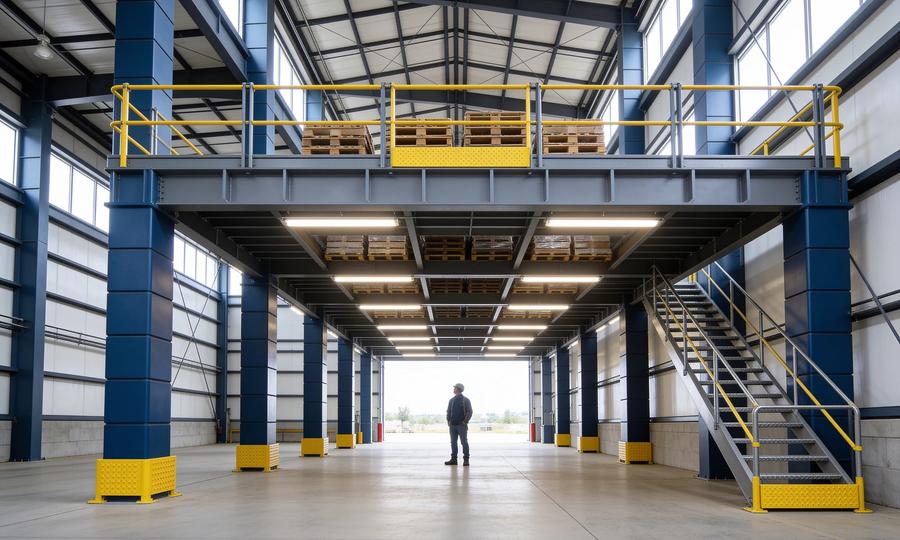
Engineering
Mezzanine Ceiling Height Requirements & Clearance
Work through mezzanine ceiling height requirements, clear headroom and framing depth. Check sprinkler obstructions and forklift clearance before planning.
Engineering
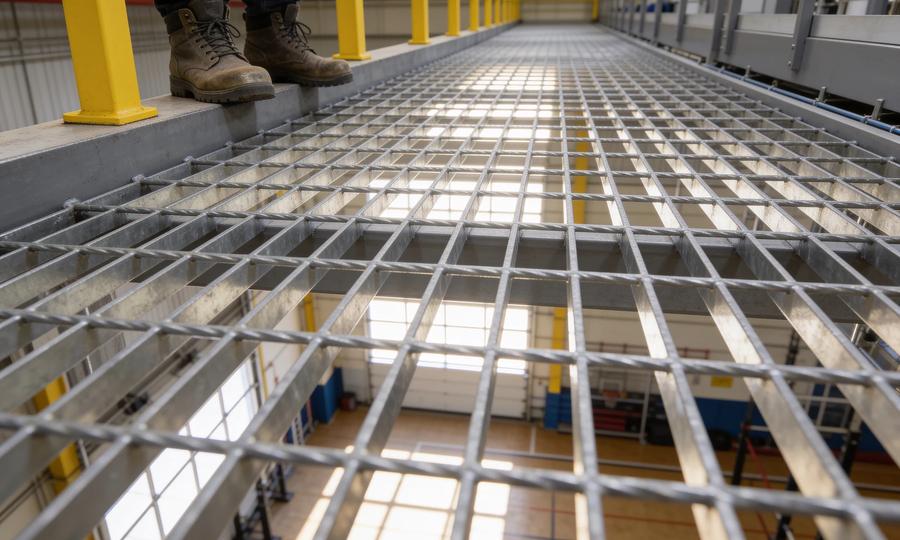
Mezzanine Decking Options: Grating, Panels & Concrete
Compare mezzanine decking options for storage and equipment: bar grating, floor panels, steel plate and concrete. Review trade-offs and use the decking selector.

Engineering
Mezzanine Load Capacity: PSF Ratings & Point Loads
Understand mezzanine load capacity, PSF ratings, live loads and point loads. Learn what to specify for storage, pallet racks and handling equipment.