

Cold storage mezzanines: condensation, coatings, and the freezer slab you can't drill
Cold changes four things about a mezzanine: where the anchors can go, what coats the steel, what sprinkler system runs under the deck, and the clear height left.
Editorial
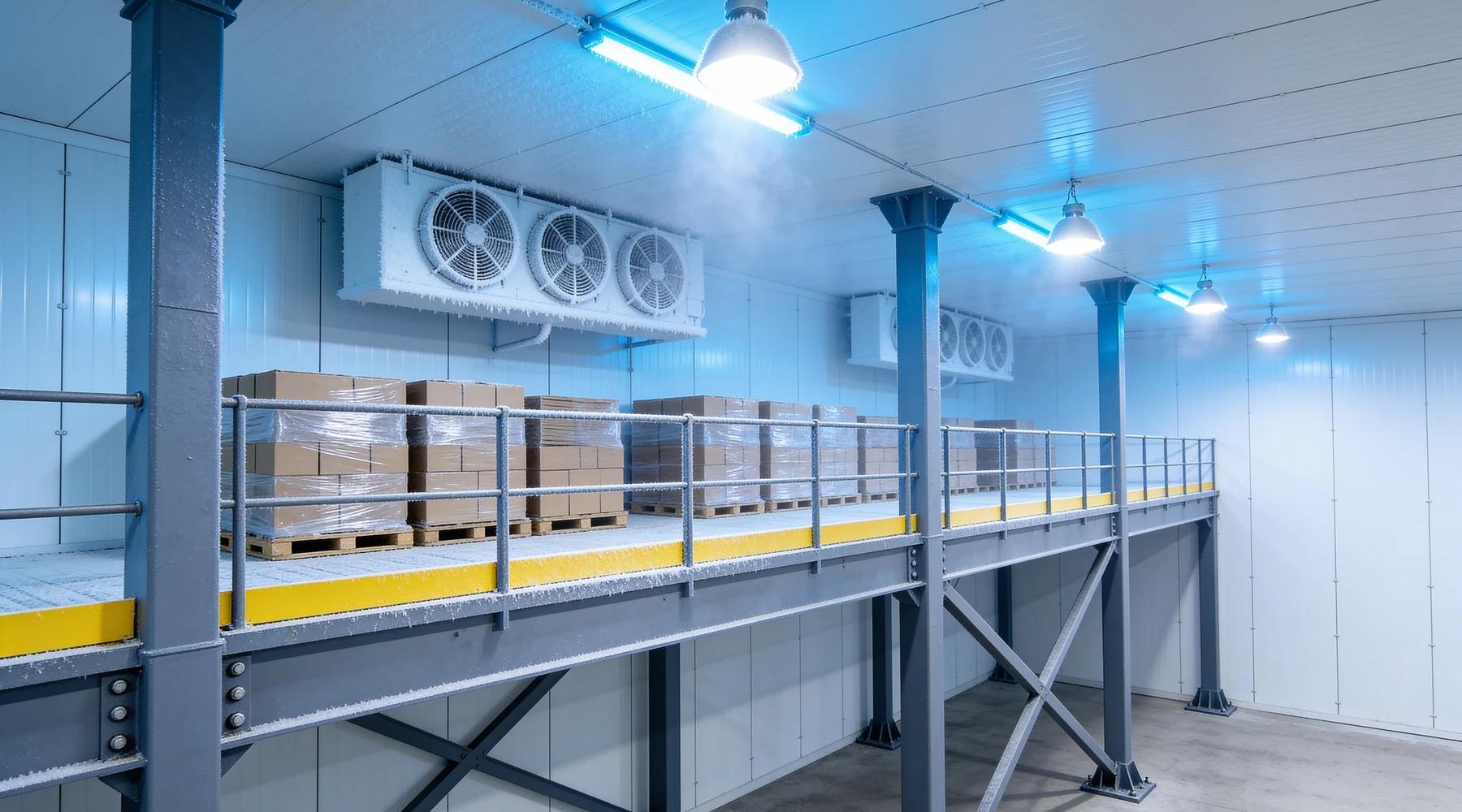
The US cold storage market just changed direction. Newmark's first-half 2026 read reports "the first negative 1H net absorption since 2007, pushing vacancy to 7.7%" — with the softness concentrated in aging legacy facilities while modern space keeps absorbing demand. That is a market telling owners to make the box they have work harder, and it lands on stock whose average age in the top US markets is 37 years and where building new costs "twice the cost per square foot of traditional warehouses or more."
Going vertical inside a refrigerated envelope is the obvious answer. It is also a different engineering problem from a mezzanine in a dry warehouse — and almost nothing published on the subject says so.
This article covers only what cold changes. The general rules are elsewhere on this site: storage mezzanines covers storage occupancy and pallet point loads, the IBC walkthrough covers §505.2 generally, mezzanine flooring covers deck build-ups, and fire sprinkler requirements covers head layout under a deck. Everything below is the cold-specific layer on top of those.
Will a mezzanine cause condensation inside a cold room?
Only where the steel is colder than the dew point of the air touching it — but in cold storage that condition is the norm, not the exception. The vapor drive runs the opposite direction from a normal building, so the envelope is fighting moisture pushing in.
Johns Manville's cold storage design guide, drawing on the ASHRAE Handbook—Refrigeration, puts it plainly: exterior air is almost always warmer, so "water vapor will tend to drive inward". And it names the components that catch it — "the interior of wall panels, suspended ceiling supports, roof decks, and even metal fasteners that penetrate through the insulation can all become points for condensation." A mezzanine is a large volume of exactly that kind of steel.
Below freezing, the consequence is not a drip. Architect Jennifer Carr's published account of cold storage design notes that once air is inside the cold space it cannot hold its moisture, so it condenses — and "if the space is 32°F or lower, it forms frost and ice".
The same source states the structural rule that matters most here: "when metal penetrates spaces of different temperatures, it will transmit temperature... A freezer structure, however, is a completely separate and independent structure from the adjacent warmer space." A mezzanine that lives entirely inside one cold room is a manageable problem. A mezzanine framed to tie a freezer to a heated adjacent bay is the thermal bridge that guidance is warning about.
Scale matters too. JM cites building-science literature showing air leakage moves moisture "approximately 100 times faster" than diffusion, and that "any discontinuity will lead to condensation problems." Every bracket you fasten through an insulated panel is a discontinuity.
Can you anchor a mezzanine column into a freezer slab?
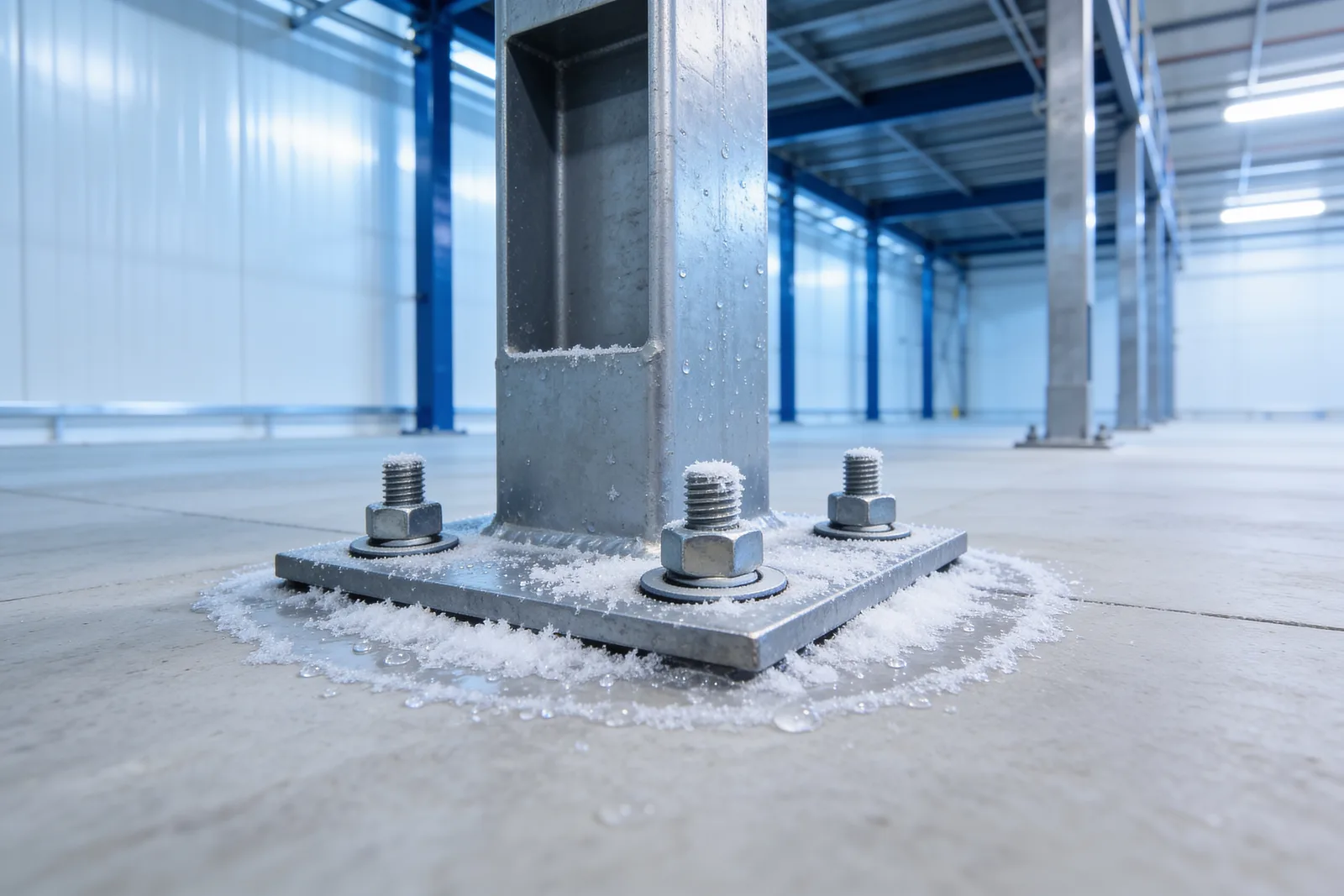
Not until you know what is underneath it. A freezer slab is not a slab — it is a layered assembly with a heating system inside it, and mezzanine column spacing lands on roughly the same grid as that heating system.
The reason the heat is there is frost heave. Left unheated, soil moisture migrates toward the cold and freezes into what the trade calls an ice ball. A hydronics specialist quoted in Plumbing & Mechanical describes the outcome: "Those ice balls can lift the footings off the building... I've seen them go as high as four feet." Delta-Therm's technical paper calls the same phenomenon "unintentional permafrost", producing "cracks in the floor and distort[ed] foundation walls."
The countermeasure is a glycol loop or electric heat trace below the insulation. The published build-up runs, from the top: the freezer slab, then "6 inches of polystyrene insulation above the radiant heating system", then a vapor barrier, then the tubing in a slurry slab or sand. Thermon's design guide for electric systems states the objective — maintain temperatures below the insulation "at or above 40°F (4°C)" — and publishes the spacing:
| Freezer temperature | Conduit spacing, R-20 floor | Conduit spacing, R-30 floor |
|---|---|---|
| −40°F | — | 4.5 ft |
| −20°F | 4.0 ft | 6.0 ft |
| −10°F | 5.0 ft | 7.5 ft |
| 0°F | 6.0 ft | 8.0 ft |
| +10°F and above | 8.0 ft | 8.0 ft |
Four to eight feet on center. That is the same order of spacing as a mezzanine column line and its base plate anchor pattern.
Two practical consequences. First, scan before you drill: concrete scanning firms name "anchor drilling" as the most common trigger for a slab scan, and put a typical pre-drill location at "5 to 20 minutes" to scan, interpret and mark — trivial against the cost of hitting a glycol loop under a finished freezer floor. Second, anchor embedment is bounded by the insulation and the vapor barrier below the concrete, not by the concrete alone. A wedge anchor that reaches through both has breached the assembly the whole envelope depends on. General slab capacity questions are in mezzanine slab requirements; the freezer-specific limits belong to your structural engineer and the refrigeration designer together, and should be settled before a column grid is fixed.
Timing matters as well. Carr notes a space takes "up to a month" to reach full 0°F, and that floor joint sealant should only be installed once the slab is at final temperature "due to contraction of the floor slab." Installing steel into a slab that has not finished moving is a scheduling decision worth making deliberately — see installation timeline.
What finish should the steel have?
Humidity governs the choice, not temperature — and a +35°F cooler is harder on steel than a −10°F freezer. Deep cold freezes moisture out of the air; the condensing band in the middle is where corrosion actually happens.
The American Galvanizers Association is direct about the cold end: studies on low-temperature environments "indicate the minimal change in the behavior of the galvanized coating. In fact, HDG coatings do not show any significant differences in corrosion rate in temperatures below -40 F." It adds the caveat that applies to any steel at very low temperature — "the material becomes brittle with extended use." Separately, the AGA notes observed zinc corrosion rates "rarely exceed 0.3 mils per year" and that indoor service life is significantly longer than outdoor.
The Rack Manufacturers Institute's published finish guidance splits exactly along the humidity line:
| Finish | RMI's stated fit |
|---|---|
| Hot-dip galvanized | "wet, high-humidity spaces indoors, such as refrigerated warehouses and coolers" |
| Paint | "frequently used in ambient warehouses and in low-humidity freezers" |
| Powder coat | "light-duty retail and freezer applications" |
| Zinc plated | transient areas such as a wash bay or dock door |
Source: RMI Rack Safety, December 2024. The deck-side version of this comparison is in wire mesh decking.
Two details nobody covering this subject mentions. Wet storage stain — the white or grey deposit that forms when newly galvanized steel is "stored or shipped under damp and poorly ventilated conditions" — can ruin a coating before the mezzanine is erected, and the AGA specifically recommends spacers during shipping "if there is a likelihood of condensation." And field repair is genuinely awkward in a freezer: ASTM A780 governs repair of damaged galvanizing, requires touch-up to at least 2.0 mils, and its zinc-solder method calls for preheating the steel to around 600°F. Cutting or drilling galvanized members inside an operating cold room creates a repair obligation that is much easier to discharge in the fabricator's shop.
Specify the coating standards by number: ASTM A123 for structural members, A153 for fasteners and hardware, A653 for continuously galvanized sheet such as B-deck.
Do you need sprinklers under a mezzanine in a freezer?
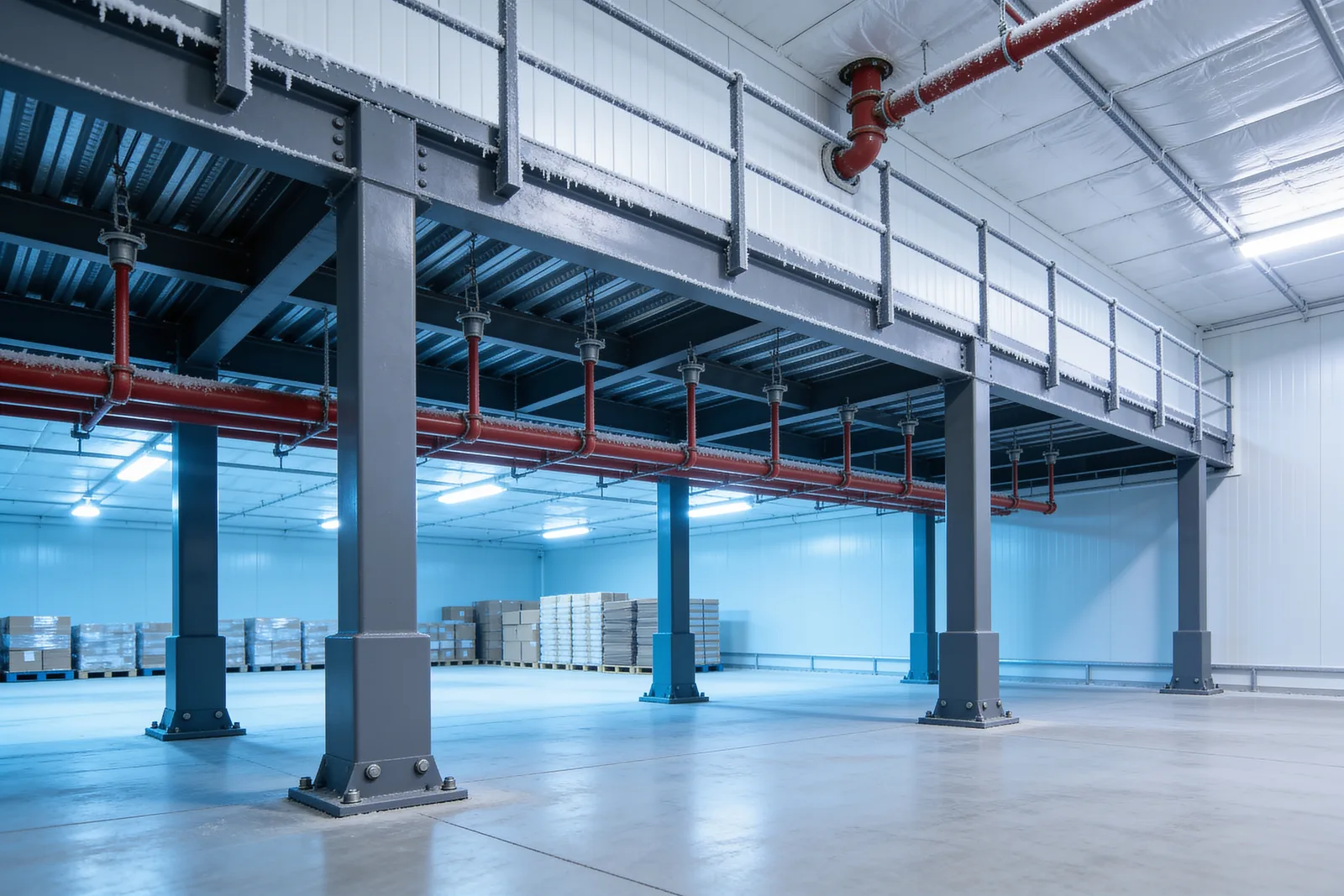
For a solid deck over four feet wide, generally yes — and in a freezer that sub-deck piping cannot be wet pipe. This is where two separate bodies of guidance collide, and where the mezzanine trade contradicts itself in public.
The obstruction rule first. NFPA 13's 2016 edition "requires sprinklers to be installed underneath fixed obstructions over 4ft (48") in width", with the annex defining width as the lesser of the two horizontal dimensions; the provision sits at §9.5.5.3 in the 2019 and 2022 editions.
Does open grating get you out of it? The industry does not agree. Panel Built states grating means "sprinkler systems above the mezzanine can reach lower levels", reducing insurance cost. Mezzanine fabricator A-Mezz says the opposite in as many words: customers ask for grating "thinking that they will not need to add sprinkler lines below the platform. Unfortunately this is not the case," because deck and framing occlude enough that "your fire inspector will still require you to sprinkle below the deck". Fire-test evidence supports the cautious reading: a loss-control summary of FM Global testing reports the non-solid walkway test "opened twice as many sprinklers", and describes FM Data Sheet 2-8N as treating ceiling and under-deck as one fire area, with under-deck sprinklers at 100 sq ft maximum spacing for storage areas and 165°F rack-type heads.
Now add cold. A 165°F wet-pipe head is not an option in a freezer. Viking Group's engineering guidance distinguishes the two cases: a "box-in-a-box" freezer with a heated area above maintained at or above 40°F can run wet pipe overhead with dry sprinklers dropping through the freezer ceiling; where the freezer is the building, "using a wet pipe sprinkler system is not an option" and the system of choice becomes a double interlock preaction system, which requires both detection and air-pressure loss before the valve opens — "preventing trapped water in the system piping, which could potentially lead to ice plugs."
The consequence for your deck: sub-mezzanine piping in a freezer is dry or preaction pipe, and it adds volume to a system that is already working against a clock. Fire protection contractors point to NFPA 13 (2022) §8.2.3.4 and Annex E for fluid delivery time calculations, and note that "large system volumes, long branch lines, and high ceilings can extend delivery times." A mezzanine adds all three. This is a conversation to have with your fire protection engineer and the AHJ before the deck material is chosen, not after — the general obstruction rules are in mezzanine fire sprinkler requirements, and the deck options themselves in decking options compared or the decking selector.
One envelope note that belongs here: the insulated metal panels forming a cold room may have a combustible core. Fire engineers advise specifying panels with a noncombustible core or ones approved under FM Approval Standard 4880, and where IMPs are used on exterior walls of Type I–IV construction, IBC §2603.5 pulls in NFPA 285 full-assembly fire testing.
Is a refrigerated warehouse Group S-1 or S-2?
The commodity decides, not the temperature. IBC §311.3 lists under low-hazard Group S-2, explicitly: "Frozen foods," "Meats," "Foods in noncombustible containers," and "Dairy products in nonwaxed coated paper containers." Group S-1 is defined by exclusion — storage uses "that are not classified as Group S-2".
So a freezer full of frozen product starts out S-2. The trap is packaging. Viking's commodity discussion notes the same product can be Class I in non-plastic packaging and "up to a Class III commodity when stored on plastic trays", and that "the pallet type can also increase the commodity based upon whether it is a wood pallet or plastic pallet." The modern cold chain runs on plastic pallets and plastic-wrapped loads, which is how a nominally low-hazard building acquires a higher-hazard sprinkler design — and that governs allowable area and the mezzanine you can build. What occupancy classification does to a storage deck generally is covered in storage mezzanines.
Is there enough clear height?
Run the subtraction before anything else. IBC §505.2 requires clear height "not less than 7 feet" both above and below the mezzanine floor construction, and caps aggregate mezzanine area at one-third of the room — one-half only in Type I or II construction with both §903.3.1.1 sprinklers and a §907.5.2.2 voice/alarm system.
Set that against the stock. Newmark's own methodology footnote puts the average clear height of its US cold storage dataset at 25.86 feet. Fourteen feet goes to the two clear-height minimums. The remainder has to absorb deck and beam depth, ceiling-hung evaporator units, dry or preaction sprinkler mains, defrost drain lines and lighting — all of which hang lower in a cold room than in a dry warehouse. Many older refrigerated buildings do not clear it. The arithmetic is worked through in ceiling height requirements.
Why a mezzanine at all, rather than more racking? Because the floor is the expensive part. The ASHRAE-derived envelope table in JM's guide calls for R-27 floor insulation for a −10 to −20°F holding freezer and R-30 for a blast freezer. A deck adds a working level without touching that assembly — provided its columns land where the heat grid isn't.
What changes for the people and trucks on the deck?
Ice is named in the regulation. OSHA 1910.22(a)(3) requires walking-working surfaces to be "maintained free of hazards such as sharp or protruding objects, loose boards, corrosion, leaks, spills, snow, and ice" — the only place in the general industry walking-working surfaces rule where frost on an elevated deck is addressed directly. Paragraph (d) adds that those surfaces be inspected regularly, with structural repairs performed or supervised by a qualified person.
There is no OSHA slip-resistance number to design to. OSHA's own interpretation states that "OSHA does not have any standards that mandate a particular COF for walking/working surfaces" and explains that the widely quoted 0.5 figure comes from a non-mandatory 1990 rulemaking appendix, "not intended to be an absolute standard value." The same document does note that textured, serrated and punched surfaces and steel grating "may offer additional slip-resistance."
Deck materials carry hard temperature limits. ResinDek publishes its panels as "engineered to withstand temperatures as low as -20°F" — which covers a holding freezer but not a blast freezer at −40 to −50°F. Serrated bar grating is the traditional answer for icy surfaces; the trade-offs are in bar grating mezzanines and resin deck.
For people, OSHA is explicit that "OSHA does not have a specific standard that covers working in cold environments" and that the duty runs through the General Duty Clause instead — with warm-up breaks, the buddy system, and the instruction to "avoid touching cold metal or wet surfaces with bare skin," which is a live concern on a steel guardrail. The same page notes trench foot "can occur in temperatures as high as 60°F if feet are constantly wet," because wet feet lose heat 25 times faster than dry.
For trucks, plan the energy. Crown reports that "lead-acid batteries can lose 30% of their rated capacity when used in temperatures below 32° F", and that taking a truck out of the cold zone for a battery change causes condensation to form on the machine. If your mezzanine is served by a lift truck, that derating is part of the throughput calculation — see forklifts on mezzanines and price the structure with the cost calculator.
None of this is advice for a specific building. Anchoring into an insulated heated slab, sprinkler design in a preaction system, and steel selection for sub-zero service are decisions for your structural engineer, fire protection engineer, refrigeration designer and AHJ — this article reports what the published standards and design guidance say, and where they disagree.
What to read next
- Storage mezzanines: how storage duty changes the code, the loads, and the price — occupancy classification and pallet point loads in full
- Mezzanine fire sprinkler requirements — the obstruction rules that decide what goes under any deck
- Mezzanine slab requirements — what the floor has to do before a column lands on it
Put this guide into practice
Frequently asked questions
- Will a mezzanine cause condensation in a cold storage warehouse?
- Only where steel sits below the dew point of the air around it. In cold storage the vapor drive runs inward from the warm exterior, so ASHRAE-based design guidance names suspended ceiling supports and metal fasteners penetrating insulation as condensation points. Below 32F that condensate becomes frost and ice.
- Can you anchor a mezzanine column into a freezer floor?
- Not without knowing what is under the slab. Freezer slabs are typically poured over six inches of insulation and a vapor barrier above a glycol or electric heat grid on four to eight foot centers, which is roughly the same spacing as a mezzanine column grid. Scan before drilling.
- Should cold storage mezzanine steel be galvanized or painted?
- It depends on humidity more than temperature. The Rack Manufacturers Institute recommends hot-dip galvanizing for wet, high-humidity indoor spaces such as refrigerated warehouses and coolers, and notes that plain paint is frequently used in ambient warehouses and in low-humidity freezers.
- Do you need sprinklers under a mezzanine in a freezer?
- Generally yes for a solid deck. NFPA 13 requires sprinklers beneath fixed obstructions over four feet wide, and open grating does not reliably exempt you. In a freezer that sub-deck piping cannot be wet pipe, so it becomes dry or double interlock preaction.
- Is a refrigerated warehouse Group S-1 or Group S-2?
- The commodity decides, not the temperature. IBC Section 311.3 lists frozen foods and meats explicitly under Group S-2. But plastic pallets and plastic trays can raise the commodity classification, which is how a nominally S-2 cold building drifts toward S-1 treatment.
Continue planning your mezzanine
All Complete Guide guides →
Complete Guide
Warehouse Mezzanine Floors: Storage, Layout & Costs
Plan a warehouse mezzanine floor for storage, picking, packing or offices. Compare layouts, material flow, project examples and the scope of supplier quotes.
Complete Guide
What Is a Mezzanine Floor? Meaning, Types & Uses
What is a mezzanine floor? Learn its meaning, industrial types and warehouse uses, then compare flooring, material lifts and the questions to ask before buying.
Engineering
Free-standing vs rack-supported vs structural mezzanines: a buyer's decision framework
The three structural types of industrial mezzanine — free-standing, rack-supported, and structural — solve different problems. Here's how to pick the right one based on use case, flexibility, cost, and code path.